Showing posts with label Cost/Benefit. Show all posts

Sunday, August 11, 2013

Fannie Mae and Freddie Mac: Borrowing and Payments to Treasury

In September 2008 Fannie Mae and Freddie Mac were placed under the Conservatorship of the Federal Housing Finance Agency.  At the time, they owned around $3.4 trillion in mortgage backed securities and $1.6 trillion in debt.  In return for $100 billion (later $200 billion) in capital investments guarantees, the U.S. Treasury received $1 billion in senior preferred stock with a 10% coupon (later changed to sweep all of Mae and Mac's profits).

How bad a deal was this for U.S. taxpayers?  We know that the Maiden Lane I and II transactions (the bailout of AIG) ended up making money for the Treasury and Federal Reserve Bank (while the Treasury is still $24.2 billion in the hole, it owns 53% of the stock of a company with a market cap of $71 billion).  How much did the bailouts of Fannie and Freddie cost U.S. taxpayers?

Below, Corrections depicts the cumulative draws and dividend payments that Fannie has engaged in with the Treasury (click to enlarge).  Often, the companies were drawing on the Treasury's capital in order to pay the required 10% dividend to Treasury (hence, dividends are being paid to Treasury at the same time draws are being made).
We can alternatively look at the simple difference between net loans and net payments (click to enlarge):
Both Fannie and Freddie look to be on track to pay back the Treasury for capital infusions over the next few years.  However, because these payments are simply payments to the government's preferred stock, and not considered paying back loans (the government offered a capital line, not loans) the government is likely to make a profit on this deal, even if we wind down Fannie and Freddie over the next few years, as both the House, Senate, and White House desire (though in different ways).  

Saturday, November 27, 2010

A Woman. A Prostitute. A Slave.

New York Times article "A Woman. A Prostitute. A Slave." (November 27th, 2010)states that, when it comes to ending forced prostitution "There are no silver bullets, but the critical step is for the police and prosecutors to focus more on customers (to reduce demand) and, above all, on pimps."Corrections has a silver bullet: legalize prostitution. Essentially reiterating an earlier point ("Enabling prostitution" from September 3rd, 2010), it seems rather obvious that forced prostitution is an inferior input into prostitution services. Presumably, upon the legalization of prostitution, willing prostitute supply will shift out dramatically more than forced prostitutes.  This will cause forced prostitute quantity to shift down. We depict the silver bullet to severely decrease forced prostitution in the United States graphically below (click to enlarge).
The responsibility for the larger amount of unwilling prostitutes is on those that oppose legalized prostitution.

Monday, November 22, 2010

The Cost of Terrorism and Airline Security

Lost in much of the debate on airline security and invasive searches has been a realistic examination of the worth of the costs and benefits of these invasive searches. Given that the last few attempted terrorist attacks, such as the al-Qaeda's Shoe Bomber, or Umar Abdul Mutallab, the Underwear Bomber were stopped in the air rather than by airport security, it's unclear whether or not security has stopped any attacks that Corrections has heard of. Let us leave that aside.

Let's say that airport security could stop all attacks, and without it two Boeing 737's would explode in the mid-air with 175 passengers every year, with no survivors. The average flyer is 42 years of age, and they would lose around of their expected 77.9 year life, or 33.9 years. This is a total 12,565 life-years lost. There are 809,611,003 airline passengers per year, and according to the wait time figures Corrections found, each individual spends about 5-6 minutes in line (between 1 and 25). This is a waste of approximately 7,697 life-years to 9,236 life-years each year.

If this tradeoff is about correct, then a pure utilitarian back-of-the-envelope calculation makes it look as though the time tradeoff from waiting in line alone is about the same magnitude as the cost of death from two Boeing 737's blowing up every year.

For skeptics, the annual budget is $8.1 billion a year. Taking the typical government $6.9 million per life saved, (a statistical measure of the value of human life), it appears as though we are spending the value of 1,173 people each year on the TSA. That is, if the TSA isn't saving 1,173 people per year, the money may be better spent elsewhere.

From these back of the envelope calculations, it appears that everyone would benefit from the government abolishing the TSA and allowing many people to die each year. Further, this assumes the TSA actually has some nonzero impact.

Corrections is interested in comments. Obviously these are back-of-the-envelope calculations and assume away some issues. What first-order losses or gains are we missing?

Saturday, October 23, 2010

Hidden costs to tax cut

Boston Herald article "Hidden Costs to Tax Cut" (October 23rd, 2010) talks about the benefits of a tax cut as if it would be a direct transfer from government coffers to consumers. However, they would potentially gain much more.
Each voter must decide if that 3 cents per dollar savings is worth more to them than what they would lose in cuts to public safety, schools, roads, senior programs, health care, libraries, housing.
Because taxes create deadweight loss, for every three cents transferred from government is more transferred to them. Indeed, it could be much more. This is depicted in a competitive constant marginal cost case graphically below (click to enlarge). However, it could be extended to a monopolistically competitive case--this would make Corrections point even more strongly, as tax incidence may sum to more than 100% for monopolies, as they transfer the loss of the tax to the consumer inefficiently, so to speak.
Put in the way the Herald is arguing it, individuals may be losing one cent of government services for every three they get back in sales tax. Additionally, they are gaining not only what they lost, but what they never bought because of the tax wedge. They gain the amount they were taxed as well as the distortion, the tax wedge, brought on by that tax.

Monday, September 27, 2010

High Court reveals anonymous donor paid men to grant bills of divorce

Haaretz article "High Court reveals anonymous donor paid men to grant bills of divorce" (September 21st, 2010) notes a curious and uneconomic practice in Israel. Female Jews married in Israel are not allowed to divorce men without their permission, but instead must obtain a "get." This distinction carries legal and not just religious consequences because there is no civil marriage in Israel, but only religious marriages (Christian, Jewish, and Muslim). Because men hold their wives "hostage," anonymous donors give money to the divorcing body, the Chief Rabbinate, to bribe the men to provide a get.
The rabbinical courts' administration already has an arrangement to pay men who refuse to divorce their wives in certain cases, as an incentive to grant the divorce. The money is budgeted by the state. However, the verdict shows that in 2004-2005 an anonymous donor gave the rabbinical courts money to pay off dozens of men and even a few women, to divorce their spouses.

The unintended consequences of paying off spouses are threefold. First, in the long run it's not clear that bribes to Jewish men to divorce their wives will change the equilibrium number of "trapped" wives. Potential wives will simply be free to choose a lower threshold of men to marry (private donors subsidize their gamble). Second, if they're monetary expected value maximizers it's in the interest of men to raise their asking price for a divorce by the amount the Rabbinical Court is willing to bribe them. Otherwise, they will raise their asking amount, though not necessarily by the exact amount. In this respect any donation may simply be a pure transfer to husbands without any change in outcome, and private donors subsidize "kidnapping" husbands. Third, it takes away motivation for any reform of Rabbinical Courts (such as allowing civil marriage or intermarriage in Israel) by reducing the benefit of a complementary good. That is, legal reform of Rabbinical power presumably is a bundled good--if bribes are successful, it reduces the benefit of reform.

Thursday, September 23, 2010

Value of College Degree Is Growing, Study Says

New York Times article "Value of College Degree Is Growing, Study Says" (September 21st, 2010) gets the correlation/causation distinction correct. However, it doesn't give the clear causal reasons why better educated and wealthier people eat more healthily and exercise more: while people often face the same price of an activity, they often face different shadow prices, the relevant price for making decisions.
The report, first issued in 2004 and updated in 2007, also described social benefits: those with a bachelor’s degree, it said, are more likely to volunteer, vote, exercise and have health insurance and pensions. They are also less likely to smoke, be obese or have low-birth-weight babies. It did not assert that a college education, by itself, was responsible for all those differences.

'Correlation is not the same as causation,' Ms. Baum said. 'But that said, the people who have done careful statistical analyses, controlling for demographic characteristics like income and family background, have overwhelmingly concluded that there’s some causation here, that some things that happen to you in college, for example, would make you more likely to adopt healthier behavior.'

Better educated and wealthier people have more incentive to live longer because their time is worth more. Take Kevin Murphy's shadow price of a cheeseburger example (briefly mentioned at the end of this interview). Eating unhealthy cheeseburgers shortens your life, but you gain happiness from them. The time of a low-wage person should be valued by that low-wage person as their wage (or outside wage, if the two are only approximately equal). While state-dependent utility disclaimers apply, the thrust of our argument will be robust to secondary and tertiary corrections.

Let us imagine that the time a rich person is willing to give up for an extra hour of his life is $200, but a poor person is only willing to give up $100. Then if a cheeseburger takes an hour off of an individual's life (for instance), then the true cost to a rich person is $204, while the cost to a poor person is $104. The shadow prices the two individuals face are different. Unhealthy decisions cost rich people more because they value their lives more.

When people decide to become educated, they induce themselves to have different marginal utilities and therefore make different decisions due to facing different shadow prices--a cheeseburger is more expensive for a rich person.

Wednesday, September 22, 2010

Bridging the achievement gap

Los Angeles Times opinion editorial "Bridging the achievement gap" (September 22nd, 2010) discusses the achievement gap between black males and all other students (black females and white males being the primary groups of comparison). It speaks only of educational means to fix the graduation gap, while discussing crime. Corrections would like to entertain a different possibility that might help solve both. The Times also confuses correlation and causation.
These disparities aren't new — the Schott report could have been published a generation ago. What is new and noteworthy is solid evidence that this gap can be bridged, with well-tested approaches that don't require massive changes in public education and don't depend on superhero teachers and administrators.
An economic idea might be that individuals, both black and white, make decisions about education today based on what they believe their income differentials will be tomorrow. One way to encourage education is to ensure higher wages for the educated. Another is to ensure lower wages for the uneducated.

The Times suggests that some of these students might be on the "prison track." "All too often they're on what educators privately dub 'the prison track.'"

If the Times is concerned that black males (or, for that matter, individuals of any race or gender) are opting out of educations and into lives of crime, one way of reducing their involvement in crime and increasing their graduation rates might be to lower their future wages as criminals.

We do a quick back-of-the-envelope calculation to test this hypothesis. We should see a correlation between an increase in law enforcement officers tomorrow and an increase in graduation rates. For the 50 states from 1998-2003, we plot the two, and offer a fitted least squares line. This is displayed graphically below (click to enlarge).
The relationship is indeed positive, which is itself phenomenal. If high schoolers were myopic and unresponsive to future police presence, we would have expected a drop in graduation rates to result in an increase in police next period--an increase in bad high school students should make more police next period a necessity. The fact that we see this indicates that the difference between our two effects is rather large. At a first glance, while the relationship is only near significant, it would appear tantalizing. For those concerned about the outliers, the relationship remains positive dropping them from a fixed effects panel data regression.

The Times discusses young black males, their graduation rates, and crime. Following our above analysis, we might think that a way to increase the graduation rates of young black males (who head into crime at higher rates than young white men or young black women) might be to decrease their wage differential between crime and legitimate employment through the hiring of more law enforcement officials over the course of several years. This would have the added effect of decreasing crime. Indeed, if individuals are forward looking and we have a believable commitment mechanism, we needn't wait to see the effects.

Clearly the analysis Corrections provides is both preliminary and inconclusive--it is merely suggestive. Nevertheless, it offers an interesting avenue to improve education by rational forward-looking individuals of all races and genders.

Beyond this discussion of heterogeneous impacts by race of an increase in future police presence on future crime and graduation rates, we might also add a particularly offensive quote by the Times:
A large-scale study in Chicago found that 74% of the boys who attended preschool graduated from high school, compared with 57% of those who didn't.
This is a correlation. It is not clearly causal.

Thursday, September 16, 2010

F.D.A. Panel Urges Denial of Diet Drug

New York Times article "F.D.A. Panel Urges Denial of Diet Drug" (September 16th, 2010) discusses the FDA's rejection of a new diet pill and their standards without addressing the improper incentives that lead the FDA to cause the excess deaths of thousands of people a year, and cause excess pain to hundreds of thousands.
The advisers to the Food and Drug Administration voted 9 to 5 that the potential benefits of the drug, called lorcaserin and developed by Arena Pharmaceuticals, did not outweigh the risks.
Let's imagine, for simplicity, that there are two kinds of medical drugs. Drugs that save lives, and drugs that kill people.  When pharmaceutical companies test drugs, they gain a signal with error about whether or not that drug is a good drug or a bad drug. The U.S. Food and Drug Administration will then choose the cutoff. If we assume that error to be normally distributed (this is an innocuous assumption: the difference between the sample average and the true signal converges to a normal distribution by Lindeberg-Levy Central Limit Theorem).

The FDA must choose some threshold for a signal, below which they reject all drugs, and above which they accept.  They save lives by rejecting bad drugs and accepting good ones.  The FDA kills by rejecting good drugs or accepting bad bad drugs.    (Corrections is willing to discuss our precise "moral" phrasing, which we posit as accurate).

The FDA can't tell the difference between good drugs and bad drugs beyond the signal they receive. The point, therefore, is what the proper cutoff should be. Whether or not the FDA should be "very cautious" and kill by denial of more good drugs than prevention of bad, or "loose" and kill by allowing more bad drugs than good drugs. The optimal "life saving" diagram is depicted graphically below (click to enlarge).
Officials at the FDA are not in the business of saving lives, however. If a bad drug gets through their screens and kills, they lose their jobs. If a good drug never gets through, no one is ever penalized, as the consequences are not graphic. Below, we depict the FDA's scheme due to improper incentives (click to enlarge):
As we can see, because the FDA is risk-averse because of its suboptimal incentive scheme, it ends up, at the margin, killing many more individuals through its denial of live-saving drugs than it saves because of the marginal life saved by limiting a dangerous drug.

Individuals often state that among the first things the government should be doing after protection from coercion internationally through the military and internally through the justice system is setting up systems like the FDA.  What is not noted is that the FDA, because of poor incentives, kills many more individuals by withholding drugs than the private market would.  

A private system would be optimally incentivized because of the long-term, monopolistically competitive nature of its brand.  For those that think this wouldn't be a viable private enterprise, consider the 14 Californian kosher-certification services, or dozens of national certification services.  These companies have been successfully serving tiny portions of the United States population for decades.  Further, these companies have reason to avoid regulatory capture (unlike the FDA) because they are competing with other companies for consumer's trust (the FDA does not have competition).  

If anything, the FDA isn't among the first things government-loving individuals should push for--instead, an altruistic government-loving individual should abolish the FDA to save lives.  Any individual with a smidgeon of appreciation for the private market should be chomping at the bit to abolish the FDA and save lives, ease the pain of those denied efficient drugs, save the money of the poor who are denied price-reducing competition, and help improve the lives of individuals who might be benefitted by diet drugs endorsed by almost everyone but an intensely risk-averse FDA.  

Friday, September 10, 2010

Seatbelts are the lifesavers in your car

New Orleans Times-Picayune editorial "Seatbelts are the lifesavers in your car" (September 9th, 2010) speaks positively of seat belts.  While they have undoubtedly saved lives, they have also undoubtedly cost them through the externalities their cost-shifting generates.
More Louisianians buckled up this year compared to last, according to the Louisiana Highway Safety Commission, but the New Orleans area actually saw a 1.1 percent decline in the percentage of people using seat belts.

Even with the statewide increase for drivers and front-seat passengers, which went from 74.5 percent to 75.9 percent, Louisiana still lags behind the nationwide usage rate of 83 percent.

That's discouraging, because buckling up is a simple and easy thing to do, and it's a proven life-saver.
The most interesting economic concept when it comes to seat belts and safety regulation is the "Peltzman Effect", as Sam Peltzman discusses in his 1975 Journal of Political Economy article "The Effects of Automobile Safety Regulation" (gated).  Below, we reproduce his diagram graphically (click to enlarge).  What the diagram indicates is that risky driving gives us something we enjoy--for example getting to our destination more rapidly.  Our first bit of risky driving is particularly beneficial--perhaps when we are in a hurry.  As we increase our risky driving, the marginal benefit decreases.  This is represented by the downward sloping red line. Under a regime with no seat belts, we end up at an equilibrium represented by point A on the risky driving schedule.  Under a regime with seat belts, we end up at an equilibrium represented by point B.  As driving becomes safer, we drive more riskily.
This, in turn may cause more pedestrian deaths, whose cost is presumably not fully borne by drivers.  Below, we graphically depict the relationship between risky driving and pedestrian deaths (click to enlarge).  We can see that pedestrian deaths rise as we go from point A and B.  (Point C will be discussed below).
As a thought exercise, famous among Austrian economists, is what would occur if instead of seatbelts or airbags, we installed a large spike in driving wheels, faced toward the driver a driving wheel looking similar to this:
In this case, we would have the following relationship between risky driving probability of death to driver (click to enlarge):

If this is the case, we end up at point C on the diagram above (again, click to enlarge).

This article serves to demonstrate a few concepts.  First, a common refrain on Corrections: when we reduce the cost of behavior that has benefits and costs, we increase the partaking of that behavior.  Second, when that behavior has externalities, as it does with driving, we may actually foist the cost of risky driving onto pedestrians rather than consumers.    

Sunday, September 5, 2010

A Legislature of far too little impact

Los Angeles TImes editorial "A Legislature of far too little impact" (September 5th, 2010) neglects the economic idea that an inefficient government may be desirable.
Unfortunately, those successes must be regarded as exceptions. Smart and important legislation, much of it propelled by substantial public support, fell by the wayside in the final days. Indeed, what is most notable about the recently concluded session is not the little bit of good policy the Legislature made but the great deal that it did not. Not to mention the bad bills it passed.
At first glance, it would appear that an increase in efficiency of government would always be pareto improving. However, it may be that an inefficient government is desirable for some.

Specifically, one might see increased government activity as a long-term drain on growth. If, as Rothbard put it, "the State is nothing more nor less than a bandit gang writ large", then we might consider the societal implications for that band being more efficient (they are better able to steal). In this sense, it may be desirous for us to constrain government to only support inefficient programs.

The Law of Demand holds: if something is more expensive, people will buy less of it. In this case, increasing the price of government makes us demand less of it. This, in turn, helps to maximize freedom. This point would hold for consequentialist libertarians, for instance, who might view any government action as more likely to be from an interest group looking to transfer money from the general public using the government, than out of a real interest of a populace.
Where else might this apply?  Deontological libertarians recognize that behind every state action is the barrel of a gun, to put it bluntly.  Take a parking ticket--it wouldn't seem that a firearm is behind one.  However, if one foregoes payment, either a violation warrant may be issued, at which point at any time a man with a firearm (police officer) may go to your home and arrest you by force.  Alternatively, you may simply run the risk of being arrested (through the use of force) the next time you are pulled over.  The only power The Law has is violence and the threat of violence.  

Deontological libertarians further believe that this initiation of the use of force is wrong.  Consequentialist libertarians have no such issue with the initiations of the use of force.  These libertarians support liberty because they see it as bringing about desirable conditions.  Therefore, a politically savvy Deontological libertarian might desire to make large government inefficient so Consequentialst libertarians essentially adopt all Deontological positions.

Corrections concludes that a government that efficiently takes and spends resources is not necessarily desirable due to these economic concerns.  Indeed, we have indicated that for reasons of political economy, some groups may even desire to make it less efficient to manipulate other groups to the adoption of similar positions.

Friday, September 3, 2010

Enabling prostitution

Philadelphia Inquirer editorial "Enabling Prostitution" (09/03/2010) discusses prostitution in a misinformed manner. It further does not appropriately analyze counterfactual scenarios.
Some misguided observers of this debate actually believe there's nothing wrong with adults offering sex for money online. They ignore the fact that prostitution often involves other dangerous crimes, including robbery and assault. And sometimes these ads facilitate the illegal sex trafficking of women or girls who are being held against their will.

It is the case that forced prostitution is present in the United States. However, it is by no means clear that either a significant portion of prostitution is forced, nor that the level of forced prostitution would decrease when the difficulty of prostitution increases.

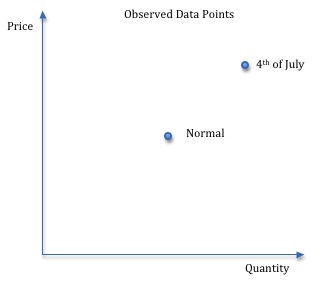
On the first point, we can take a recent empirical study on prostitution that requests no citation (citation will be given when the paper is published). What it indicates, however, is that there is a 63% increase in the number of tricks done on the 4th of July weekend. Forty-three percent of that apparently comes from full-time prostitutes. The other 20% comes from 4th-of-July-only prostitutes, part-time prostitutes that only come in because of the $11 average price increase. To Corrections, this sort of short-term supply elasticity, a vast reservoir that enters the market for one weekend only indicates voluntary prostitution.

If we assume that the 4th of July comes solely from a demand shock, that the fundamentals of supply remain the same, and approximating with linearity then we can identify the supply change (this is the source of the supply increase identification).

Below, we depict the pure data:

Here, we take the same data and add supply and demand lines, based on the idea that the 4th of July represents a demand shock:


On the second point, if we think that forced prostitutes are an inferior input into the production of prostitution, then enabling prostitution, causing an increase in the quantity supplied, will reduce their use in prostitution. The same concept might be applied to manual labor in manufacturing computers. It is likely that an increase from one computer demanded a year to several thousand would cause manual labor to all but disappear. So too with forced prostitution--cheapening the cost of supplying prostitution is likely to compete forced prostitution out of business.

Thursday, September 2, 2010

On Course for a Cleaner Hudson

New York Times article "On Course for a Cleaner Hudson" (September 1st, 2010) discusses the best way to clean up polychlorinated biphenyls (PCBs) in the Hudson river. In a previous article, "Don't scorn Germany and Japan; learn from them", Corrections has extolled the near-incomprehensible properties of exponential growth. However, when the discount rate is greater than the growth rate, this may not be the case.
The E.P.A. now says the dredging might end up taking 10 years, which is fine. A job done slowly and right is better than one altered or abandoned.

Fortunately, we will not have to wait until the job is completed to see good things happen. When PCB concentrations start falling in the river, they decline in fish. This means the benefits of the project will start being felt long before the last load of toxic mud is pulled up from the bottom. This is the strongest rebuttal to G.E.’s old argument that the answer is to let the carcinogens lie in the river, decaying on their own.

If the cleanup of a river that has been tainted for 60 years and counting takes a few years longer than first planned, nobody should be complaining.
We can model the type of situation that the New York Times is suggesting. Specifically, we might have something we desire, say the Hudson River's stock of fish. We have two options for the same cost: quick cleaning and thorough cleaning. The growth rate of the stock of fish is increased to a higher long-term level due to thorough cleaning, but more slowly. It is increased to a lower long-term level due to quick cleaning. The difference between the changing growth rates is depicted graphically below (click to enlarge).

What would this mean for fish stocks? Normalizing our starting stock to one, we can display this graphically as well (click to enlarge)
However, we value current benefits more than we value future benefits--we discount exponentially. If our discount rate is greater than our growth rate, then it's quite possible that the net present value of "quick" is more valuable than "thorough". While exponential growth is a powerful force, exponential discounting may make slower growth now preferable to rapid growth later.

One way to illustrate this is to depict how much we value the first period, the first two periods, the first three periods, out to as many as we please. We do so graphically below (click to enlarge). As one can see, while the gap is closed, the net present value from today including any period in the future will always indicate quick growth as better.
Corrections simply notes, therefore, that a job done quickly is not always worse than a job done thoroughly--there are distinct tradeoffs even when considering exponential growth.

Tuesday, August 31, 2010

Would New Orleans levees hold for a second Katrina?

Christian Science Monitor article "Would New Orleans levees hold for a second Katrina?" (August 29th, 2010) offers only a partial discussion of the costs and distribution of destructive floods.
The Corps says the reinforcements are built to provide a defense against a 100-year storm surge, which means protection against flooding that in any given year, may have a 1 percent chance of taking place. For a peak storm surge, such as one that may occur once every 500 years, the system is designed to allow overtopping, where a storm sends waves over the top of the wall.
[...]
Mr. Barry says the levees should be constructed to withstand a 1,000-year flood, adding that Holland enjoys a 10,000-year protection standa
The article should have, but did not, recognize and discuss the nature of the flood distribution that a levee system has to protect against. Specifically, we can imagine that a number of floods or hurricanes occur in New Orleans every year. Each flood's destructive power is drawn from some distribution.  (Note that our general point will hold for any exponential distribution, which includes the normal, gamma, Weibull, binomial, Poisson, and more). What we need to be concerned about is not the distribution itself, but the distribution of the maximum for a given year.

To illustrate our point, we can imagine hurricane density distributed as a normal with mean 5 and standard error .6.  Each year ten floods are sampled from this distribution.   This maximum will be distributed as a Type-I Gumbel Distribution.  These two are depicted graphically below--a single flood's distribution in blue, and the maximum of that season in red (click to enlarge).
The important thing to note is how the distribution of the maximum positively skews the probability distribution we're considering to a long-right-tailed maximum flood, and that this is the distribution we need to consider when making optimal flood insurance decisions.

In this light, the article's discussion of 100, 1,000, and 10,000-year floods should be interpreted--as costs of protection rise, the benefits of protection become dramatically smaller.

Wednesday, August 25, 2010

The Littlest Redshirts Sit Out Kindergarten

New York Times article "The Littlest Redshirts Sit Out Kindergarten" (August 20th, 2010) discusses the "redshirting" of kindergarteners, the practice of holding them back a year so they have an age advantage. Corrections is dubious that the practice could become a problem, and that it will wane, despite "the signs."
“Redshirting” of kindergartners — the term comes from the practice of postponing the participation of college athletes in competitive games — became increasingly widespread in the 1990s, and shows no signs of waning.
The Times doesn't articulate the tradeoffs that altruistic parents face when deciding when their children will enter school. Children gain some initial advantage entering Kindergarten later because they are older and more mature, and they may gain a measure of happiness by not entering into school immediately. What they lose is that year of their life that they might have spent working or retiring. There are two important empirical questions the Times should have addressed when discussing this issue. First, whether or not there is an advantage to entering kindergarten late, and if so, the time-profile of this benefit. Second, whether or not the net present value of the time profile for benefits due to entering early is greater than, or less than, the net present value of the time profile for benefits due to not entering early.

What are the benefits to entering class early, assuming there are any? On the one hand, if the "alpha dogs" of a class get a larger share of the resources, confidence, and attention, then we might expect benefits to late enrollment to explode over time. Alternatively, if students enter with a fixed advantage and all students learn equally over time, then the benefits to being a year older than one's peers decays over time. Two prototypical time paths are displayed graphically below (click to enlarge). The plot simply shows an advantage, measured initially at 1, and its decay or growth over time. The black line separates two answers to our second question. If a plot stays above the black line, then benefits grow or stay constant, and below, benefits decay or stay constant.


Evidence indicates that the blue line of decaying benefits is the empirical reality. Elder & Lubotsky find that benefits are relatively short lasting in "Kindergarten Entrance Age and Children's Achievement, Journal of Human Resources" (2009) (gated) (ungated). The authors use exogenous changes in state age cutoffs and consequential differences between predicted and actual entrance ages to produce identification (a counterfactual).

Elder & Lubotsky indicate that there are benefits, however fleeting. What are the costs? Earnings rise as one gets older (falling as one enters retirement age). Inspired by Empirical Age-Earnings Profiles (Kevin M. Murphy and Finis Welch, Journal of Labor Economics, April 1990), Corrections offers a similar treatment, using historical cohort averages of earnings from the Current Population Survey (available at the Census Bureau). We use the data (not plotted) to fit a cubic polynomial of earnings over time or age for cohorts born in 1940 or 1950, displayed graphically below. The first plot has earnings (all earnings in current dollars) by age (click to enlarge) the second plot has earnings by year (click to enlarge). Both plots use median data from males only (all races).


To overcome the cost of putting off one's earnings profile by one year, how much would an individual born in 1940 have to be paid? In this primitive analysis, ceteris paribus, if the net present value of putting off one's education is greater than $8,500, an individual should do it.

Corrections might further add that even if the trend has been increasing, it is likely to find some equilibrium. As the proportion of "alpha-dogs" increase, their allotment of resources above the baseline presumably decreases--the benefits of postponing decrease, while the costs, as discussed above, remain the same. This leads to an interior equilibrium, (the equilibrium proportion of late-entrants is .247, the point of intersection) as displayed below (click to enlarge). In this case, no benefit is gained to waiting, and individuals are indifferent to waiting or not.

Friday, August 6, 2010

Hiroshima 65 years later: US attends ceremony, but offers no apology

Christian Science Monitor article "Hiroshima 65 years later: US attends ceremony, but offers no apology" (August 6th, 2010) offers a mildly confusing omission when discussing the August 6th and August 9th, 1945 atomic bombings of Hiroshima and Nagasaki.

Some Japanese still want an apology for the atomic bombings of Hiroshima and Nagasaki, while others complained about the absence of President Obama.


Corrections is confused at their desire for an apology. It would appear to any student of coetaneous documentation that nuclear bombing was a Pareto-improving (if unilateral) decision. Surrender was not an immediate option. Waiting for surrender would have caused more continuous Chinese civilian deaths in Manchuria. Waiting would also have given the Soviet Union the opportunity to invade; it is worth noting that the mass rapes of East Germans in the aftermath of invasion (approximately 240,000 East German women died in connection with Soviet rapes, of a population of around 19 million, let alone massive German deportations to the Gulag and tens of thousands of deaths in Speziallager as the war ended). A planned invasion, Operation Downfall, composed of two separate invasions, Operation Olympic and Operation Coronet, would have caused anywhere from 500,000 and 1,000,000 Japanese deaths, also causing between 109,000 and 800,000 Allied deaths. Comparably, the bombings killed between 8-13 Allied deaths (POW's held in Nagasaki) and between 150,000 and 246,000 Japanese deaths. We forego discussions of other paths of history (for example, the singular bombing of Hiroshima, or a "display" bombing for Japanese observers), suggesting merely that examination of wartime documents offer similar analyses.

The decisions are graphically represented below (click to enlarge). It is difficult to view without opening in a larger window, due to the scope of differences in deaths. The x-axis represents Allied deaths, while the y-axis represents Japanese deaths. The grey-blue area are the maximum and minimum estimates of Secretary of War Henry Stimson. The green bars represent the Joint Chief's estimate earlier in the year. The red bars represent the actual deaths because of the nuclear bombings. Finally, note that the 8-13 Allied deaths are not displayed in the red because they do not render in a manner discernible from zero.


As we can see from the diagram, the nuclear bombings were clearly the favorable outcome for almost any weighting of Japanese and Allied deaths. This analysis foregoes discussion of casualties, rather than fatalities, which only strengthen the point. Indeed, as an interesting side fact, 500,000 Purple Hearts were produced in anticipation of the invasions--these have instead been used for all Purple Hearts given out in the Korean War, Vietnam War, Operations Desert Shield/Storm, Operation Enduring Freedom, and Operation Iraqi Freedom/New Dawn. There are still approximately 100,000 Purple Hearts left over from this anticipatory production run.

It would appear to Corrections an apology by the United States for the use of nuclear weapons does not appear appropriate, given the Pareto-improving nature of the decision to bomb Hiroshima and Nagasaki. Rather, from our analysis it appears that the Japanese should offer an expression of gratitude for the bombings, which saved hundreds of thousands of Japanese lives.

Thursday, July 29, 2010

In American politics, stupidity is the name of the game

Washington Post editorial "In American politics, stupidity is the name of the game" (July 29th, 2010) offers shrill ignorance when making a backhanded comment concerning economics.

That could never happen here because the fairy tale of supply-side economics insists that taxes are always too high, especially on the rich.


The author was referring to various tax solutions to the deficit, though the topic is not what concerns Corrections here. What we wish to deal with is the snide sciolism that E.J. Dionne Jr. displays in his dismissal of "supply-side" economics. Corrections offers just such a "fairy-tale" story here, reiterating Harald Uhlig's recent American Economic Review article "Some Fiscal Calculus" (May 2010) (Corrections previously spoke about a working paper version here).

In his concise paper, Uhlig undertakes to understand the "multipliers" of tax cuts and government spending. He does so in a typical, non-Keynesian model, though his result is stronger in a Keynsian model. We replicate his figures using his code. In our case, the most important portion of his paper is displaying the benefits of a tax cut and government spending (both are advocated as stimulus measures, the former Mr. Dionne is criticizing).

The first figure we display, Figure 2 in Uhlig's paper, is of the multipliers calculated for either government spending and a tax cut (click to enlarge). As we see, initially government spending has a high multiplier, while a tax cut has a low. However, because the spending must be paid for with higher taxes in the future, government spending's multiplier drops over time. Tax cuts, because they encourage growth and reduce distortionary taxes, have a positive multiplier.


Figure 4 of Uhlig's paper offers the dynamics of debt and the tax rate's increase for a government spending stimulus, displaying the reason why stimulus is worse in the long run (increased taxes) (click to enlarge).


Figure 5 displays the dynamics of government spending and output in the very long run, indicating the massive long-run tradeoff to output for a short-run boost to today (click to enlarge).


Uhlig concludes with the finding that with government spending stimulus, $3.40 of output is lost eventually when we discount it back to the present day, while cutting taxes generates $1.70 in extra output, discounted back to today.

The Washington Post, as is its wont, is in need of a permanent Correction to its deep-seated love of taxation.

Tuesday, July 27, 2010

Student1776 on "No Closing Time for Income Taxes" and Response

Corrections deeply appreciates the opportunity to engage in subjects on a more substantial level than newspapers often warrant. To this end, we enjoy commentary. In this case, a comment from Student1776 on "No Closing Time for Income Taxes" (June 15th, 2010) offers just such an opportunity.
Government, particularly for the Democrats, is all about expropriating wealth created by some in order to give it to their own constituents using whatever rationale they can fashion for the purpose. Like the continuation of bridge and causeway tolls long after the bridge or causeway is long since paid off and monies for its maintenance in perpetuity are put away the toll continues. Any route for the draining of economic blood from any population susceptible to the draining is kept open. Plan on it. Some things never change. Parasitism is one of them.

Corrections largely agrees. It was perhaps Rothbard who said it best. Paralleling Plato's note that a city was man writ large, Rothbard stated: "Government is a band of thieves writ large." However, while we agree that parasitism will always be present and proportional to government size, it does shift in degrees, and may have multiple equilibria.

Let us imagine, in the vein of Murphy, Schleifer, and Vishy's 1993 paper "Why is Rent-Seeking So Costly to Growth?" (that there are two types of individuals: predators, and producers. Predators might represent all individuals who are net recipients of government benefits beyond their marginal product. Producers are the opposite--individuals who are producing more than they consume. Further, for the sake of simplicity, let us imagine all individuals are equal (our results hold without this). They will become either Predators or Producers depending on which pays better (therefore, unless everyone is a Predator or Producer, both roles must pay the same amount). Then we might draw the following diagram, also found in David Romer's Advanced Macroeconomics textbook (click to enlarge):


However, and our main point in this article, is that there may be multiple equilbria.  While obviously Predator income must be zero when 100% of a society is Predators, and that both slopes must be negative, the functional form on both functions is unknown.  Below, we display a curve with two stable equilbria (denoted by circles with green centers) as well as an unstable equilibria (denoted by a circle with a red center) (click to enlarge).


With this sort of analysis in mind, we might note that Student1776 is correct: predation, most significantly in the form of government, is not a stable equilibrium.  However, we should further note that there are multiple stable equilbria--one with low predation and one with high.  Absent the destruction of Predators and predation, a society should strive to move to the most efficient equilibrium (low predation).   

Corrections might tangentially mention that it is with the idea of multiple equilibria in mind that we should think of economists like Paul Romer and his push for Charter Cities.  The idea is that self-selecting experimentation on a large scale may help societies change the rules under which individuals interact, just as charter schools allow us to discover best practices in education.  For example, Shenzen's special economic area helped provide the evidence to begin to economically liberate China--it is yet to be seen whether or not men like Milton Friedman or Francis Fukuyama are correct in their suggestions that liberty follows prosperity.   Charter Cities are one means to an end of moving from the high-predation, low-efficiency rules third world countries have now, to low-predation, efficient rules.  

Monday, July 26, 2010

wheninrome15 on "Can a Soda Tax Save Us From Ourselves?"

Corrections appreciates commentary. A comment by “wheninrome15” was left in response to our post “Can a Soda Tax Save Us From Ourselves?” (June 4th, 2010).   It was thoughtful enough to warrant its own post in response.

The post by wheninrome15 follows:
I'm going to have to side with Mankiw on this one, but his argument is not completely clear, so I can see why you would go in this direction with it. Maybe he is just aiming at a more general audience, but if we're going to do the real deal, we have to address the elephant in the room, namely dynamic inconsistency. Below are my notes from thinking the matter through, hope they will benefit you as well.
To frame this issue, let's first consider a 2-period model with discounting (with 2 periods it doesn't matter what sort of discounting is going on, geometric, hyperbolic or otherwise). The agent maximizes $$u_1(x_1)+du_2(x_2)$$ subject to some budget constraint (say, $$x1+x2=M$$) where d is the discount factor.
In solving this problem, we know that, starting from an allocation of $$u_1(x_1), du_2(x_2)$$, the agent moves an extra dollar to the second period precisely when the transfer causes $$du_2$$ to go up by more than $$u_1$$ goes down. If we are instead thinking of a “multiple agents” framework, then it must be that such bargaining occurs precisely when agent 2, with utility function $$du_2$$, gains more from an extra dollar than agent 1, with utility function u1, loses. So you could think of this as Coasian bargaining, but the 2nd period agent is _not_ someone with utility function $$u_2$$; rather, he has utility function $$du_2$$.
[Sidenote: By the way, in one sense it is an illusion that Coasian bargaining is occurring here. Why are the agents trading with utility functions $$u_1$$ and $$du_2$$ rather than $$u_1$$ and $$u_2$$? The problem is a total unilateral lack of property rights. Agent 1 can steal whatever he wants from agent 2 (provided he has free access to credit, he can even go into debt, which agent 2 will be forced to repay). Agent 2's share is completely determined by agent 1's altruism. If $$d=0$$, for example, then agent 2 is simply screwed, unless we really are thinking of him as an agent with utility function $$du_2=0$$. Another clue is that the outcome is completely independent of the initial assignment of property rights (i.e. period 1 and 2 endowments). But for the present purposes it is actually somewhat useful to continue to suppose Coasian bargaining is occurring, so let's keep it.]
So, when you say that Coasian bargaining will occur, let us be clear that you mean between agents with utility functions $$u_1$$ and $$du_2$$, not $$u_1$$ and $$u_2$$. When Mankiw uses the word “externality,” he does not mean that perfect bargaining isn't taking place, but rather that it is taking place at the exchange rate of 1 to d rather than 1 to 1. Coase does not say what the exchange rate should be, it simply says that, given the exchange rate, trade will occur.
To say that agent 1 imposes an externality on agent 2 is to say that agent 1 is not fully weighing the effect of his actions on agent 2's utility...so how much should he be weighing it? How much, really, should we care about agent 2? Here we are discounting his native utility function $$u_2$$ by a factor of d, but maybe that's just fine...in reality we might think discounting should be going on. Perhaps people are fine with the fact that they don't care about tomorrow as much as they care about today. It would be a poor social planner who made it his goal to eliminate discounting that people really wanted around. It's hard to construct a defensible argument that people shouldn't be geometrically discounting. In a multiperiod model, with discounting $$(1, d, d^2, d^3,...)$$, there is no job for a social planner. But on the other hand it's pretty easy to take issue with hyperbolic discounting and the like. Dynamic inconsistency is rotten, and there is value in helping people to eliminate it [see endnote, but don't read it till you finish this paragraph]. Once you have dynamic inconsistency, everything you're saying simply flies out the window. Coase does not answer the question of what the relative price should be; you have to decide that for yourself, you have to take a stand. In the world of dynamic inconsistency, “the” utility function is no longer well-defined, because it depends on the perspective in time that you choose! You may want a “t=minus infinity” perspective or a “t=10 periods ago” perspective or a “t=now” perspective...but once you pick it you're stuck, you have to evaluate everything from that perspective. It is no longer simply maxing utility, but rather maxing utility w.r.t. time t. Go ahead and treat the agent's weights of ($$1, bd, bd^2, bd^3$$,...) as gospel if you like (that's quasihyperbolic discounting from t=now. The b captures the notion that the agent discounts in the usual geometric way except that he discounts all future periods by an additional factor of $$b<1$$, i.e. he really cares about now), have that be your criterion for how resources ought to be allocated if you like...but all the agent's plans will just fly out the window next period, won't they? If agent 1 wants to stop agent 2 from gorging at agent 3's expense, Coase will not save him! Agent 1 wants the terms of trade to be $$bd$$ to $$bd^2$$ (i.e. 1 to d), but next period they will simply be 1 to $$bd$$. One solution is for agent 1 to precommit, and indeed in a world with perfect information and frictionless and complete commitment, there is no dynamic inconsistency problem. But in reality people are often naive or inert. Thus, the reasoning goes, people can potentially be helped by a soda tax that helps them to resist soda that isn't really maximizing their utility (w.r.t. the point in time that you have decided they really care about). In matters such as these, protecting people from themselves is always always always about dynamic inconsistency. So if your argument does not go there, then you can be sure that it's not getting to the heart of the matter. The point of this is not at all to convince you that soda taxes are a good thing on net; that will come down to Mankiw's last sentence. But that is Mankiw's point too, that it comes down to his last sentence. I do not think his argument stops short of that.
[Endnote: I said that with dynamically consistent discounting, it's hard to argue that a person should do something else. The reason is that, for any proposed alternative, you would be telling them to do something they'd never want to do, no matter what perspective in time they were looking at it from. But with dynamic inconsistency, their decision about what's best depends on their perspective in time, and so in fact you have to make a judgment call about what perspective to call best. And once you pick the perspective, you are forced to concede that the agent -- who does not stick with the perspective you picked (or any perspective, for that matter) -- is doing things that do not maximize his utility.]

In broad strokes, your argument as Corrections understands it can be summarized by the following points (in order of their argumentation):

  1. Mankiw did not address dynamic inconsistency but it is relevant.
  2. We can summarize the intertemporal problem as a problem of negotiation between two agents.
  3. That point (2) is an illusion because the first individual has full property rights.
  4. Mankiw's point suggests that perfect trade may be taking place, but at the wrong "exchange" rate.
  5. We can't make an argument against geometric discounting very well, but we can against hyperbolic discounting.
  6. Hyperbolic discounting leads to an "unnecessary" loss in utility.
  7. When evaluating utility loss, one must pick a period and discuss utility from that discounted period only.
  8. People are naive or intert, and because of this, they may be helped by a soda tax.


Our responses are organized as follows:

  • We agree that dynamic inconsistency is an elephant in the room, but not that it is important.
  • We argue that the primary vehicle for dynamic inconsistency, hyperbolic discounting, is not suitable because it cannot generate a significant loss in utility for individuals (which is why it is so often used in public policy analysis).
  • We argue that dynamic inconsistency generally, and hyperbolic discounting in particular is either 1) secretly hidden among individuals 2) have some semi-hyperbolic discounting along some of their income but not all 3) are constantly starving to death in secret.
  • We argue that most empirical time preference literature is not necessarily a product of inconsistency, following a line of argument established by Gary Becker and Casey Mulligan.
  • We note that irrationality itself is endogenous, using a paper by Gary Becker and Yona Rubinstein on terrorism and fear to make our main point.
  • We disagree that one cannot argue for hyperbolic-style discounting--we believe it makes a great deal of sense when we deal with the idea of tradeoffs-with-certainty and tradeoffs-without-uncertainty.
  • Finally we note that hyperbolic discounting may largely be an artifact of the laboratory.
  • We conclude with a rule of thumb.

First, we agree that Mankiw did not address dynamic inconsistency, so we did not speak to it. We spoke to a case in which an individual body is composed of many different individuals over time. We further noted that these individuals appeared to all have a degree of income, due to savings. We then suggested that given some sort of exchange between past-and-future individuals is occurring, the two should be on the Pareto Frontier. If they are not, because a future-self smokes, then he would do better to save less, and smoke more, in the "Coaseian" bargain that we suggested. We suggest that this argument remains untouched, and maintain our point that Mankiw is wrong in the point he made, in our reading.

We see your point as related-in-conclusion but actually quite different from Mankiw's current-self future-self terminology. Yours is about a single, specific individual attempting to maximize their total utility.

First, we address hyperbolic discounting. For the uninitiated, economists generally model time preferences as exponential discounting. This suggests that people are as impatient between today and tomorrow as they are between tomorrow and the next day. Hyperbolic discounting suggests something special about today, and that people value the difference between today and tomorrow differently from tomorrow and the next day (less). The difference between the two systems in discrete time is displayed graphically below (click to enlarge; the graphic is deliberately very large in the enhancement). Hyperbolic discounting offers a "now-oriented" bent to discounting.


To understand why hyperbolic discounting might be of concern to economists, we can examine how two individuals who have ten time periods to consume 100 units of a good might behave. We give one exponential discounting with $$\beta=.95$$. This indicates that he would be indifferent between consuming 1 unit of good today or .95 units tomorrow. Similarly, we give another with quasi-hyperbolic discounting .95203 and the .96, deliberately calibrating it for comparability with our exponential discounting--they choose to consume the same amount on the first day. However, because in each period, the hyperbolic discounter is newly-impatient upon arrival at a new period, and initially they consume more than they planned in the first period. Using log-preferences, this is displayed graphically below (click to enlarge).


We might notice a few things. First, that the red line, the hyperbolic plan, is different than the green line, what actually happens. The second is how, with reasonable parameters (log-preferences and the aforementioned discount rates) and over a long span (ten periods, or years as calibrated), the deviation from optimal plan is not very large. Indeed, if we were to calculate how much our hyperbolic discounter should pay to stay on his optimal plan, it would be .0322 units, of his 100 units. That is, in this reasonable example calibrated for a ten-year horizon, individuals lose 0.03% of their initial income due to hyperbolic discounting. The sheer smallness of this number suggests that economists concerning themselves with this loss in public policy without first examining the much larger government waste must have ulterior motives.

But let us forego our concerns about the minute nature of hyperbolic discounting and instead note that even were it not small, any person without hyperbolic discounting should be hunting for these individuals with as much passion as the harpies who hunted an Aeschylean Orestes in The Eumenides. Why should we hunt these people with great passion?

Say they have a $$\beta$$ of .95 and a $$\delta$$ of .975. Therefore, in exchange for 1.026 units of period three, I buy one unit of period two consumption from you. Time passes one period, and I can now sell you the one unit of period two consumption for 1.08 units of period three, netting myself a profit of .05 in the third period without sacrificing any consumption.

Of course, this does not have to be done with only one unit--it can be done with your entire fortune. Because the relative prices between future periods are changing for hyperbolic discounters, any arbitrager may come along and, over the course of two periods, consensually exchange all of a hyperbolic discounter's fortune away from him--a hyperbolic discounter and his money are soon parted.

This leads us to conclude that either a) hyperbolic discounters do not exist b) they are well hidden within the population (and thus safe from such traders or c) they have starved in the streets, silently, bereft of the money that was once theirs.

We might further note that time preferences are endogenously determined, as Gary Becker and Casey Mulligan do in their 1997 Quarterly Journal of Economics paper "The Endogenous Determination of Time Preference." They note that by endogenizing discount rates, "it appears possible to explain with a model of rational behavior many assertions in the literature that are claimed to imply irrational choices." Their list includes the fact that people are not equally patient, that income is associated with higher consumption growth, and the relationship between schooling and consumption growth, relationships previously identified as irrational.

Finally, and in light of our previous point, we should note that any lingering inefficiencies will be small. It is difficult to see any market failure preventing individuals from investing in their own time preferences, in individuals requiring the government to provide that good, especially given information asymmetry going the wrong way. At any place where there should be great inefficiencies due to "irrationalities", we should also see great individual effort to overcome the irrationalities.

This is seen, for example, in the paper "Fear and Response to Terrorism: An Economic Analysis" by Gary Becker and Yona Rubinstein, who identify the role of fear in economic behavior, finding that individuals overcome their terror (they study suicide bombers and the use of buses by Israelis) more when they have incentives to do so. So too, do we expect individuals who lose the most because they are irrational to invest the most in changing their own behavior. We might add that subsidizing "irrationality" though a series of government nudges and shoves encourages the opposite type of meta-behavior.

Let us forego the ideas that hyperbolic discounting cannot generate large losses in utility with reasonable parameters, or that they provide arbitrage opportunities, or that individuals will optimally invest in controlling their irrationality and that there appear to be no market failures. Instead, let us note that even without these, hyperbolic discounting might have a real economic rationale. Specifically, there is a reason that today and tomorrow and tomorrow and the next day are different. The decisions we make are assured between today and tomorrow, where we have no such assurances in the next day.

Corrections only sees hyperbolic discounting literature applied in the literature on public choice, perhaps because only public choice examines long enough time periods for hyperbolic discounting to become important (for example, discussing global warming). In this case, there is an obvious reason why individuals should be today-focused. Specifically, because tomorrow has a degree of uncertainty that is not present today, but is present in all future periods. Let us imagine, for the sake of argument, that who is in power politically is an i.i.d. process. Then in making decisions about what legislation to pass, and what to have it depend on, whoever is passing the law should "trust" themselves more than future generations of lawmakers, because they have a smaller chance at being in power in all future periods (and due to our i.i.d. nature, the same, nonunity chance of being in power in all periods). This is a case in which hyperbolic discounting is "rational," though inefficient due to public choice incentives, rather than having anything to do with discounting.

Finally, we note, as Glenn Harrison and Morten Igel Lau do in "Is the Evidence for Hyperbolic Discounting in Humans Just An Experimental Artefact?," that while individuals participating in laboratory experiments appear to prefer to be paid in the present rather than the future, this may be a function of rational payment uncertainty rather than any discounting. Indeed, in this case, hyperbolic discounting in the lab in this situation is actually optimal behavior.

A number of the points we make hold for any form of dynamic inconsistency. We chose hyperbolic discounting because it was both mentioned in the post and is the most common form of dynamic inconsistency.

In light of these arguments, Corrections recalls a the opening of George Stigler's "The Intellectual and the Market Place"

The Intellectual has never felt kindly toward the market place; to him it has always been a place of vulgar men and of base motives. Whether this intellectual was an ancient Greek philosopher, who viewed economic life as an unpleasant necessity which should never be allowed to become obtrusive or dominant, or whether this intellectual is modern man, who focuses his scorn on gadgets and Madison Avenue, the basic similarity of view has been pronounced.
Corrections sees the relationship between the intellectual and individual freedom to be similar. Whether it is Rousseau's belief that individuals must be "forced to be free" (end of Section 7), or Plato's belief in a static, unchanging society where popular music, theatre, and poetry are banned, and the right to raise one's own children is eliminated (in The Republic), or Isaiah Berlin's corruption of the phrase "liberty" in Two Concepts of Liberty to argue a perverted liberty that required an obligation from one's fellow men beyond non-interference, intellectuals have rarely been friends of liberty.

It is in the light of a would-be tyrant that all paternalists should be seen, Corrections notes. As we have noted before, paternalists are would-be slavemasters with a smile.  History, economic and otherwise, as well as the economic theory of public choice, help us see this relationship. Individuals are very good at running their own lives, and are miserable, if not genocidal, when running the lives of others.  The ambivalence of intellectuals to a soda tax is simply a symptom of the hostility of intellectuals to the market place, and to liberty.