Showing posts with label Maximization. Show all posts

Sunday, December 22, 2013

Why are US firms holding so much cash?

A question for the last few years has been: why are U.S. firms holding so much cash?  Cash holdings as a percent of net assets has increased by 22% over the last few years (around a trillion dollars).  Note: this is a question about why firms are holding so much wealth in liquid form!  Most explanations hover around the impact of the financial crisis, the Great Recession, and policy uncertainty.  While never satisfied (anything that smacks too heartily of politics is wrong more often than not), Corrections lacked good micro evidence.

Of course, Compustat has a large sample of firms in its dataset with detailed information on financial holdings.  Examining it, we find  aggregate cash holdings of firms has been dramatically increasing since around 1996 (increasing to 500% of original value).  From the St. Louis Fed's Juan Sanchez and Emircan Yurdagul, aggregate cash and equivalents of U.S. Firms (from Compustat) (click to enlarge):
Aggregate Cash and Equivalents of U.S. Firms
Or, in percentage terms of net assets (the real question, as it is more reasonable to stay constant over time) (click to enlarge):
Ratio of Cash to Net Assets

Saturday, March 19, 2011

Give Peaceful Resistance a Chance

New York Times opinion "Give Peaceful Resistance a Chance" (March 9th, 2011) offers insight into part of an economist's raison d'ĂȘtre. The article by Erica Chenoweth, a Professor of Government at Wesleyan University, misunderstands heterogeneity in revolutionary starting conditions. Her claim:
Unfortunately for the Libyan rebels, research shows that nonviolent resistance is much more likely to produce results, while violent resistance runs a greater risk of backfiring.
To back up this statement, she claims that:
Indeed, a study I recently conducted with Maria J. Stephan, now a strategic planner at the State Department, compared the outcomes of hundreds of violent insurgencies with those of major nonviolent resistance campaigns from 1900 to 2006; we found that over 50 percent of the nonviolent movements succeeded, compared with about 25 percent of the violent insurgencies.
Why is this bad research? Because not all revolutions have the same starting conditions. Imagine a world in which there exist dissidents who optimally choose between armed rebellion and peaceful protesting. These dissidents know the government they face and the probability of success of a given venture. Then the observed probability of failure for armed revolution may be higher than of peaceful protest even when both were always chosen optimally. To understand why Chenoweth and Stephan get the results they do, observe the following conjecture in figure form (click to enlarge).


A rational rebel will take the upper envelope of these two decisions. If this is the case, then we will see violent revolutions under oppressive regimes that generally fail, and peaceful protest under non-oppressive regimes that generally succeed. There will be no Ghandi's under Hitlers, Stalins, and Mussolini's. Ghandis can only be successful under men who are inherently peaceful when others are peaceful with them, such as Churchill. Similarly, it may often be difficult for Malcolm X's or The Weathermen to succeed in vastly less oppressive societies, where hoses and dogs rather than machine guns and concentration camps are used to control protest. They are unable to gain the sympathies of the populace. Martin Luther Kings are better suited for the United States than the Malcolm Xs or Bill Ayers of the world.

It is no coincidence that Bill Ayers changed from attempting to bring down the United States by armed rebellion to bringing it down from within--he reoptimized.

The conclusions Chenoweth attempts to draw are faulty due to sample selection.  Armed rebellion may be more likely to succeed conditional on the situation but less likely to succeed when looking at the unconditional success rate.

Monday, November 22, 2010

The Cost of Terrorism and Airline Security

Lost in much of the debate on airline security and invasive searches has been a realistic examination of the worth of the costs and benefits of these invasive searches. Given that the last few attempted terrorist attacks, such as the al-Qaeda's Shoe Bomber, or Umar Abdul Mutallab, the Underwear Bomber were stopped in the air rather than by airport security, it's unclear whether or not security has stopped any attacks that Corrections has heard of. Let us leave that aside.

Let's say that airport security could stop all attacks, and without it two Boeing 737's would explode in the mid-air with 175 passengers every year, with no survivors. The average flyer is 42 years of age, and they would lose around of their expected 77.9 year life, or 33.9 years. This is a total 12,565 life-years lost. There are 809,611,003 airline passengers per year, and according to the wait time figures Corrections found, each individual spends about 5-6 minutes in line (between 1 and 25). This is a waste of approximately 7,697 life-years to 9,236 life-years each year.

If this tradeoff is about correct, then a pure utilitarian back-of-the-envelope calculation makes it look as though the time tradeoff from waiting in line alone is about the same magnitude as the cost of death from two Boeing 737's blowing up every year.

For skeptics, the annual budget is $8.1 billion a year. Taking the typical government $6.9 million per life saved, (a statistical measure of the value of human life), it appears as though we are spending the value of 1,173 people each year on the TSA. That is, if the TSA isn't saving 1,173 people per year, the money may be better spent elsewhere.

From these back of the envelope calculations, it appears that everyone would benefit from the government abolishing the TSA and allowing many people to die each year. Further, this assumes the TSA actually has some nonzero impact.

Corrections is interested in comments. Obviously these are back-of-the-envelope calculations and assume away some issues. What first-order losses or gains are we missing?

Thursday, September 16, 2010

F.D.A. Panel Urges Denial of Diet Drug

New York Times article "F.D.A. Panel Urges Denial of Diet Drug" (September 16th, 2010) discusses the FDA's rejection of a new diet pill and their standards without addressing the improper incentives that lead the FDA to cause the excess deaths of thousands of people a year, and cause excess pain to hundreds of thousands.
The advisers to the Food and Drug Administration voted 9 to 5 that the potential benefits of the drug, called lorcaserin and developed by Arena Pharmaceuticals, did not outweigh the risks.
Let's imagine, for simplicity, that there are two kinds of medical drugs. Drugs that save lives, and drugs that kill people.  When pharmaceutical companies test drugs, they gain a signal with error about whether or not that drug is a good drug or a bad drug. The U.S. Food and Drug Administration will then choose the cutoff. If we assume that error to be normally distributed (this is an innocuous assumption: the difference between the sample average and the true signal converges to a normal distribution by Lindeberg-Levy Central Limit Theorem).

The FDA must choose some threshold for a signal, below which they reject all drugs, and above which they accept.  They save lives by rejecting bad drugs and accepting good ones.  The FDA kills by rejecting good drugs or accepting bad bad drugs.    (Corrections is willing to discuss our precise "moral" phrasing, which we posit as accurate).

The FDA can't tell the difference between good drugs and bad drugs beyond the signal they receive. The point, therefore, is what the proper cutoff should be. Whether or not the FDA should be "very cautious" and kill by denial of more good drugs than prevention of bad, or "loose" and kill by allowing more bad drugs than good drugs. The optimal "life saving" diagram is depicted graphically below (click to enlarge).
Officials at the FDA are not in the business of saving lives, however. If a bad drug gets through their screens and kills, they lose their jobs. If a good drug never gets through, no one is ever penalized, as the consequences are not graphic. Below, we depict the FDA's scheme due to improper incentives (click to enlarge):
As we can see, because the FDA is risk-averse because of its suboptimal incentive scheme, it ends up, at the margin, killing many more individuals through its denial of live-saving drugs than it saves because of the marginal life saved by limiting a dangerous drug.

Individuals often state that among the first things the government should be doing after protection from coercion internationally through the military and internally through the justice system is setting up systems like the FDA.  What is not noted is that the FDA, because of poor incentives, kills many more individuals by withholding drugs than the private market would.  

A private system would be optimally incentivized because of the long-term, monopolistically competitive nature of its brand.  For those that think this wouldn't be a viable private enterprise, consider the 14 Californian kosher-certification services, or dozens of national certification services.  These companies have been successfully serving tiny portions of the United States population for decades.  Further, these companies have reason to avoid regulatory capture (unlike the FDA) because they are competing with other companies for consumer's trust (the FDA does not have competition).  

If anything, the FDA isn't among the first things government-loving individuals should push for--instead, an altruistic government-loving individual should abolish the FDA to save lives.  Any individual with a smidgeon of appreciation for the private market should be chomping at the bit to abolish the FDA and save lives, ease the pain of those denied efficient drugs, save the money of the poor who are denied price-reducing competition, and help improve the lives of individuals who might be benefitted by diet drugs endorsed by almost everyone but an intensely risk-averse FDA.  

Sunday, September 5, 2010

A Legislature of far too little impact

Los Angeles TImes editorial "A Legislature of far too little impact" (September 5th, 2010) neglects the economic idea that an inefficient government may be desirable.
Unfortunately, those successes must be regarded as exceptions. Smart and important legislation, much of it propelled by substantial public support, fell by the wayside in the final days. Indeed, what is most notable about the recently concluded session is not the little bit of good policy the Legislature made but the great deal that it did not. Not to mention the bad bills it passed.
At first glance, it would appear that an increase in efficiency of government would always be pareto improving. However, it may be that an inefficient government is desirable for some.

Specifically, one might see increased government activity as a long-term drain on growth. If, as Rothbard put it, "the State is nothing more nor less than a bandit gang writ large", then we might consider the societal implications for that band being more efficient (they are better able to steal). In this sense, it may be desirous for us to constrain government to only support inefficient programs.

The Law of Demand holds: if something is more expensive, people will buy less of it. In this case, increasing the price of government makes us demand less of it. This, in turn, helps to maximize freedom. This point would hold for consequentialist libertarians, for instance, who might view any government action as more likely to be from an interest group looking to transfer money from the general public using the government, than out of a real interest of a populace.
Where else might this apply?  Deontological libertarians recognize that behind every state action is the barrel of a gun, to put it bluntly.  Take a parking ticket--it wouldn't seem that a firearm is behind one.  However, if one foregoes payment, either a violation warrant may be issued, at which point at any time a man with a firearm (police officer) may go to your home and arrest you by force.  Alternatively, you may simply run the risk of being arrested (through the use of force) the next time you are pulled over.  The only power The Law has is violence and the threat of violence.  

Deontological libertarians further believe that this initiation of the use of force is wrong.  Consequentialist libertarians have no such issue with the initiations of the use of force.  These libertarians support liberty because they see it as bringing about desirable conditions.  Therefore, a politically savvy Deontological libertarian might desire to make large government inefficient so Consequentialst libertarians essentially adopt all Deontological positions.

Corrections concludes that a government that efficiently takes and spends resources is not necessarily desirable due to these economic concerns.  Indeed, we have indicated that for reasons of political economy, some groups may even desire to make it less efficient to manipulate other groups to the adoption of similar positions.

Sunday, August 29, 2010

What if the end isn't near?

USA Today article "What if the end isn't near?" (August 23rd, 2010) discusses a large subpopulation in America that ostensibly believes that the Second Coming of Christ will occur within the next forty years. The article is deeply concerned about this and its effects on public policy (e.g. if Nuclear Disarmament or Global Warming are long-term threats, we need spend resources on them, as the world ends before they become problems).
A new poll from the Pew Research Center for the People and the Press finds that roughly four in 10 Americans believe the Second Coming will happen by 2050.
and
Thankfully, Wigg-Stevenson and many new-breed evangelicals like him are refusing the kind of end-times bait that lets believers off the hook — off the hook of inspired social action that can make their faith a powerful blessing to their society and their time.
Corrections, from its own a priori beliefs, finds this statistic difficult to believe. The proper economic method for discerning beliefs is to watch what individuals do, not what they say. Our a priori beliefs are so strong that Corrections suggests that individual economic activity simply doesn't match up with these beliefs--people are professing things to pollsters that they don't believe.Corrections ventures out of its area of expertise into christian eschatology to understand this poll figure. Any corrections are welcome; the purpose here is just to get a grasp on what individuals might believe, as various interpretations impact economic behavior.There are five important events or periods that are relevant to the Christian End Times: 1) The First Coming, 2) Tribulation 3) The Second Coming 4) The Millenial Reign 5) The Last Judgement.
  1. The First Coming kicks off the sequence of events, bounding the sequence of events and marking the beginning of the "countdown".
  2. The Tribulation is a period of time after the Rapture (taking of Christians to Heaven, and their disappearance on Earth). In this period of time, for many, the Four Horsemen of the Apocalypse come, many individuals die.
  3. The Second Coming is the arrival of Christ on earth.
  4. The Millennial Reign is the Thousand-Year Reign of Christ before Judgement Day.
  5. Judgement Day is the point at which all economic activity ceases (e.g. August 29, 1997 as Judgement Day would signal the cessation of all economic activity, as individuals are separated into good and bad, and sent to the afterlife).
First, we stipulate all individuals believing in the Second Coming are Christians. In our understanding, there are several ways to interpret "The Millennium," mentioned in the bible before the Last Judgement (after which we suppose all economic activity to cease). These beliefs can be broken down into two categories and two sub-categories within those.The first is Premillennialism, which includes both Post-tribulational Premillennialism and Pre-tribulational Premillenialism. These believers hold that there is economic activity after the Second Coming--that the Second Coming occurs before the Millennial Reign.

In this case, these individuals do not believe that economic activity will cease upon the second coming. (Though Pre-tribulational Premillennialists may believe that the rapture will remove them or others from economic activity upon the Second Coming. Neither of these allows for the end of the world before 2040, requiring at least a Millennial Reign.

The second category are individuals who believe the Second Coming and the Last Judgement will be concurrent--in this case, all economic activity ceases. Included in this are Postmillennialists and Amillennialists, the former thinking that the Millennial Reign will occur before the Second Coming (and may have been happening for some time) and Amillennialists believing that the Bible only refers to a "symbolic" Millennial Regin. Both allow for the end of the world to occur in or before 2040.In any case, the article can only be concerning itself, as far as Corrections can see, with Postmillennialists and Amillennialists, as it would be difficult for either Premillenialists to believe the Second Coming will happen, due to the requirement of the Millennial Reign which has not happened--these people should still be willing to invest in their futures or their children's futures, as the Second Coming may happen in 2040, the world doesn't end.

Do people act as if the world will end by 2040 rather than at an indeterminate time? Corrections suggests not. To understand why, we merely need to understand that individuals would have starkly different consumption patterns. To understand why, take two individuals, starting out with the same consumable resource. They enjoy consuming it, but given they don't consume it, it grows or reproduces at some rate. An example of this might be any animal herding, or saving money (which grows at the real interest rate). Individuals are impatient, but also want to smooth consumption. One individual believes in an infinite-horizon world, where they save for themselves and future generations. Another believes the world will end in forty periods. How would their consumption patterns look? We solve the dynamic programming problem for when to sell a herd stock for both individuals. Their stock of animals and number of animals sold is displayed graphically below (click to enlarge):


As one can see, savings and consumption patters are starkly different in the two groups quite quickly--people who have dynastic preferences and solve an infinite-horizon problem (or something approximating it) are able to take advantage of exponential growth in a way that finite-horizoned individuals cannot. The question is whether or not we see this sort of behavior among the 40% of the population the Pew Research Center claims. It is also worth noting that the difference seen would be enlarged further by any comparison before today's date (we assume the same resources today--were individuals to have started with the same resources five years ago, a difference would be even more noticeable, because there is more time for divergence).

How might we see this in public policy? Any individual believing that Judgement Day would happen before 2050 and born after 1983 will not see any social security benefits, while paying in for social security and other retirement programs. Indeed, individuals born before 1983 will not come remotely close to being paid their contributions, and should rebel equally agianst this program.

Such individuals should not be saving for retirement, and certainly not be taking care of their bodies--many of this 40% who believe the world will end by 2050 should begin smoking, and planning for a family may be seen as mildly short-sighted.

In summary, Corrections believes that the lack of evidence on this 40% of the population, the lack of articles noting the incredible rise of unhealthy behavior and savings is evidence of individuals not believing what they claim to believe in surveys. Corrections might further note that while one may joke about short-sightedness among Americans today, the question is about whether or not people are behaving with the degree of extremity necessary to act as if the world was going to end in 40 years.

Wednesday, August 25, 2010

The Littlest Redshirts Sit Out Kindergarten

New York Times article "The Littlest Redshirts Sit Out Kindergarten" (August 20th, 2010) discusses the "redshirting" of kindergarteners, the practice of holding them back a year so they have an age advantage. Corrections is dubious that the practice could become a problem, and that it will wane, despite "the signs."
“Redshirting” of kindergartners — the term comes from the practice of postponing the participation of college athletes in competitive games — became increasingly widespread in the 1990s, and shows no signs of waning.
The Times doesn't articulate the tradeoffs that altruistic parents face when deciding when their children will enter school. Children gain some initial advantage entering Kindergarten later because they are older and more mature, and they may gain a measure of happiness by not entering into school immediately. What they lose is that year of their life that they might have spent working or retiring. There are two important empirical questions the Times should have addressed when discussing this issue. First, whether or not there is an advantage to entering kindergarten late, and if so, the time-profile of this benefit. Second, whether or not the net present value of the time profile for benefits due to entering early is greater than, or less than, the net present value of the time profile for benefits due to not entering early.

What are the benefits to entering class early, assuming there are any? On the one hand, if the "alpha dogs" of a class get a larger share of the resources, confidence, and attention, then we might expect benefits to late enrollment to explode over time. Alternatively, if students enter with a fixed advantage and all students learn equally over time, then the benefits to being a year older than one's peers decays over time. Two prototypical time paths are displayed graphically below (click to enlarge). The plot simply shows an advantage, measured initially at 1, and its decay or growth over time. The black line separates two answers to our second question. If a plot stays above the black line, then benefits grow or stay constant, and below, benefits decay or stay constant.


Evidence indicates that the blue line of decaying benefits is the empirical reality. Elder & Lubotsky find that benefits are relatively short lasting in "Kindergarten Entrance Age and Children's Achievement, Journal of Human Resources" (2009) (gated) (ungated). The authors use exogenous changes in state age cutoffs and consequential differences between predicted and actual entrance ages to produce identification (a counterfactual).

Elder & Lubotsky indicate that there are benefits, however fleeting. What are the costs? Earnings rise as one gets older (falling as one enters retirement age). Inspired by Empirical Age-Earnings Profiles (Kevin M. Murphy and Finis Welch, Journal of Labor Economics, April 1990), Corrections offers a similar treatment, using historical cohort averages of earnings from the Current Population Survey (available at the Census Bureau). We use the data (not plotted) to fit a cubic polynomial of earnings over time or age for cohorts born in 1940 or 1950, displayed graphically below. The first plot has earnings (all earnings in current dollars) by age (click to enlarge) the second plot has earnings by year (click to enlarge). Both plots use median data from males only (all races).


To overcome the cost of putting off one's earnings profile by one year, how much would an individual born in 1940 have to be paid? In this primitive analysis, ceteris paribus, if the net present value of putting off one's education is greater than $8,500, an individual should do it.

Corrections might further add that even if the trend has been increasing, it is likely to find some equilibrium. As the proportion of "alpha-dogs" increase, their allotment of resources above the baseline presumably decreases--the benefits of postponing decrease, while the costs, as discussed above, remain the same. This leads to an interior equilibrium, (the equilibrium proportion of late-entrants is .247, the point of intersection) as displayed below (click to enlarge). In this case, no benefit is gained to waiting, and individuals are indifferent to waiting or not.

Friday, August 20, 2010

Israelis don't need lectures from American leaders

Seattle Times syndicated column "Israelis don't need lectures from American leaders" (August 19th, 2010) by George Will offers a curious observation. Specifically, that under threat of school buses exploding, Israeli parents would send their children on separate buses to lessen the likelihood of losing two children.
During the onslaught, which began 10 Septembers ago, Israeli parents sending two children to a school would put them on separate buses to decrease the chance that neither would return for dinner.
Corrections finds this rather peculiar. Either sending both children on the same bus, or sending them on different buses can be justified depending on the parent's risk aversion. However, Corrections would expect state-dependent utility to cause parents to send both their children on the same school bus. (Enough to be curious about Will's claim).

The idea is as follows. Parents cannot reduce the expected number of children killed by a terrorist device or gunfire by splitting them up or putting them together. All they can do is choose the spread of their losses. Let us imagine, assuming tractable, rather than realistic, numbers, that there is a 50% chance any given bus is blown up.

In this case, then parents are deciding between two options, given they send their children to school.  If they send both together, then they have a 50% chance of losing none, and a 50% chance of losing both.  There is a 0% chance of losing just one, as both will live or die together.  However, if they send both apart, then each has an independent 50% chance of being killed.  With independent chances (assuming negatively correlated shocks, or negative covariance between attacks, would only strengthen our point), their probabilities will now be 25% chance of losing zero children, 50% chance of losing one, and 25% chance of losing both.

The two options are displayed graphically below (click to enlarge).  The red line indicates the decision to send both children apart.  The blue line indicates the decision to send both children together.  As we could calculate, the expected number of children killed is the same: one child.  What is different is the spread of the children killed.

It is up to each individual to discover which choice they prefer.  However, Corrections would have conjectured that parents would choose to keep their children together, because they have state-dependent utility.  Far from dismissing or trivializing the pain a parent would feel, Corrections is conjecturing that, if human beings have some maximum level of pain, and the loss of a child raises one to that level, then individuals are at a "censoring" point for their "gambles" with their children's lives.

Our stylized conjecture about the pain of losing a number of children is displayed graphically below (click to enlarge).  The idea is as follows:  a parent hits a "maximum pain" point as soon as a single child dies.  The loss of another cannot raise their pain past the point at which it is already.  (We note that our general point also survives any two-children-lost pain-level adjustment that does not raise the pain loss of two children to greater than double the loss of one). If we then plot the expected pain of each decision, we see that sending both children on the same bus, because it is "upward censored", gives an expected pain level of .5.  However, sending both children on different buses  gives an expected pain level of .75. The two expected levels of pain are also displayed on our graph, blue denoting the pain of sending children apart, and red denoting the pain of sending children together.
As we can see, the expected pain of sending children together would appear to be less than the expected pain of sending them apart, due to the "censoring" of pain--the pain of the loss of two is less than double the pain of the loss of one.

However, Israeli parents, according to Will's article, are not behaving in the way Corrections would suggest.  Faced with theory and reported empirics not meeting, methodologically, several options are open to our understanding:
  1. Parental utility does not fall into the broad class of relative utilities we conjecture.
  2. Will's facts are wrong.
  3. Will's facts are right, his reasons are wrong (reasons we miss).
  4. Our broader framework of expected utility maximization is incorrect.
Corrections ascribes the failure of our model as most likely to be due to either Option 2 or Option 3.  Supporting Will's claim, a cursory examination of the ~170 bus casualties in Israel in the last 10 years yields  few people with the same last name killed in the same explosion or gunfire, and fewer same-age siblings.  Suggesting Option 2 is the likelihood that the observation came purely from anecdote.

Friday, August 6, 2010

Hiroshima 65 years later: US attends ceremony, but offers no apology

Christian Science Monitor article "Hiroshima 65 years later: US attends ceremony, but offers no apology" (August 6th, 2010) offers a mildly confusing omission when discussing the August 6th and August 9th, 1945 atomic bombings of Hiroshima and Nagasaki.

Some Japanese still want an apology for the atomic bombings of Hiroshima and Nagasaki, while others complained about the absence of President Obama.


Corrections is confused at their desire for an apology. It would appear to any student of coetaneous documentation that nuclear bombing was a Pareto-improving (if unilateral) decision. Surrender was not an immediate option. Waiting for surrender would have caused more continuous Chinese civilian deaths in Manchuria. Waiting would also have given the Soviet Union the opportunity to invade; it is worth noting that the mass rapes of East Germans in the aftermath of invasion (approximately 240,000 East German women died in connection with Soviet rapes, of a population of around 19 million, let alone massive German deportations to the Gulag and tens of thousands of deaths in Speziallager as the war ended). A planned invasion, Operation Downfall, composed of two separate invasions, Operation Olympic and Operation Coronet, would have caused anywhere from 500,000 and 1,000,000 Japanese deaths, also causing between 109,000 and 800,000 Allied deaths. Comparably, the bombings killed between 8-13 Allied deaths (POW's held in Nagasaki) and between 150,000 and 246,000 Japanese deaths. We forego discussions of other paths of history (for example, the singular bombing of Hiroshima, or a "display" bombing for Japanese observers), suggesting merely that examination of wartime documents offer similar analyses.

The decisions are graphically represented below (click to enlarge). It is difficult to view without opening in a larger window, due to the scope of differences in deaths. The x-axis represents Allied deaths, while the y-axis represents Japanese deaths. The grey-blue area are the maximum and minimum estimates of Secretary of War Henry Stimson. The green bars represent the Joint Chief's estimate earlier in the year. The red bars represent the actual deaths because of the nuclear bombings. Finally, note that the 8-13 Allied deaths are not displayed in the red because they do not render in a manner discernible from zero.


As we can see from the diagram, the nuclear bombings were clearly the favorable outcome for almost any weighting of Japanese and Allied deaths. This analysis foregoes discussion of casualties, rather than fatalities, which only strengthen the point. Indeed, as an interesting side fact, 500,000 Purple Hearts were produced in anticipation of the invasions--these have instead been used for all Purple Hearts given out in the Korean War, Vietnam War, Operations Desert Shield/Storm, Operation Enduring Freedom, and Operation Iraqi Freedom/New Dawn. There are still approximately 100,000 Purple Hearts left over from this anticipatory production run.

It would appear to Corrections an apology by the United States for the use of nuclear weapons does not appear appropriate, given the Pareto-improving nature of the decision to bomb Hiroshima and Nagasaki. Rather, from our analysis it appears that the Japanese should offer an expression of gratitude for the bombings, which saved hundreds of thousands of Japanese lives.

Saturday, July 31, 2010

A Sin and a Shame

New York Times editorial "A Sin and a Shame" (July 30th, 2010) offers another installation of Bob Herbert painfully writing about concepts he does not understand, and quoting figures that do not support his point.
The recession officially started in December 2007. From the fourth quarter of 2007 to the fourth quarter of 2009, real aggregate output in the U.S., as measured by the gross domestic product, fell by about 2.5 percent. But employers cut their payrolls by 6 percent.
Herbert then suggests that these figures mean that "cruel, irresponsible, shortsighted policy" has taken hold in American corporations. However, using a simple bread-and-butter real business cycle model involving investment-specific technological change, solved with Matlab program Dynare (this is a DSGE model, or Dynamic Stochastic General Equilibrium Model), we can show the relative movements can the result of far-sighted optimizing behavior, rather than the result of capital in the hands of individuals destined for the Fourth Circle of Dante's Inferno for their avarice, as Herbert perpetually suggests in various columns.

Below, we plot the impulse-response functions of one such model, in which firms maximize profits from a Cobb-Douglas production function, households have log-preferences, capital depreciates, produced goods are either invested or consumed, and both technology and quality of investment good are independent stochastic first-order autoregressive processes. (For the interested, this flavor of model is prototypically described in "The Role of Investment-Specific Technological Change in the Business Cycle", published in the European Economic Review (2001) by Greenwood, Hercowitz and Krusell). We examine what happens when we have a negative investment quality shock. The impulse-response functions to a are plotted below (click to enlarge):
How should we interpret these figures? First, for those unfamiliar, impulse-response functions plot the response of all other related variables to an exogenous shock over time. Here, we plot the reactions of all other variables in percentage points of their own standard deviations to a one-standard deviation negative shock to investment good quality. The "direction" of reaction can be seen by comparing the black line, which is the reaction of a variable to our shock, to the red line, which is a "baseline." We forgo concern about the size of the shocks and focus on the qualitative reactions of each variable.

Specifically, we see that when investment in durable goods this period gives less (lower quality investment goods), we see a decline in both production and labor (increasing back to steady state (or stable growth path) over time), while seeing an increase in productivity, precisely the sort of reaction Herbert pretends is irrational. This is a product not of shortsighted policy, but of perfect foresight (though not perfect information).

Indeed, one doesn't need to examine even simple real business cycle models to explain why we should see productivity rise, labor fall, and production fall by less than labor in the short run. In the United States, labor can be treated as a consumable good. Labor is more flexible than durable goods. In a simple analysis, we can hold capital as fixed and labor is flexible in the short run, while in the long run, both are flexible.

We might imagine our aggregate production function is Cobb-Douglas, using labor and capital, depicted graphically below (click to enlarge). We also denote a dark black line, indicating a schedule for production given fixed capital. Therefore, we might consider any point on this graph viable combinations for inputs and corresponding output in the long run, while considering only the dark black line viable in the short run (were we to have that specific level of capital, .5 in this case).
We could simply graph the dark black line in two dimensions (click to enlarge). This represents production along a fixed capital stock, as we would see in the short run:


On this graph, we can see our whole story: output, labor supply, and productivity. Marginal labor productivity, which may be defined as $$\Delta$$output/$$\Delta$$labor, is the slope of any point on this line. Average productivity is simply the ratio of output to labor. We can see that any time we shift downward along the supply schedule, labor will, on average, be more productive. Note that this is not true in the long run, because capital will shift as well (this Cobb-Douglas is constant returns to scale in the long run, decreasing returns to scale in the short run). We can display this on the same graph, also writing out productivity below two sample points (click to enlarge):


All this is to say that if we make less, our average productivity increases when we are in a regime with decreasing marginal returns to scale. It appears Bob Herbert's real complaint is about decreasing marginal returns, or his ignorance of economics, rather than "corporate greed" or "shortsightedness."

As a last point, Crypto-Marxists like Herbert appear to adopt the poor understanding of capital and labor that Marx shared with Malthus. The belief that capital (land, in Malthus's case) is fixed, and labor is elastic (people have more children and "soak up" any wage higher than subsistence living).
Productivity tells the story. Increases in the productivity of American workers are supposed to go hand in hand with improvements in their standard of living. That’s how capitalism is supposed to work. That’s how the economic pie expands, and we’re all supposed to have a fair share of that expansion.

Corporations have now said the hell with that.
This is incorrect. If corporations could always just say "to hell with that" and not pay workers as much, they would have done so at some point in the past 150 years. Over the last 150 years, the return on invested capital has remained unchanged, while real wages have continued to rise. The mistake that Marx, Malthus and Herbert make is to believe that capital is fixed (inelastically supplied) while labor is flexible (elastic), and so capital gains all benefits from a shift in productivity.

To be clear, the mistaken idea is as follows. Society has a productivity gain. There is a large excess pool of labor that will compete away any higher wages, while capital remains fixed. Therefore, because labor competes all gains away, capital gets all the benefits of a productivity gain.

The reason this idea is mistaken is that there is a large excess pool of possible capital--its primary "input" is simply foregone consumption, and that can be supplied rather easily, if the real interest rate is high enough. Real wages have gone up over time, while real return on capital has not.

The opposite is true--capital is elastic, while labor is relatively inelastic, explaining why real wages have been the claimant on all increases in productivity over the last 150 years.

Monday, July 26, 2010

wheninrome15 on "Can a Soda Tax Save Us From Ourselves?"

Corrections appreciates commentary. A comment by “wheninrome15” was left in response to our post “Can a Soda Tax Save Us From Ourselves?” (June 4th, 2010).   It was thoughtful enough to warrant its own post in response.

The post by wheninrome15 follows:
I'm going to have to side with Mankiw on this one, but his argument is not completely clear, so I can see why you would go in this direction with it. Maybe he is just aiming at a more general audience, but if we're going to do the real deal, we have to address the elephant in the room, namely dynamic inconsistency. Below are my notes from thinking the matter through, hope they will benefit you as well.
To frame this issue, let's first consider a 2-period model with discounting (with 2 periods it doesn't matter what sort of discounting is going on, geometric, hyperbolic or otherwise). The agent maximizes $$u_1(x_1)+du_2(x_2)$$ subject to some budget constraint (say, $$x1+x2=M$$) where d is the discount factor.
In solving this problem, we know that, starting from an allocation of $$u_1(x_1), du_2(x_2)$$, the agent moves an extra dollar to the second period precisely when the transfer causes $$du_2$$ to go up by more than $$u_1$$ goes down. If we are instead thinking of a “multiple agents” framework, then it must be that such bargaining occurs precisely when agent 2, with utility function $$du_2$$, gains more from an extra dollar than agent 1, with utility function u1, loses. So you could think of this as Coasian bargaining, but the 2nd period agent is _not_ someone with utility function $$u_2$$; rather, he has utility function $$du_2$$.
[Sidenote: By the way, in one sense it is an illusion that Coasian bargaining is occurring here. Why are the agents trading with utility functions $$u_1$$ and $$du_2$$ rather than $$u_1$$ and $$u_2$$? The problem is a total unilateral lack of property rights. Agent 1 can steal whatever he wants from agent 2 (provided he has free access to credit, he can even go into debt, which agent 2 will be forced to repay). Agent 2's share is completely determined by agent 1's altruism. If $$d=0$$, for example, then agent 2 is simply screwed, unless we really are thinking of him as an agent with utility function $$du_2=0$$. Another clue is that the outcome is completely independent of the initial assignment of property rights (i.e. period 1 and 2 endowments). But for the present purposes it is actually somewhat useful to continue to suppose Coasian bargaining is occurring, so let's keep it.]
So, when you say that Coasian bargaining will occur, let us be clear that you mean between agents with utility functions $$u_1$$ and $$du_2$$, not $$u_1$$ and $$u_2$$. When Mankiw uses the word “externality,” he does not mean that perfect bargaining isn't taking place, but rather that it is taking place at the exchange rate of 1 to d rather than 1 to 1. Coase does not say what the exchange rate should be, it simply says that, given the exchange rate, trade will occur.
To say that agent 1 imposes an externality on agent 2 is to say that agent 1 is not fully weighing the effect of his actions on agent 2's utility...so how much should he be weighing it? How much, really, should we care about agent 2? Here we are discounting his native utility function $$u_2$$ by a factor of d, but maybe that's just fine...in reality we might think discounting should be going on. Perhaps people are fine with the fact that they don't care about tomorrow as much as they care about today. It would be a poor social planner who made it his goal to eliminate discounting that people really wanted around. It's hard to construct a defensible argument that people shouldn't be geometrically discounting. In a multiperiod model, with discounting $$(1, d, d^2, d^3,...)$$, there is no job for a social planner. But on the other hand it's pretty easy to take issue with hyperbolic discounting and the like. Dynamic inconsistency is rotten, and there is value in helping people to eliminate it [see endnote, but don't read it till you finish this paragraph]. Once you have dynamic inconsistency, everything you're saying simply flies out the window. Coase does not answer the question of what the relative price should be; you have to decide that for yourself, you have to take a stand. In the world of dynamic inconsistency, “the” utility function is no longer well-defined, because it depends on the perspective in time that you choose! You may want a “t=minus infinity” perspective or a “t=10 periods ago” perspective or a “t=now” perspective...but once you pick it you're stuck, you have to evaluate everything from that perspective. It is no longer simply maxing utility, but rather maxing utility w.r.t. time t. Go ahead and treat the agent's weights of ($$1, bd, bd^2, bd^3$$,...) as gospel if you like (that's quasihyperbolic discounting from t=now. The b captures the notion that the agent discounts in the usual geometric way except that he discounts all future periods by an additional factor of $$b<1$$, i.e. he really cares about now), have that be your criterion for how resources ought to be allocated if you like...but all the agent's plans will just fly out the window next period, won't they? If agent 1 wants to stop agent 2 from gorging at agent 3's expense, Coase will not save him! Agent 1 wants the terms of trade to be $$bd$$ to $$bd^2$$ (i.e. 1 to d), but next period they will simply be 1 to $$bd$$. One solution is for agent 1 to precommit, and indeed in a world with perfect information and frictionless and complete commitment, there is no dynamic inconsistency problem. But in reality people are often naive or inert. Thus, the reasoning goes, people can potentially be helped by a soda tax that helps them to resist soda that isn't really maximizing their utility (w.r.t. the point in time that you have decided they really care about). In matters such as these, protecting people from themselves is always always always about dynamic inconsistency. So if your argument does not go there, then you can be sure that it's not getting to the heart of the matter. The point of this is not at all to convince you that soda taxes are a good thing on net; that will come down to Mankiw's last sentence. But that is Mankiw's point too, that it comes down to his last sentence. I do not think his argument stops short of that.
[Endnote: I said that with dynamically consistent discounting, it's hard to argue that a person should do something else. The reason is that, for any proposed alternative, you would be telling them to do something they'd never want to do, no matter what perspective in time they were looking at it from. But with dynamic inconsistency, their decision about what's best depends on their perspective in time, and so in fact you have to make a judgment call about what perspective to call best. And once you pick the perspective, you are forced to concede that the agent -- who does not stick with the perspective you picked (or any perspective, for that matter) -- is doing things that do not maximize his utility.]

In broad strokes, your argument as Corrections understands it can be summarized by the following points (in order of their argumentation):

  1. Mankiw did not address dynamic inconsistency but it is relevant.
  2. We can summarize the intertemporal problem as a problem of negotiation between two agents.
  3. That point (2) is an illusion because the first individual has full property rights.
  4. Mankiw's point suggests that perfect trade may be taking place, but at the wrong "exchange" rate.
  5. We can't make an argument against geometric discounting very well, but we can against hyperbolic discounting.
  6. Hyperbolic discounting leads to an "unnecessary" loss in utility.
  7. When evaluating utility loss, one must pick a period and discuss utility from that discounted period only.
  8. People are naive or intert, and because of this, they may be helped by a soda tax.


Our responses are organized as follows:

  • We agree that dynamic inconsistency is an elephant in the room, but not that it is important.
  • We argue that the primary vehicle for dynamic inconsistency, hyperbolic discounting, is not suitable because it cannot generate a significant loss in utility for individuals (which is why it is so often used in public policy analysis).
  • We argue that dynamic inconsistency generally, and hyperbolic discounting in particular is either 1) secretly hidden among individuals 2) have some semi-hyperbolic discounting along some of their income but not all 3) are constantly starving to death in secret.
  • We argue that most empirical time preference literature is not necessarily a product of inconsistency, following a line of argument established by Gary Becker and Casey Mulligan.
  • We note that irrationality itself is endogenous, using a paper by Gary Becker and Yona Rubinstein on terrorism and fear to make our main point.
  • We disagree that one cannot argue for hyperbolic-style discounting--we believe it makes a great deal of sense when we deal with the idea of tradeoffs-with-certainty and tradeoffs-without-uncertainty.
  • Finally we note that hyperbolic discounting may largely be an artifact of the laboratory.
  • We conclude with a rule of thumb.

First, we agree that Mankiw did not address dynamic inconsistency, so we did not speak to it. We spoke to a case in which an individual body is composed of many different individuals over time. We further noted that these individuals appeared to all have a degree of income, due to savings. We then suggested that given some sort of exchange between past-and-future individuals is occurring, the two should be on the Pareto Frontier. If they are not, because a future-self smokes, then he would do better to save less, and smoke more, in the "Coaseian" bargain that we suggested. We suggest that this argument remains untouched, and maintain our point that Mankiw is wrong in the point he made, in our reading.

We see your point as related-in-conclusion but actually quite different from Mankiw's current-self future-self terminology. Yours is about a single, specific individual attempting to maximize their total utility.

First, we address hyperbolic discounting. For the uninitiated, economists generally model time preferences as exponential discounting. This suggests that people are as impatient between today and tomorrow as they are between tomorrow and the next day. Hyperbolic discounting suggests something special about today, and that people value the difference between today and tomorrow differently from tomorrow and the next day (less). The difference between the two systems in discrete time is displayed graphically below (click to enlarge; the graphic is deliberately very large in the enhancement). Hyperbolic discounting offers a "now-oriented" bent to discounting.


To understand why hyperbolic discounting might be of concern to economists, we can examine how two individuals who have ten time periods to consume 100 units of a good might behave. We give one exponential discounting with $$\beta=.95$$. This indicates that he would be indifferent between consuming 1 unit of good today or .95 units tomorrow. Similarly, we give another with quasi-hyperbolic discounting .95203 and the .96, deliberately calibrating it for comparability with our exponential discounting--they choose to consume the same amount on the first day. However, because in each period, the hyperbolic discounter is newly-impatient upon arrival at a new period, and initially they consume more than they planned in the first period. Using log-preferences, this is displayed graphically below (click to enlarge).


We might notice a few things. First, that the red line, the hyperbolic plan, is different than the green line, what actually happens. The second is how, with reasonable parameters (log-preferences and the aforementioned discount rates) and over a long span (ten periods, or years as calibrated), the deviation from optimal plan is not very large. Indeed, if we were to calculate how much our hyperbolic discounter should pay to stay on his optimal plan, it would be .0322 units, of his 100 units. That is, in this reasonable example calibrated for a ten-year horizon, individuals lose 0.03% of their initial income due to hyperbolic discounting. The sheer smallness of this number suggests that economists concerning themselves with this loss in public policy without first examining the much larger government waste must have ulterior motives.

But let us forego our concerns about the minute nature of hyperbolic discounting and instead note that even were it not small, any person without hyperbolic discounting should be hunting for these individuals with as much passion as the harpies who hunted an Aeschylean Orestes in The Eumenides. Why should we hunt these people with great passion?

Say they have a $$\beta$$ of .95 and a $$\delta$$ of .975. Therefore, in exchange for 1.026 units of period three, I buy one unit of period two consumption from you. Time passes one period, and I can now sell you the one unit of period two consumption for 1.08 units of period three, netting myself a profit of .05 in the third period without sacrificing any consumption.

Of course, this does not have to be done with only one unit--it can be done with your entire fortune. Because the relative prices between future periods are changing for hyperbolic discounters, any arbitrager may come along and, over the course of two periods, consensually exchange all of a hyperbolic discounter's fortune away from him--a hyperbolic discounter and his money are soon parted.

This leads us to conclude that either a) hyperbolic discounters do not exist b) they are well hidden within the population (and thus safe from such traders or c) they have starved in the streets, silently, bereft of the money that was once theirs.

We might further note that time preferences are endogenously determined, as Gary Becker and Casey Mulligan do in their 1997 Quarterly Journal of Economics paper "The Endogenous Determination of Time Preference." They note that by endogenizing discount rates, "it appears possible to explain with a model of rational behavior many assertions in the literature that are claimed to imply irrational choices." Their list includes the fact that people are not equally patient, that income is associated with higher consumption growth, and the relationship between schooling and consumption growth, relationships previously identified as irrational.

Finally, and in light of our previous point, we should note that any lingering inefficiencies will be small. It is difficult to see any market failure preventing individuals from investing in their own time preferences, in individuals requiring the government to provide that good, especially given information asymmetry going the wrong way. At any place where there should be great inefficiencies due to "irrationalities", we should also see great individual effort to overcome the irrationalities.

This is seen, for example, in the paper "Fear and Response to Terrorism: An Economic Analysis" by Gary Becker and Yona Rubinstein, who identify the role of fear in economic behavior, finding that individuals overcome their terror (they study suicide bombers and the use of buses by Israelis) more when they have incentives to do so. So too, do we expect individuals who lose the most because they are irrational to invest the most in changing their own behavior. We might add that subsidizing "irrationality" though a series of government nudges and shoves encourages the opposite type of meta-behavior.

Let us forego the ideas that hyperbolic discounting cannot generate large losses in utility with reasonable parameters, or that they provide arbitrage opportunities, or that individuals will optimally invest in controlling their irrationality and that there appear to be no market failures. Instead, let us note that even without these, hyperbolic discounting might have a real economic rationale. Specifically, there is a reason that today and tomorrow and tomorrow and the next day are different. The decisions we make are assured between today and tomorrow, where we have no such assurances in the next day.

Corrections only sees hyperbolic discounting literature applied in the literature on public choice, perhaps because only public choice examines long enough time periods for hyperbolic discounting to become important (for example, discussing global warming). In this case, there is an obvious reason why individuals should be today-focused. Specifically, because tomorrow has a degree of uncertainty that is not present today, but is present in all future periods. Let us imagine, for the sake of argument, that who is in power politically is an i.i.d. process. Then in making decisions about what legislation to pass, and what to have it depend on, whoever is passing the law should "trust" themselves more than future generations of lawmakers, because they have a smaller chance at being in power in all future periods (and due to our i.i.d. nature, the same, nonunity chance of being in power in all periods). This is a case in which hyperbolic discounting is "rational," though inefficient due to public choice incentives, rather than having anything to do with discounting.

Finally, we note, as Glenn Harrison and Morten Igel Lau do in "Is the Evidence for Hyperbolic Discounting in Humans Just An Experimental Artefact?," that while individuals participating in laboratory experiments appear to prefer to be paid in the present rather than the future, this may be a function of rational payment uncertainty rather than any discounting. Indeed, in this case, hyperbolic discounting in the lab in this situation is actually optimal behavior.

A number of the points we make hold for any form of dynamic inconsistency. We chose hyperbolic discounting because it was both mentioned in the post and is the most common form of dynamic inconsistency.

In light of these arguments, Corrections recalls a the opening of George Stigler's "The Intellectual and the Market Place"

The Intellectual has never felt kindly toward the market place; to him it has always been a place of vulgar men and of base motives. Whether this intellectual was an ancient Greek philosopher, who viewed economic life as an unpleasant necessity which should never be allowed to become obtrusive or dominant, or whether this intellectual is modern man, who focuses his scorn on gadgets and Madison Avenue, the basic similarity of view has been pronounced.
Corrections sees the relationship between the intellectual and individual freedom to be similar. Whether it is Rousseau's belief that individuals must be "forced to be free" (end of Section 7), or Plato's belief in a static, unchanging society where popular music, theatre, and poetry are banned, and the right to raise one's own children is eliminated (in The Republic), or Isaiah Berlin's corruption of the phrase "liberty" in Two Concepts of Liberty to argue a perverted liberty that required an obligation from one's fellow men beyond non-interference, intellectuals have rarely been friends of liberty.

It is in the light of a would-be tyrant that all paternalists should be seen, Corrections notes. As we have noted before, paternalists are would-be slavemasters with a smile.  History, economic and otherwise, as well as the economic theory of public choice, help us see this relationship. Individuals are very good at running their own lives, and are miserable, if not genocidal, when running the lives of others.  The ambivalence of intellectuals to a soda tax is simply a symptom of the hostility of intellectuals to the market place, and to liberty.

Saturday, June 5, 2010

Can a Soda Tax Save Us From Ourselves?

New York Times article "Can a Soda Tax Save Us From Ourselves?" (June 4th, 2010) by Greg Mankiw offers an idea that appears clever at first glance, but ultimately fails empirical inspection, as far as Corrections can discern. Mankiw notes, quite correctly, that most "sin" taxes are rejected prima facie on the facile princeps of economics--they do not feature neither externalitites nor information asymmetries nor monopoly. He then offers the idea that smokers or soda-drinkers are imposing negative externalities on themselves, as a possible justification for a soda tax.

There is, however, an altogether different argument for these taxes: that when someone consumes such goods, he does impose a negative externality — on the future version of himself. In other words, the person today enjoys the consumption, but the person tomorrow and every day after pays the price of increased risk of illness.

This raises an intriguing question: To what extent should we view the future versions of ourselves as different people from ourselves today?

Corrections sees this as a theoretical possibility, but one that does not hold in reality. If individuals feel altruism, a love of others, then surely most feel a sense of philauty, a love of self. In such a case, we should expect to see transfers from individuals-now to individuals-tomorrow as much, or more, than we should see consanguineous transfers.

However, there is a deeper, Stiglarian point to be made here. All the necessary conditions for the Coase Theorem to hold are present, as far as Corrections can discern. There is no problem of enforcement, negotiations, or property rights. An individual will reach a Pareto optimal outcome without government intervention. They will be capable of bargaining with themselves in the future.

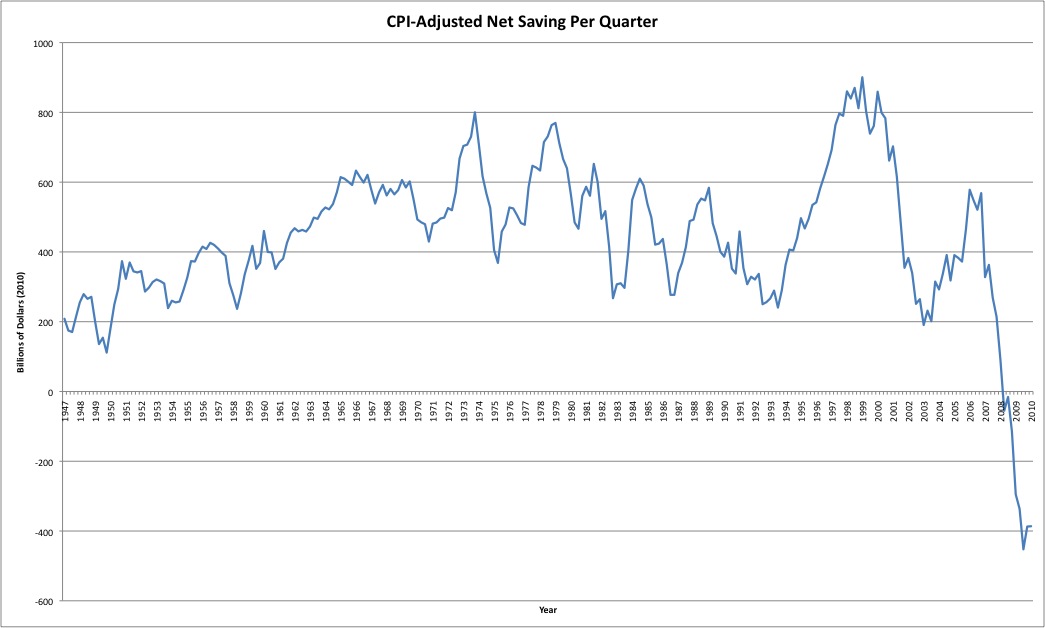
Furthermore, most individuals save. For individuals who are convinced that Americans do not save, net national savings (roughly adjusted for inflation to 2010 dollars) is depicted below (click to enlarge).
Before Professor Mankiw's idea is accepted, it must be explained why most individuals save, if individuals tomorrow are distinct entities from individuals today.  Should this be counted as charity?  Given that most save, if an individual knew that their future-self valued health at more than their now-self valued soda, they should simply have their future-self "pay" them to not drink soda by saving less--an efficient, Coaseian transfer.  Corrections conjectures that Professor Mankiw's idea is not robust to these considerations.  


Addendum: Corrections now recognizes that our point is robust even if an individual is not saving, so long as he can go into debt that his future-self must pay off. That is, the presence of savings is not even a necessary condition for Mankiw's point to collapse, as we first suggested.

Sunday, March 14, 2010

Cox: Raise lottery ticket price to boost school funding

The Atlanta Journal-Constitution "Cox: Raise lottery ticket price to boost school funding" (March 12th, 2010) reports on the question of pricing lottery tickets without delineating any of the economics at hand.
Cox floated the idea on Thursday during a state Board of Education meeting, saying a 50-cent surcharge per ticket could bring in $350 million a year and help address Georgia’s massive education funding gap.
The article continues,
And the move could backfire if enough players balk at paying higher ticket prices, said David Gale, executive director of the North American Association of State and Provincial Lotteries.
This comes close to naming the way to determine whether or not the State should raise lottery ticket prices. Assuming the state is describing a tax increase rather than an increase in ticket prices that is passed through to higher lottery prize, as it seems it is, then the optimal price increase is determined by the elasticity of demand for lottery tickets. The government has a monopoly on lottery ticket sales in Georgia, and seeks to simultaneously maximize its profits from lottery ticket sales and provide a small amount of the wealth re-distribution as a public good. In principle, the state always knows this and was pricing optimally. Justification for a 50% increase in price requires some serious doubts in the government's ability to price optimally to begin with.

The question is not whether or not enough payers will "balk" at a price increase, but rather, whether or not the people who are almost indifferent between buying a lottery ticket and not doing so will decide not to when faced with a higher price. Raising the price by a full 50% will certainly deter some of these consumers. Without providing any evidence on the sensitivity of demand to price, the state runs the risk of losing a great deal of wealth by increasing ticket prices so severely.

Friday, January 22, 2010

More Men Marrying Wealthier Women

The New York Times article "More Men Marrying Wealthier Women" (January 18th, 2010) separates two inextricably linked boons associated with marriage: pecuniary and non-pecuniary gains. In particular, the article notes,
“Men now are increasingly likely to marry wives with more education and income than they have, and the reverse is true for women,” said Paul Fucito, spokesman for the Pew Center. “In recent decades, with the rise of well-paid working wives, the economic gains of marriage have been a greater benefit for men.”
without any mention of non-pecuniary gains from marriage (specifically, in terms of housework and raising children), it is impossible to understand who gains the most from marriage. For example, the figure below displays two levels of happiness (U1 and U2) that a couple can achieve (click to enlarge).


In period 1, the couple cannot obtain a higher level of happiness than curve U1. However, suppose that (due to a decrease in discrimination) women's earning ability increases at the same time that man's household production ability increases (perhaps due to the advent of easy-to-use household cleaning appliances). Now, looking at the period 2 curve, the couple can achieve a happiness level of U2. At their optimal point, the wife works more than she was before, but it is clear that both partners are better off--perhaps the wife gains from doing less housework. Ultimately, the gains in marriage do not have to be pecuniary.

Friday, January 8, 2010

Floridians Shiver, and Pray for the Strawberries

New York Times article "In Cold Snap, Floridians Shiver, and Pray for the Strawberries" (January 6th, 2010)focuses on the individual firm and their individual attempts to save their strawberries while ignoring the fact that it appears in the industry's interest to not save their strawberries. Corrections has discussed this problem as a war-on-drugs previously. A downward shock to supply could actually help strawberry industry profits.

The good news is that the current freeze, so far, has not been nearly as damaging as the bitter cold snaps of 1835, 1962 or 1989, each of which destroyed dozens of businesses and altered breakfast menus nationwide. The bad news is that its unusual length has already begun to test the patience of nearly everyone who touches a strawberry or wants to.

Prices for the red wonders of winter — with Florida names like Radiance — have increased by $2 a pound since Christmas, and supplies will be limited for weeks, even if temperatures rise.

It appears that (short run) demand is inelastic. The mean own-price elasticity for strawberries reported by the United States Department of Agriculture's Economic Research Service is -0.92826. That is, a one percent increase in price would give a 0.92 percent decrease in quantity demanded. Conversely, a one percent decrease in quantity would give a 1.08 percent increase in price. This, in turn, gives a 0.08 percent increase in total revenue.

The manner in which strawberries are likely to increase industry profits is displayed graphically below (click to enlarge).  


Thursday, December 31, 2009

Unhealthy habits are what's killing us

CNN.com article "Unhealthy habits are what's killing us" (December 28th, 2009) appears to misunderstand that total utility of life comes from both quality of life and quantity. Furthermore, Corrections notes that higher rates of early death for minorities appears as a natural outcome of maximization, rather than a product of irrationality or a failure of willpower.

So if the U.S. health system does such a good job saving its middle-aged and elderly sick, why do Americans die comparatively young?

Answer: because Americans are much more likely to get sick in the first place.

And that likelihood owes very little to the health care system and a great deal to the bad choices American individuals make.

If you eat too much, exercise too little, drink too much, smoke, take drugs, fail to wear a seat belt or ignore gun safety, there is only so much a doctor or hospital can do for you.

Corrections does not see bad health and dying early as a bad decision. Total happiness comes from both quality and quantity of life. Individuals enjoy eating, drinking, smoking, and consuming drugs. The author begs the question whether or not Americans are actually making the right choices.

CNN.com has one additional observation that is not contradictory to a rational-individual hypothesis. Specifically, that minorities often engage in self-destructive behavior at higher rates than whites.

Acting on this information won't be easy: It violates too many taboos. Americans understandably treasure their right to make their own choices, including the choice to super-size it. And many are uncomfortably aware that self-destructive behavior is most often found among the poor and among minorities: Black women are more than three times as likely as white women to be severely obese.

This may be a rational discrepancy. If minorities also have lower wages, then their foregone earnings from dying early are less. The shadow cost of unhealthy behavior is lower--we should therefore expect higher rates of early death, coming not from irrationality or dynamic preferences, but from rational maximization.

Judges Consider New Factor at Sentencing: Military Service

Wall Street Journal editorial "Judges Consider New Factor at Sentencing: Military Service" (December 31st, 2009) waves its hands at, but fails to actually observe any externalities in military service that require the parallel justice system it describes. Specifically, it notes that military veterans coming back from foreign deployment have received special judicial treatment in light of their service.

As more soldiers return home from combat overseas and end up in the criminal-justice system, a number of state and federal judges are deciding to show former soldiers leniency in light of their service. Some veterans are receiving probation coupled with psychological treatment, generally for nonviolent crimes that normally would land them in prison.

The article gives an example of one judge's reasoning:

'We dump all kinds of money to get soldiers over there and train them to kill, but we don't do anything to reintegrate them into our society,' says John L. Kane, a federal judge in Denver. Earlier this month, Mr. Kane sentenced an Iraq war veteran convicted of bribery to probation instead of prison.

Yet Judge Kane's argument does not appear to have sound foundations, in the understanding of Corrections. The United States has a volunteer army. Individuals who sign up are doing so because the total discounted lifetime path of wages (cognitive and monetary) are higher than their next best alternative. If they were not, individuals would choose their "next best" (contradictorily, their best) alternative.

If the cost of joining the army, including the probability an individual survives, breaks down psychologically and commits crimes upon their return is too high, individuals will opt out of military service. They will do so until wages are increased or the future costs that cause them to commit crimes are decreased. This is the proper market solution to unfortunate military conditions. If military service is unattractive and unfortunate, fix it through wages, rather than through fringe benefits, like reducing disincentives on producing negative externalities to others (crime), an unsound economic proposition.

Individuals who perform military service are paid in a variety of ways. The public honors them as protectors of freedom. They are paid a wage. They gain fringe benefits through discriminatory governmental hiring practices. The military should make sure it is paying in the most efficient manner, and it is by no means clear that removing disincentives from criminal activity is welfare-enhancing.

The only case in which offering these fringe benefits to soldiers makes sense to Corrections is if ex ante the military has difficulty predicting the single individual of many to pay higher wages in the form of a light sentence, and ex post it can identify them, that the value of this benefit is high, and the moral hazard it poses is low, an unconvincing conjecture.

One might add that there could simply be sample selection in sentencing. Individuals with military service might be less prone to recidivism, incarcerating them less effective, and lighter sentences may be efficient. The article does not address this, though Corrections sees it as a possibility.

Wednesday, December 23, 2009

Despite Recession, Crime Figures Are Down

Time magazine's article "Despite Recession, Crime Figures Are Down" (December 21st, 2009) wonders why the recent recession hasn't triggered a rise in crime; notably, there is no statistical evidence for such a correlation.
Murder and manslaughter dropped a surprising 10 percent for the first half of the year, according to the FBI's data.
In addition, the Pittsburgh Tribune Review puts forth the following explanation in their article "Hard times bring drop, not rise, in serious crime" (December 22nd, 2009)
...there are several possible explanations for the drop in crime, including extended unemployment benefits and other government attempts at economic stimulus that "have cushioned and delayed for many people the big blows that come from a recession."
as noted in the Journal of Economic Perspectives, though changes in fiscally motivated crime-rates (such as robbery and property crime rates) can be explained in part by unemployment, there is no statistically significant correlation between violent crime and unemployment (Levitt, 2004). Fundamentally, the benefits to committing violent crime, especially murder and manslaughter, is unlikely to change in the face of a recession. On the cost side, it is possible that the opportunity cost of going to prison for committing murder does decrease. However, the long-term jail sentence a criminal can expect to serve after committing a murder far exceeds the length of a recession, so long run costs (on which people make decisions) change little. Ultimately, it seems unlikely that thousands of people are lurking in the stands, waiting until they lose their job to commit murder  For illustrative purposes only, the relationship between change in national unemployment and change in graphically below.  As in Levitt's paper, the relationship is negligible.