Showing posts with label Crime and Punishment. Show all posts

Wednesday, December 29, 2010

Killing in L.A. drops to 1967 levels

LA Times article "Killing in L.A. drops to 1967 levels" (December 26th, 2010)" makes the common and unfortunate mistake of claiming, without cause, that crime rises during economic downturns.
Strikingly, homicides in the city have dropped by about one-third since 2007, the last full year before the economic downturn, according to a Times' analysis of coroner records.
It's unclear why a reasonable person would think that murders rise during bad economic times, beyond some primitive association of poverty and criminality. Certainly, all evidence is to the contrary. The graphs below show the trends in homicide rates over time (first in per capita rates, and second in per capita percentage changes in crime). Nothing in these trends supports the Time's "predictions that a bad economy would inexorably lead to higher crime."
(click to enlarge)

(click to enlarge)
In addition, a 2004 Journal of Economic Perspectives article written by University of Chicago economist Steven Levitt (available here) argues that the impact of macroeconomic variables on crime such as murder is theoretically ambiguous, and that violent crimes do not vary systematically with the unemployment rate. Pointing out how little "experts" seemed to know about crime trends, the article includes the following graph (re-printed without permission, click to enlarge), which could have served as a warning to the LA times.


Saturday, November 27, 2010

A Woman. A Prostitute. A Slave.

New York Times article "A Woman. A Prostitute. A Slave." (November 27th, 2010)states that, when it comes to ending forced prostitution "There are no silver bullets, but the critical step is for the police and prosecutors to focus more on customers (to reduce demand) and, above all, on pimps."Corrections has a silver bullet: legalize prostitution. Essentially reiterating an earlier point ("Enabling prostitution" from September 3rd, 2010), it seems rather obvious that forced prostitution is an inferior input into prostitution services. Presumably, upon the legalization of prostitution, willing prostitute supply will shift out dramatically more than forced prostitutes.  This will cause forced prostitute quantity to shift down. We depict the silver bullet to severely decrease forced prostitution in the United States graphically below (click to enlarge).
The responsibility for the larger amount of unwilling prostitutes is on those that oppose legalized prostitution.

Sunday, October 31, 2010

Wyoming Rep. Lummis: Estate tax rise has some planning death

Casper Star-Tribune article "Wyoming Rep. Lummis: Estate tax rise has some planning death" (October 30th, 2010) discusses a cause that Corrections has championed for years but that has been relatively unreported in the media. The estate tax is set to rise from 0% this year to 55% next year for gifts in excess of over $3,000,000. Cynthia Lummis reports an unintended consequence of this tax hike.  She does not, however, note how the same incentives encourage murder.
U.S. Rep. Cynthia Lummis says some of her Wyoming constituents are so worried about the reinstatement of federal estate taxes that they plan to discontinue dialysis and other life-extending medical treatments so they can die before Dec. 31.
In terms of numbers, this most importantly captures small businesses and farms with high levels of capital that are transferred from one generation to the next (hence its mention in a local Wyoming newspaper). Remember that the business does not have to have revenues in excess of $3,000,000, but worth of over $3,000,000.  The death tax has several marginal tax rates, depending on wealth, as displayed graphically below.
If it hasn't earned it previously, the estate tax certainly earns its nickname "death tax" because of the manner in which it currently incentivizes death.  This will come in the form of both voluntary death, as the article notes, such as suicide, or involuntary death, such as a child murdering their elderly parents.  We can graph out the increasing incentive children have to murder their parents--upwards of $3,000,000, they gain about $1,500,000.  Certainly, when store clerks are murdered for less than $100 in a robbery, it is not overly difficult to imagine these incentives meeting a threshold for murder.  Below, we graph the "benefit to murder" created by a hike in the estate tax (click to enlarge).

We note that our analysis foregoes inclusion of the $1,000,000 exclusion allowed for in 2011. Our core point will of course remain the same.

Perhaps the most interesting note is not how much death taxes encourage murder, but how regulatory uncertainty motivates murder.  It could well be that the coming tidal wave of Republicans in Congress will roll back the estate tax.  However, this will occur after it is too late for prospective inheritors to murder their parents.  Therefore, it may be in their interest to pre-emptively murder their parents, even if they think a Republican congress will roll back the estate tax.  In this sense, not only will a hike in the estate tax cause murder, but we can also say that regulatory uncertainty kills.

Wednesday, September 22, 2010

Bridging the achievement gap

Los Angeles Times opinion editorial "Bridging the achievement gap" (September 22nd, 2010) discusses the achievement gap between black males and all other students (black females and white males being the primary groups of comparison). It speaks only of educational means to fix the graduation gap, while discussing crime. Corrections would like to entertain a different possibility that might help solve both. The Times also confuses correlation and causation.
These disparities aren't new — the Schott report could have been published a generation ago. What is new and noteworthy is solid evidence that this gap can be bridged, with well-tested approaches that don't require massive changes in public education and don't depend on superhero teachers and administrators.
An economic idea might be that individuals, both black and white, make decisions about education today based on what they believe their income differentials will be tomorrow. One way to encourage education is to ensure higher wages for the educated. Another is to ensure lower wages for the uneducated.

The Times suggests that some of these students might be on the "prison track." "All too often they're on what educators privately dub 'the prison track.'"

If the Times is concerned that black males (or, for that matter, individuals of any race or gender) are opting out of educations and into lives of crime, one way of reducing their involvement in crime and increasing their graduation rates might be to lower their future wages as criminals.

We do a quick back-of-the-envelope calculation to test this hypothesis. We should see a correlation between an increase in law enforcement officers tomorrow and an increase in graduation rates. For the 50 states from 1998-2003, we plot the two, and offer a fitted least squares line. This is displayed graphically below (click to enlarge).
The relationship is indeed positive, which is itself phenomenal. If high schoolers were myopic and unresponsive to future police presence, we would have expected a drop in graduation rates to result in an increase in police next period--an increase in bad high school students should make more police next period a necessity. The fact that we see this indicates that the difference between our two effects is rather large. At a first glance, while the relationship is only near significant, it would appear tantalizing. For those concerned about the outliers, the relationship remains positive dropping them from a fixed effects panel data regression.

The Times discusses young black males, their graduation rates, and crime. Following our above analysis, we might think that a way to increase the graduation rates of young black males (who head into crime at higher rates than young white men or young black women) might be to decrease their wage differential between crime and legitimate employment through the hiring of more law enforcement officials over the course of several years. This would have the added effect of decreasing crime. Indeed, if individuals are forward looking and we have a believable commitment mechanism, we needn't wait to see the effects.

Clearly the analysis Corrections provides is both preliminary and inconclusive--it is merely suggestive. Nevertheless, it offers an interesting avenue to improve education by rational forward-looking individuals of all races and genders.

Beyond this discussion of heterogeneous impacts by race of an increase in future police presence on future crime and graduation rates, we might also add a particularly offensive quote by the Times:
A large-scale study in Chicago found that 74% of the boys who attended preschool graduated from high school, compared with 57% of those who didn't.
This is a correlation. It is not clearly causal.

Saturday, September 18, 2010

Old age robs criminals' skill

Boston Herald article "Old age robs criminals' skill" (September 18th, 2010) offers a rarity for opinion editorials: an intellectually stimulating article and relatively original idea. The article's interesting question is: why does crime rise in some recessions, and fall in others? The article's proposed answer is recessions with high inflation drive crime because criminals see individuals as holding large amounts of cash now in anticipation for needing it in the future (implicitly, an economic "cash-in-advance" model). Recessions with low inflation will simply find individuals with less in their pockets, and therefore less to steal.
But in previous recessions, in the 1970s and ’80s, the crime rates went up. The difference perhaps was that those recessions were in times of high inflation, giving robbers an incentive to take your money while it still held its value.

Being broke, people don’t go out late and thus are less likely to be mugged. And if folks do travel, the thieves know they’re probably not carrying much of value.

If newspaper writers are going to undertake causal analysis or conjecture, it's enjoyable when they use good structure or thoughtful analysis. If the reflexive premises of the New York Times are that firms are evil and people are very dumb and easily tricked, this article argues that even criminals respond to incentives, and puts forth their testable conjecture--the pinnacle of a non-empirical opinion editorial.

As Corrections sees it, the testable prediction the Herald's conjecture offers is as follows: real goods, such as automobiles or jewelry, are relatively robust to inflation. Cash is not. If burglary and robbery are substitutes for one another, but inflation causes robbery to become relatively less valuable than burglary, then a difference-in-difference will bring out the causal link between inflation and crime.

That is to say when inflation changes from low to high, we should expect the difference between the change in robbery and the change in burglary to be negative. Below, we first graphically display the data: inflation rate, robbery and burglary rates over time (click to enlarge), from 1960-2003.

A graphical and first-approximation is to plot percent change in inflation on the x-axis and the difference between percent changes in robbery and burglary on the y-axis. As we can see from the positive slope, if anything an increase in inflation appears to lead to a relative increase in robberies, not burglaries, as the Herald's theory might predict (click to enlarge).
Of course, this is only a first-pass approach. Consumers, recognizing that inflation will cause more robberies, could reinforce their homes and cause less total robberies (due to security) that has a larger effect than inflation causing more robberies. However, the empirical evidence behind the Herald's theory appears weak--rather than burgling more inflation-robust assets when inflation increases, individuals are robbing more inflation-insecure assets when inflation increases.

Friday, September 3, 2010

Enabling prostitution

Philadelphia Inquirer editorial "Enabling Prostitution" (09/03/2010) discusses prostitution in a misinformed manner. It further does not appropriately analyze counterfactual scenarios.
Some misguided observers of this debate actually believe there's nothing wrong with adults offering sex for money online. They ignore the fact that prostitution often involves other dangerous crimes, including robbery and assault. And sometimes these ads facilitate the illegal sex trafficking of women or girls who are being held against their will.

It is the case that forced prostitution is present in the United States. However, it is by no means clear that either a significant portion of prostitution is forced, nor that the level of forced prostitution would decrease when the difficulty of prostitution increases.

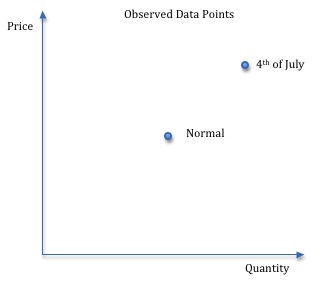
On the first point, we can take a recent empirical study on prostitution that requests no citation (citation will be given when the paper is published). What it indicates, however, is that there is a 63% increase in the number of tricks done on the 4th of July weekend. Forty-three percent of that apparently comes from full-time prostitutes. The other 20% comes from 4th-of-July-only prostitutes, part-time prostitutes that only come in because of the $11 average price increase. To Corrections, this sort of short-term supply elasticity, a vast reservoir that enters the market for one weekend only indicates voluntary prostitution.

If we assume that the 4th of July comes solely from a demand shock, that the fundamentals of supply remain the same, and approximating with linearity then we can identify the supply change (this is the source of the supply increase identification).

Below, we depict the pure data:

Here, we take the same data and add supply and demand lines, based on the idea that the 4th of July represents a demand shock:


On the second point, if we think that forced prostitutes are an inferior input into the production of prostitution, then enabling prostitution, causing an increase in the quantity supplied, will reduce their use in prostitution. The same concept might be applied to manual labor in manufacturing computers. It is likely that an increase from one computer demanded a year to several thousand would cause manual labor to all but disappear. So too with forced prostitution--cheapening the cost of supplying prostitution is likely to compete forced prostitution out of business.

Thursday, August 26, 2010

Why California should just say no to Prop. 19

LA Times OpEd "Why California should just say no to Prop. 19" (August 25th, 2010) deceives readers.
A 2004 meta-analysis published in the journal Drug and Alcohol Review of studies conducted in several localities showed that between 4% and 14% of drivers who sustained injuries or died in traffic accidents tested positive for delta-9-tetrahydrocannabinol, or THC, the active ingredient in marijuana. Because marijuana negatively affects drivers' judgment, motor skills and reaction time, it stands to reason that legalizing marijuana would lead to more accidents and fatalities involving drivers under its influence.
The meta-analysis the article mentions is called "A review of drug use and driving: epidemiology, impairment, risk factors and risk perceptions" in the Drug and Alcohol Review Volume 23, Issue 3 by Erin Kelly, Shane Darke and Joanne Ross, and is available here (gated). The analysis notes explicitly that, "There is inconsistent evidence regarding the impairing effects of cannabis in field studies." It lists four field studies and notes that three of them indicate no significant impact of cannabis consumption on driving. The article concludes, "the relationship between between THC and street driving performance is equivocal." Any reader inclined towards believing what the data is telling them, rather than what they wish they could find, would conclude not that "legalizing marijuana would lead to more accidents and fatalities involving drivers under its influence", as the LA Times piece has, but rather that we shouldn't expect legalizing marijuana to change the number of accidents and fatalities. The OpEd's conclusion is ridiculous and unsupported by the evidence they themselves cite.

In addition the the egregious error discussed above, the article also provides readers with a foolish analysis of negative externalities.
The current healthcare and criminal justice costs associated with alcohol and tobacco far surpass the tax revenue they generate, and very little of the taxes collected on these substances is contributed to offsetting their substantial social and health costs. For every dollar society collects in taxes on alcohol, for example, we end up spending eight more in social costs. That is hardly a recipe for fiscal health.
This analysis implies that the pleasure people get from drinking is worthless. Drinkers and non-drinkers alike deserve to have their utility taken into account when analyzing the costs and benefits of a liquor tax. Basic economic theory would tell us that social surplus is maximized when the marginal social cost of drinking equals the marginal social benefit of drinking. If we are counting drinkers as members of society, then it follows that some level of drinking is optimal. The figure below demonstrates how a pigouvian tax allows us to arrive at the optimal social level of alcohol consumption (click here to enlarge).

In equilibrium, the level of the tax just measures the difference between marginal private cost (cost of drinking to drinkers) and marginal social cost (cost of drinking to society, including alcohol-related externalities). Taxes on goods with externalities are meant to regulate consumption to socially optimal levels. As in the figure above, it is possible to draw social and private cost curves that yield the result discussed in the article--tax revenue is one eighth the area between social cost and private cost curves. The red shaded area represents the tax revenue and the blue shaded area represents the difference between social and private cost. This is a socially optimal (but not necessarily revenue maximizing) tax.

Wednesday, August 25, 2010

Case of soup-kitchen thief fuels critics of three-strikes laws

Christian-Science Monitor article "Case of soup-kitchen thief fuels critics of three-strikes laws" (August 19th, 2010) discusses California's three-strikes law, a law that requires an individual be sentenced to life imprisonment after being convicted of three felonies. It leaves relatively undiscussed the statistical reasons for such a law.

Los Angeles Superior Court Judge Peter Espinoza said Taylor’s sentence was one of many third-conviction cases that brought “disproportionate” sentences and “resulted in, if not unintended, then at least unanticipated, consequences.”

[...]

But stories like Taylor’s are useful in illustrating the problems behind the law's implementation, says Ms. Levinson. The challenge for critics will be trying to prove that society does not benefit from decades-long or even life sentences for nonviolent – or at least not serious – crimes.

Corrections suggests that it may make sense to permanently incarcerate individuals who have been convicted of only minor crimes previously, because the likelihood that they have committed unobserved and serious crimes is high. It's worth noting that, truncating the distribution of claims at the 90th percentile, burglars appear to commit about 38.1 burglaries per year (Visher 1986, reported by NSW Bureau of Crime Statistics and Research). The Senate Congressional record from 2004 indicates that rapists commit between 8 and 10 rapes on average, before being caught (Congressional Record, page 22999). Car Thieves in England appear to steal 45 cars before they're 18, and 94 when they're older (Car Theft: The Offender's Perspective, Light, Nee and Ingham, 1993, page 11). Between 545 and 707 metric tons of cocaine was shipped toward the United States in 2007. Two-hundred and fifty-nine metric tons were caught by U.S. authorities, either internally, at arrival zones, or in transit. Given the discrepancy, Corrections conjectures that distributors of cocaine go through hundreds, or thousands of transactions without being caught.

Perhaps some of these statistics are individually not dependable, but their consistency and magnitude serve as more general suggestive evidence. Given someone has been convicted of one crime, the likelihood that they have committed an order of magnitude more without having been caught appears rather large. The idea that crimes someone is convicted for are simply a signal for the crimes they have committed is the impetus for the point Corrections makes here.

Let us imagine, before we have caught and convicted an individual, that we have some probability distribution that we believe they are sampled from, some likelihood that they are a career criminal, irredeemable recidivists. This is our "prior probability," a distribution between zero and one, that someone will be a recidivist, displayed graphically below (the image is rather small, click to enlarge).

Someone's criminal act or acts provide a data distribution that the person will be a recidivist. One example of this might be their being caught and convicted of breaking into a building. Our hypothetical probability distribution we might place that someone has committed a major crime given they have been caught committing a serious crime like breaking an entering is displayed graphically below


We have distribution of the data on the probability of another criminal act, displayed graphically below (click to enlarge).


We can combine our data on our parameters of interest with our prior beliefs about the parameters, in this case the likelihood that someone will commit another criminal act (click to enlarge)


We can summarize bayesian update by displaying our prior, data, and posterior in one graph, displayed graphically below (click to enlarge). For those interested, in this case we took data to be drawn from a binomial distribution, and assumed its conjugate prior distribution, a beta distribution (therefore making the prior distribution is a beta distribution--of course, our assumptions are without loss of generality, merely for mathematical convenience).


To summarize the point Corrections is making: given that someone has committed and for two felonies previously and has been convicted of a third felony, the likelihood that they have committed dozens, or hundreds of felonies and crimes is high. Convicting and imprisoning these career criminals for life, for their three observed, and dozens of unobserved felonies and crimes, may simply be the optimal response of a justice system that is sentencing people for their likely crimes (the likely crime they were convicted, and the likely crimes they were not caught for).

For those concerned that we are convicting individuals for crimes they have only likely committed, we remind them that this is precisely what the judicial system does currently. The question is how to decide the threshold for punishment.

Corrections finally notes that it is possible punishments already take this into account--that is, the penalty for marijuana distribution, in locations (excepting those with marijuana legalization or decriminalization) are deliberately punishing crimes for which one has not yet been caught. Our discussion took place under the assumption that punishments reflect only the crime for which one was convicted.

Thursday, May 13, 2010

New York Minorities More Likely to Be Frisked

New York Times article "New York Minorities More Likely to Be Frisked" (May 12th, 2010) speaks of New York's Terry stops and how minorities are more often subjected to them. The article largely contains interviews of individuals who are against this disparity. However, the data the article cites indicates that police may be efficiently using discrimination.

According to the analysis of the 2009 raw data by the Center for Constitutional Rights, nearly 490,000 blacks and Latinos were stopped by the police on the streets last year, compared with 53,000 whites.

But once stopped, the arrest rates were virtually the same. Whites were arrested in slightly more than 6 percent of the stops, blacks in slightly fewer than 6 percent.

A check on whether or not there is discrimination is if the marginal Terry stop yields the same arrest rate. If marginally frisked whites are arrested at two times the rate than marginally frisked blacks, then this is an indication that there is statistical discrimination against blacks (not whites!)--it would be more efficient to stop more whites. But if marginal stops in the two groups yielded the same arrest rates, then we are efficiently discriminating.

While we cannot observe margins, the fact that we are gaining the same proportion of arrests post-stop is encouraging--if the average stop is approximately the marginal, then the article gives evidence that police in New York are discriminating efficiently.

Thursday, April 8, 2010

A death penalty record

Los Angeles Times article "A death penalty record" (April 8th, 2010) appears to be in error. It claims that Los Angeles County is a "killer county." While Los Angeles has sentenced individuals to death, none of those individuals have actually been killed.

Los Angeles isn't the only killer county in California; death sentences were also up sharply in Orange and Riverside counties last year.


This is hyperbolic at best. Since 1976, California has executed 13 individuals. One of these individuals, executed in 1996, George Bonin, was given two death sentences (for different sets of victims) for ten separate murders by Orange County independently of his death sentence from Los Angeles County for four other murders. The other execution, taking place in 2005, was of Stanley Williams, convicted of murdering a store clerk laying prone, and separately murdering a family of three.

It does not appear that calling Los Angeles County a "killer county" for executing two men, over the course of the last 31 years that individuals have been executed in Post-Gregg, Post-Proposition 8 California, is appropriate. Given that the two men were responsible for eighteen murders between them, the attack by the Times on Los Angeles County's death penalty cases does not seem to warrant the comment, that in the context of an absence of complete certainty about murderer culpability, Los Angeles County is "inhumane."

Saturday, March 27, 2010

Getting even on crack vs. powder

Boston Globe editorial "Getting even on crack vs. powder" (March 27th, 2010) discusses a possible gap between legal penalties for possession of crack cocaine and possession of powdered cocaine. It discusses the penalties between the two, and how there was a "100-to-1" penalty for holding crack. Corrections sees the matter as slightly more nuanced than the Globe allows.

The political wheels have begun to turn on correcting the imbalance in sentencing those who possess crack and powder cocaine, but more attention is necessary. Under current law, a person caught with five grams of crack gets the same five-year mandatory prison sentence as someone possessing 500 grams of powder. The 100-to-1 crack-to-powder ratio was enacted at a time that crack was thought to be far more addictive than powder and would spark unprecedented crime waves. Studies long ago disproved both notions, but the law remains on the books, and its burden falls disproportionately on black defendants. More than 80 percent of those incarcerated for possession of crack are black.


We noted in a previous post that addictive substances such as crack cocaine were a technological advancement on cocaine. It allowed for small cheap, unobtrusive, mass distribution in a way cocaine did not, a point lifted from Roland Fryer, Paul Heaton, Steven Levitt, and Kevin Murphy’s 2005 NBER working paper “Measuring the Impact of Crack Cocaine.” It is not immediately clear whether or not this phenomenally destructive drug would have been as prevalent as it was were cocaine itself not illegal. On the one hand, cocaine is an input into crack cocaine production. On the other hand, cocaine is a substitute to crack cocaine itself, one whose competitive availability is likely increased much more than crack cocaine’s, in light of crack’s popularity being in part due to cocaine’s inefficient illegal distribution system.

Crack cocaine is a technological advancement on cocaine--distribution is made easier. Therefore, it may make sense to "tax" it at a higher rate, if one catches individuals who deal in it much less often. That is, if one is caught half as often with crack cocaine, then a doubling of the sentence may "equalize" the penalties between the two crimes, an objective the Globe seems to pursue.

Corrections might further add that the law-race discrepancy may have less to do with politician racism than it might have to do with endogenous selection into drug markets. Let us imagine that individuals have three choices: to work for wages in the "above ground" economy (legal), to work selling powdered cocaine (powder), and to work selling crack cocaine (crack). Every job choice has two wages that are taken as a bundle--the average wage per hour and the expected years in prison one receives. A fortiori, assume wages are the same between the two groups.

Finally, imagine that while the wages of both whites and blacks are the same, blacks lose less from prison (as we shall see, a more reasonable assumption is that their outside wages are different). Let us say that a "conversion factor" between years in prison and wage is $2/year for whites and $1/year for blacks.

Then we display our hypothetical wages graphically below (click to enlarge):


In this case, we should see blacks specializing in crack, even though the sentence is higher, while whites split between legal work and powdered cocaine. The law itself caused blacks to enter into crack, rather than attempting to punish them unfairly. It's not clear whether or not sentencing caused racial segregation of this particular crime or discrimination by politicians caused the disparity in sentencing.

Finally and briefly, we might view this slightly differently and come up with an even more interesting result. Imagine that blacks and whites are two agents producing one of three goods--legal work, powdered cocaine, or crack cocaine. Each individual has an endowment of two inputs--money, and sentencing time. In this assumption, blacks have a larger endowment of the input "sentencing time," so they specialize in the good that is relatively more intensive in sentencing time. If we eliminate the disparity, then the rents they were accruing because they held more of a relatively rarer input go away--blacks could be made worse off if we eliminate the disparity by Stolper-Samuelson Theorem (note that eliminating the disparity essentially floods the market with an infinite amount of "sentencing time" and returns to possessing it become zero). Stolper-Samuelson gives the idea behind why an unskilled worker in a country such as the U.S. may have their standard of living harmed by international trade because they are much less rare an input.

Sunday, February 28, 2010

A registry of animal abusers is a bad idea

LA Times editorial "A registry of animal abusers is a bad idea" (February 25th, 2010) correctly notes the reasons why an animal-abusers registry would be poor policy in California, Corrections would only add one consideration: such a registry disproportionately affects the difficulty of obtaining work in fields other than animal abuse.
California already prohibits their cruel behavior, and a registry, however tempting, won't help them to learn compassion.
As Amanda Agan notes in an upcoming paper (available here), sex offender registries do not impact recidivism. There is little reason that we would expect presumably weaker animal registries to have such an effect. In addition, animal abusers often exploit animals for profit, knowing the illegality of their actions. Presumably, they only work with other animal exploiters and try very hard to keep their abuse a secret from those who support animal rights. A registry would not change the circumstances of this line of work. However, a registry may make legitimate sector employment more difficult to obtain, so that work promoting animal abuse becomes only more attractive to offenders. An animal registry may make recidivism more likely, and for this reason alone, it should not be enacted.

Sunday, January 31, 2010

Student1776 on "Don't Legalize Marijuana," and Response

Corrections appreciates acuminous commentary. A comment by “Student1776” was left in response to our post “Don’t Legalize Marijuana”. It was thoughtful enough to warrant its own post in response. Corrections is willing to repeat this activity for insightful commentary.

The post by Student1776 follows:

The writer of the blog makes an excellent point that the use of taxation as a means to control the extent of use. There are at least two additional pertinent elements. First, illegal status tends to constrain use differentially to areas where law is less respected or at least less effective. In the US the illegal status of marijuana or crack cocaine or other drugs tends to confine sales, distribution and to some degree consumption to ghetto areas. Making marijuana or crack cocaine legal would allow the expansion of sales and distribution to all areas - for example the suburbs - likely resulting in expanded use and an expansion of adverse social consequences both in terms of numbers of users and in terms of affecting more empowered parts of the electorate whose political pressure would doubtless be made manifest. Second, as one considers the wider principle of legalization and taxation there is a different aspect to consider. Drugs affect individuals differentially for a variety of biological and other reasons. For any given drug different people have different propensities to addiction. For example, about 6-10% of people exposed to alcohol for as little as a first exposure to several exposures will over time become addicts while 90+% of people who consume alcohol can take it or leave it. These latter people with a propensity not to be addicted are said to be able to "chip" alcohol. For opioids and tobacco the same phenomenon occurs but the number of potential addicts is larger - in a broad ballpark around 20% of people being at risk for addiction with 80% of people for example being able to use an opioid for pain for an extended period without coming to exhibit drug seeking behavior (that is to "chip" opioids or cigarettes. For amphetamine type drugs the proportion of addicts to chippers is far higher - likely on the order of 30-60% depending on the amphetamine with the number of chippers being correspondingly lower (70-40%). The point is that while marijuana has a relatively low rate of severe addictive behaviors associated with it and a high rate of chipping, other drugs are less benign. People who are addicted do continue to show some level of "rational" behavior in the sense of price responsiveness but addicts are by the nature of the disease incompletely rational. Addicts will engage in extreme and irrational activity including violence and law breaking at felony levels. The issue is that while drugs are illegal and distribution is highly restricted there are many people who are potential addicts who are simply not exposed to the addictive drug and as a consequence are able to live productive lives and not be addicted. Pricing issues might to some degree permit a similar constriction of the potential exposure of addicts but for many potential addicts not exposed at this time because of limits of distribution, their financial characteristics may allow them to surmount limitations on exposure due to pricing. It is also noted that if taxation is raised to too high a level then the taxation itself will be surmounted and we will have just created a new kind of illegality. (Not unlike the current cigarette smuggling industry). The bottom line is that the Corrections blogger is correct that taxation could be used to help control exposure, one can anticipate far wider distribution and for the highly addictive substances far higher levels of addiction and associated social damage in localities and social circles currently out of the loop of distribution.


Four points have been made that it is incumbent upon Corrections to dispute, in one form or another.

1) Illegality has differential effects on area that taxation does not have. Specifically, Student1776’s conjecture is that currently use is kept in relatively indigent areas—post legalization, it could spread to wealthier areas. This, in turn, may lead to more users, and empower “undesirable” political classes.

Concerning the first point, Corrections agrees and considered this point. However, it is important to note that there is a reason that use was constricted to indigent areas to begin with. Specifically, that these areas had low opportunity cost of both use and penalty. But it is worth noting that when the government makes something illegal, the black market has no means of writing enforceable formal contracts.

This means that in order to enforce contracts, firms use force. Firms that dominate the industry tend to be those best at wielding violence, rather than those with the most efficient methods. This, in turn, creates an industry that has a lower cost to producing violence on competing firms, consumers, and government.

Corrections posits that this helps propagate the very indigent communities that the author concerns himself with. Were these industries replaced with companies like Johnson & Johnson, Pfizer, and GlaxoSmithKline, we suspect that illegal activity such as drug-dealing, and the resultant violence, would be reduced dramatically.

This reduces transfers from wealthier communities, who will have to pay for less law enforcement, perhaps helping to empower and create more desirable political classes. Implicit in Correction’s understanding of the author’s reference to a desirable political class is one that does not depend on the Rothbardian “gang of thieves writ large,” viz., the government.

2) Drugs have differential addition rates. People who are easily addicted and were previously were not exposed to drugs will now have easy access to them. They will subsequently consume the drugs and become addicted.

Corrections does not dispute the idea that people have differential addiction rates. Indeed, it supplements the idea of differential treatment effects we expounded upon in a previous post.

We do, however, dispute the characterization that people who were previously not exposed to drugs will now have easy access to them. In the reading of Corrections, a very large proportion of the United States currently has access to crack cocaine, for instance. They may buy crack cocaine at some price. The question is in what form they pay the price. Corrections conjectures that most of the author’s potential users would pay in the form of search costs, rather than dollars. This can be translated into dollar form, of course.

Why would we assume that people who are easily addicted and have easy access to a product would become addicted? If these individuals know their propensity to become addicted, then they have the most to lose from trying before addiction. We should therefore see these very people shy away from drug use. We should expect to observe tests for whether or not someone has the propensity to become addicted. In the absence of such tests, we might expect the proper incentives to exist to develop them. In the absence of the possibility of such tests, one would expect risk-averse consumers to shy away from the product in general, as large swaths of the non-chipping population likely do for readily available drugs such as crack cocaine.

Whether or not one accepts this previous point, the first point remains: translate search costs into tax costs and it would appear the same costs from suburban individual’s point of view.

We might add that addictive substances such as crack cocaine were a technological advancement on cocaine. It allowed for small cheap, unobtrusive, mass distribution in a way cocaine did not, a point lifted from Roland Fryer, Paul Heaton, Steven Levitt, and Kevin Murphy’s 2005 NBER working paper “Measuring the Impact of Crack Cocaine.” It is not immediately clear whether or not this phenomenally destructive drug would have been as prevalent as it was were cocaine itself not illegal. On the one hand, cocaine is an input into crack cocaine production. On the other hand, cocaine is a substitute to crack cocaine itself, one whose competitive availability is likely increased much more than crack cocaine’s, in light of crack’s popularity being in part due to cocaine’s inefficient illegal distribution system.

3) Student1776 conjectures “People who are addicted do continue to show some level of "rational" behavior in the sense of price responsiveness but addicts are by the nature of the disease incompletely rational. Addicts will engage in extreme and irrational activity including violence and law breaking at felony levels.”

Corrections does not see violence and law breaking at felony levels as an irrational behavior. Take, for example, Lawrence Katz, Steven Levitt, and Ellen Shustorovich’s 2003 American Law and Economics Review article “Prison Conditions, Capital Punishment, and Deterrence”. The homicide rate within a state is negatively impacted by higher within-prison death rates (from murders, illness and AIDs, poor conditions). Indeed, the impact of one additional prison death ranged from -0.1 to -0.8 fewer homicides across the author’s specifications.

Murder, rape, robbery, aggravated assault with a firearm, and burglary of residence are not excluded from the list of crimes for which sentence enhancements significantly change behavior. Daniel Kessler and Steven Levitt found, in their 1999 Journal of Law and Economics article “Using Sentence Enhancements to Distinguish between Deterrence and Incapacitation” that those crimes declined by four percent more than California’s non-enhanced crimes, compared to the difference in decline of the same crimes in other states (without sentence enhancements) and their comparable crimes (a difference-in-difference-in-difference model).

To use the same author a third time, in the Journal of Political Economy (1998) Steven Levitt’s paper “Juvenile Crime and Punishment” shows that not only are juveniles likely deterred by differential sentences, but that an increase in the relative punitiveness of adult crimes compared to juvenile crimes causes decreases in crime when juveniles reach the age of majority. This comparison, comparable to a regression discontinuity comparison, indicates that juveniles around the age of majority appear to be making their criminal decisions based on sentences—-another rational act.

Corrections sees criminals as behaving rationally—-if not during their crimes (say, during a drug-induced state), then in the decisions leading up to the crime (the decision to become intoxicated).

4) It is also noted that if taxation is raised to too high a level then the taxation itself will be surmounted and we will have just created a new kind of illegality. (Not unlike the current cigarette smuggling industry).

Corrections concurs. We see the result as only a partial privatization. If this is the case, then at the limit legality will change nothing because the tax will be too high and the market will remain a black market. In reality, Corrections expects that a portion of the market will be legal and taxed. To take the author’s example, we posit that New York spends vastly less on enforcement and gains vastly more revenue from cigarettes by making them legal and taxing them than it would by making them illegal and paying to enforce the law (rather than be paid).

Thursday, January 28, 2010

Don't legalize marijuana

LA Times Opinion article entitled "Don't legalize marijuana" (January 28, 2010) misses one fundamental lesson on the subject of drug legalization: enough taxation can reduce marijuana consumption to current regulation levels.
Legalization almost certainly would bring with it additional substance abuse in the state, and the long-term public costs associated with that would vastly exceed the relatively modest amount of new revenue legal weed might bring in.

The economics of illegal goods weighs extremely heavily in favor of legalization and taxation rather than banning and enforcing, as Gary Becker, Kevin Murphy, and Michael Grossman outline in The Economic Theory of Illegal Goods: The Case of Drugs (NBER Working Paper, 1994).

Corrections would suggest that when marijuana is illegal, the government raises the cost of selling marijuana until production falls to the socially optimal quantity. This is a costly activity. Police must be hired, lawyers must be provided, and offenders must be jailed. The end result of all the government's expenditure is to raise price and reduce quantity consumed by the law of demand. However, legalizing marijuana and taxing its sale until the quantity demanded was reduced to the same socially optimal level as regulation would result in no change in marijuana consumption, by construction.

The graph below (click to enlarge) demonstrates the possible ways in which government can reduce marijuana consumption to its preferred point. Raising the cost of production and shifting the supply curve back is costly and loses consumer surplus. On the other hand, taxing marijuana use until consumption falls to Q_regulation results in government revenue that simply does not exist when marijuana is illegal. It is the difference between paying to destroy money and being paid to destroy it.


If the government seeks to regulate the quantity of marijuana consumed, it should choose to do so with a pricing mechanism such as taxation (from which it can earn revenue) rather than a ban (which is costly to enforce). The result is otherwise the same.

Corrections does note our a priori belief that demand will not shift out, or not shift out much, if drugs are legalized. We do not see the "stigma" of marijuana use as a major factor in utility inputs of extra-marginal users. We might further note that we see addiction arguments as lacking firm foundation in human behavior, as discussed in a previous post.

Saturday, January 9, 2010

The Price of Justice

Los Angeles Times article "The Price of Justice" (January 7th, 2010) examines a constitutional question before the Supreme Court. Specifically, the Supreme Court is to decide whether or not a defendant's right to be confronted by the witnesses against him extends to the laboratory experts who helped analyze evidence against him. The court decided previously that this was the case, but challenges based on cost have made the court revisit the ruling. The Times argues against overturning the court's ruling, arguing that one should not put a price on a constitutional right.

The 6th Amendment to the Constitution guarantees a criminal defendant the right "to be confronted with the witnesses against him." In June, the Supreme Court adapted that principle to the age of "CSI" by requiring prosecutors who use laboratory reports to call the experts who prepared them so that they can be cross-examined by the defense.

Now, after exaggerated complaints by some prosecutors, the court will revisit the issue in arguments on Monday. It should decline the invitation to rein in or reverse its ruling. Not for the first time, a court decision has forced prosecutors to change the way they do business and incur additional costs. And rightly so; the court shouldn't put a price tag on the exercise of a fundamental constitutional right.


Corrections has two points to make. The first is trivial, the second an unusual suggestion. Corrections notes that no matter what the court does, they will be putting a price on someone. Prosecutorial budgets are limited, as is the time of evidentiary experts. Putting no price on their time likely means to reduce their use by prosecutors. This, in turn, is likely to mean fewer convictions, and more crime.

Corrections notes that in a Coaseian manner, it is inconsequential to a trial's outcome if the state is not obligated to pay for evidentiary experts. If the expert's opinion is likely to absolve an individual, and that individual values not going to jail more than the cost of the expert's time, then they will hire that expert. Otherwise they will not. If the two parties are free to hire the service or not, then the outcome will be efficient, and just represent a wealth transfer.

If individuals are concerned that this wealth shift will be unfair or unjust, the state can, at worst, give all the wealth required to hire the evidentiary expert to a criminal. The criminal can either hire the expert, or keep the money. If they hire the expert, they do exactly what would have happened anyway. If they do not, then both parties are better off, as less court time and evidentiary expert time has been wasted.

The point is simple and worth reiterating. Enabling bilateral trade and exchange will make both parties better off. There is no exception to the right of a criminal to use the time of an evidentiary expert. There may be gains to trade from paying him not to waste everyone's time, a payment that by definition will make him better off (otherwise he would reject the offered trade!)

Saturday, January 2, 2010

Smoking Ban Begins In North Carolina

Greenville News article "Smoking Ban Begins In North Carolina" (January 1st, 2010) describes positive effects from a North Carolina smoking ban, but doesn't mention any reasons why bans may be harmful. One reason stands out in particular: smoking bans may have unintended negative consequences for passive smokers.

The management at Hannah Flanagan's Pub also seemed positive about the change. The pub has allowed smoking ever since it opened in 1993, but general manager Annie Hargus didn't anticipate any backlash from the new law.

"I actually think that it will have a really positive impact on our business from regaining customers who don't come in any more because of the smoke, and probably gaining new customers as well," she said.

In a forthcoming American Economic Journal: Applied Economics article "The Effect of Bans and Taxes on Passive Smoking", Jérôme Adda and Francesca Cornaglia show a curious effect on passive smoking from smoking bans in places of public recreation. Specifically, they give evidence that bans in recreational places increases the exposure of non-smokes and young children to second-hand smoke. Additionally, that smoking bans impact individuals lower down on the socioeconomic ladder in a more negative manner. Simply speaking, people smoke more at home when they can't smoke anywhere else. The findings are significant: the unintended consequences of indoor-smoking bans to passive smoking in children appear to be around half the effect winter has on children (people also smoke more at home when it's cold outside).

Though the consequences of banning smoking in restaurants are not as great, they should be considered, lest similar effects plague good intentions.

Tuesday, December 29, 2009

The drug war two-step

San Diego Union-Tribune commentary "The drug war two-step" (December 27th, 2009) fails to mention a curiosity in the "War on Drugs" that helps to make interdiction efforts a self-defeating campaign. The article suggests that the elimination of one drug dealer may reduce violence in Mexico but increase the amount of drugs shipped into the United States. Corrections sees a definite possibility for the opposite to occur. Corrections suggests that the elimination of drug dealers could cause more drug-dealer-on-state violence, smaller quantities of drugs shipped, higher drug prices, and higher industry profits.

The question is will “El Barbas’ ”death have any lasting impact on reducing cartel-related violence and reducing the flow of drugs into the United States. On the first point, there may be some hope, but not for the right reasons. Here’s the rub: drug traffickers are peace-lovers at heart, because peace means no competition for customers and profits. With Beltrán Leyva out of the way, “El Chapo” Guzman can expand his business and keep moving up the list of Forbes magazine’s wealthiest people. Meanwhile, the U.S. drug consumers who are padding his bank accounts can rest assured, there will be plenty more drugs available in the days to come.

When something is demanded inelastically, it means that a one percent increase in price will be met with a less-than-one percent decrease in demand. Addictive, illicit drugs are often examples of goods with inelastic demand. While a monopolist will never supply a good on the inelastic portion of the demand curve, competition will. It is not unlikely that the illicit drug industry is pricing drugs on the inelastic portion of the demand curve.

Therefore, if authorities artificially shift the quantity supplied leftward, it may increase illicit drug industry profits. This is depicted graphically below (click to enlarge).


It is in this manner that drug interdiction efforts may actually benefit the drug industry. It is important to note that under this scenario, fewer drugs will be consumed in the period of interdiction, even though the industry is better off. We could imagine that increased drug-industry profits might actually increase its capacity for violence against the government, concluding the reasons for the above predictions.

Corrections notes as a piquant possibility that one method of reducing the quantity of drugs sold in the United States might be to help form a cartel or monopoly supplier. As outlined above, a monopoly supplier will artificially restrict supply, gaining higher profits. It could be that the formation of a monopoly will cause a smaller quantity of drugs into the market, as depicted below (click to enlarge).

Sunday, December 27, 2009

Smart Answers to Recidivism

The New York Times editorial "Smart Answers to Recidivism" (December 24th, 2009) fails to consider the major repercussions of eliminating major post-sentence criminal punishments. The article suggests that making legitimate-sector job opportunities more available to ex-convicts will lower their recidivism rates. The article describes the changes to ex-convict employment that it supports:
No reasonable person would suggest that a sex offender be given a job in an elementary school or day-care center. An ex-offender could not be disqualified for employment unless the offense was directly related to the job. Job seekers would no longer be required to disclose convictions on applications for state, county or municipal jobs. The offenses could still be uncovered in background checks, but they would no longer automatically rule out an applicant from the start.
Of course, potential criminals likely are aware of these permanent costs of conviction--a difficult job search. Eliminating these costs would increase crime rates under a model of crime under which criminals weigh expected costs against benefits in deciding wether or not to commit crime. Perhaps better legitimate-sector opportunities lowers crime rates among past-criminals, but less punishment for crime increases crime rates overall. Thus, the question of whether or not such a change will lower total crime rates is empirical, and yet unanswered.

Wednesday, December 23, 2009

Despite Recession, Crime Figures Are Down

Time magazine's article "Despite Recession, Crime Figures Are Down" (December 21st, 2009) wonders why the recent recession hasn't triggered a rise in crime; notably, there is no statistical evidence for such a correlation.
Murder and manslaughter dropped a surprising 10 percent for the first half of the year, according to the FBI's data.
In addition, the Pittsburgh Tribune Review puts forth the following explanation in their article "Hard times bring drop, not rise, in serious crime" (December 22nd, 2009)
...there are several possible explanations for the drop in crime, including extended unemployment benefits and other government attempts at economic stimulus that "have cushioned and delayed for many people the big blows that come from a recession."
as noted in the Journal of Economic Perspectives, though changes in fiscally motivated crime-rates (such as robbery and property crime rates) can be explained in part by unemployment, there is no statistically significant correlation between violent crime and unemployment (Levitt, 2004). Fundamentally, the benefits to committing violent crime, especially murder and manslaughter, is unlikely to change in the face of a recession. On the cost side, it is possible that the opportunity cost of going to prison for committing murder does decrease. However, the long-term jail sentence a criminal can expect to serve after committing a murder far exceeds the length of a recession, so long run costs (on which people make decisions) change little. Ultimately, it seems unlikely that thousands of people are lurking in the stands, waiting until they lose their job to commit murder  For illustrative purposes only, the relationship between change in national unemployment and change in graphically below.  As in Levitt's paper, the relationship is negligible.


Tuesday, December 22, 2009

Consider the evidence

Philadelphia Inquirer opinion editorial "Consider the evidence" (December 21st, 2009) ignores an interesting possibility concerning the delay in police departmental testing of rape kits. The article is perturbed that there is a shortage in processed rape kits.

The backlog of untested kits includes about 12,500 in Los Angeles, 10,000 in Detroit, 6,000 in San Diego, and 4,000 in Houston. (Philadelphia police, to their credit, say their lab tests every kit).

And

Money shouldn't be a roadblock to solving these crimes. Congress passed a law in 2004 to provide grants to states for rape kit testing. But the law allows police departments to use the money for other DNA testing, not just rape kits. Human Rights Watch reported last March that the Los Angeles Police Department's backlog of untested rape kits occurred despite LAPD's receiving $8 million in grants for testing during the previous four years.

There is no explicit price mechanism to clear the market for processed kits, so instead it is cleared by the implicit price mechanism of time-to-process (perhaps mixed with a nebulous definition of priority). Furthermore, supply is constant. If we increase supply, we expect waiting time to decrease in the short run. However, in the long run, prosecutors and police change their standard methods of operation, and increase their use of more sophisticated methods. This, in turn, raises the waiting time. If long run elasticity is very high, we expect supply shifts to only ever shift waiting time a little. Such a case is depicted graphically below (click to enlarge).  Additionally, our expectations on the evolution of "price" and quantity over time are depicted below (click to enlarge).  

It is foolish to focus only on waiting time or backlog--instead, optimizing behavior would be to first minimize the sentence-adjusted cost of bringing in a suspect (which may include many rape kits or few rape kits), and then choose the amount of money one wants to spend, setting the sentence-adjusted marginal benefit to our (minimized) marginal cost.