Showing posts with label Externalities. Show all posts

Friday, September 10, 2010

Seatbelts are the lifesavers in your car

New Orleans Times-Picayune editorial "Seatbelts are the lifesavers in your car" (September 9th, 2010) speaks positively of seat belts.  While they have undoubtedly saved lives, they have also undoubtedly cost them through the externalities their cost-shifting generates.
More Louisianians buckled up this year compared to last, according to the Louisiana Highway Safety Commission, but the New Orleans area actually saw a 1.1 percent decline in the percentage of people using seat belts.

Even with the statewide increase for drivers and front-seat passengers, which went from 74.5 percent to 75.9 percent, Louisiana still lags behind the nationwide usage rate of 83 percent.

That's discouraging, because buckling up is a simple and easy thing to do, and it's a proven life-saver.
The most interesting economic concept when it comes to seat belts and safety regulation is the "Peltzman Effect", as Sam Peltzman discusses in his 1975 Journal of Political Economy article "The Effects of Automobile Safety Regulation" (gated).  Below, we reproduce his diagram graphically (click to enlarge).  What the diagram indicates is that risky driving gives us something we enjoy--for example getting to our destination more rapidly.  Our first bit of risky driving is particularly beneficial--perhaps when we are in a hurry.  As we increase our risky driving, the marginal benefit decreases.  This is represented by the downward sloping red line. Under a regime with no seat belts, we end up at an equilibrium represented by point A on the risky driving schedule.  Under a regime with seat belts, we end up at an equilibrium represented by point B.  As driving becomes safer, we drive more riskily.
This, in turn may cause more pedestrian deaths, whose cost is presumably not fully borne by drivers.  Below, we graphically depict the relationship between risky driving and pedestrian deaths (click to enlarge).  We can see that pedestrian deaths rise as we go from point A and B.  (Point C will be discussed below).
As a thought exercise, famous among Austrian economists, is what would occur if instead of seatbelts or airbags, we installed a large spike in driving wheels, faced toward the driver a driving wheel looking similar to this:
In this case, we would have the following relationship between risky driving probability of death to driver (click to enlarge):

If this is the case, we end up at point C on the diagram above (again, click to enlarge).

This article serves to demonstrate a few concepts.  First, a common refrain on Corrections: when we reduce the cost of behavior that has benefits and costs, we increase the partaking of that behavior.  Second, when that behavior has externalities, as it does with driving, we may actually foist the cost of risky driving onto pedestrians rather than consumers.    

Monday, July 26, 2010

wheninrome15 on "Can a Soda Tax Save Us From Ourselves?"

Corrections appreciates commentary. A comment by “wheninrome15” was left in response to our post “Can a Soda Tax Save Us From Ourselves?” (June 4th, 2010).   It was thoughtful enough to warrant its own post in response.

The post by wheninrome15 follows:
I'm going to have to side with Mankiw on this one, but his argument is not completely clear, so I can see why you would go in this direction with it. Maybe he is just aiming at a more general audience, but if we're going to do the real deal, we have to address the elephant in the room, namely dynamic inconsistency. Below are my notes from thinking the matter through, hope they will benefit you as well.
To frame this issue, let's first consider a 2-period model with discounting (with 2 periods it doesn't matter what sort of discounting is going on, geometric, hyperbolic or otherwise). The agent maximizes $$u_1(x_1)+du_2(x_2)$$ subject to some budget constraint (say, $$x1+x2=M$$) where d is the discount factor.
In solving this problem, we know that, starting from an allocation of $$u_1(x_1), du_2(x_2)$$, the agent moves an extra dollar to the second period precisely when the transfer causes $$du_2$$ to go up by more than $$u_1$$ goes down. If we are instead thinking of a “multiple agents” framework, then it must be that such bargaining occurs precisely when agent 2, with utility function $$du_2$$, gains more from an extra dollar than agent 1, with utility function u1, loses. So you could think of this as Coasian bargaining, but the 2nd period agent is _not_ someone with utility function $$u_2$$; rather, he has utility function $$du_2$$.
[Sidenote: By the way, in one sense it is an illusion that Coasian bargaining is occurring here. Why are the agents trading with utility functions $$u_1$$ and $$du_2$$ rather than $$u_1$$ and $$u_2$$? The problem is a total unilateral lack of property rights. Agent 1 can steal whatever he wants from agent 2 (provided he has free access to credit, he can even go into debt, which agent 2 will be forced to repay). Agent 2's share is completely determined by agent 1's altruism. If $$d=0$$, for example, then agent 2 is simply screwed, unless we really are thinking of him as an agent with utility function $$du_2=0$$. Another clue is that the outcome is completely independent of the initial assignment of property rights (i.e. period 1 and 2 endowments). But for the present purposes it is actually somewhat useful to continue to suppose Coasian bargaining is occurring, so let's keep it.]
So, when you say that Coasian bargaining will occur, let us be clear that you mean between agents with utility functions $$u_1$$ and $$du_2$$, not $$u_1$$ and $$u_2$$. When Mankiw uses the word “externality,” he does not mean that perfect bargaining isn't taking place, but rather that it is taking place at the exchange rate of 1 to d rather than 1 to 1. Coase does not say what the exchange rate should be, it simply says that, given the exchange rate, trade will occur.
To say that agent 1 imposes an externality on agent 2 is to say that agent 1 is not fully weighing the effect of his actions on agent 2's utility...so how much should he be weighing it? How much, really, should we care about agent 2? Here we are discounting his native utility function $$u_2$$ by a factor of d, but maybe that's just fine...in reality we might think discounting should be going on. Perhaps people are fine with the fact that they don't care about tomorrow as much as they care about today. It would be a poor social planner who made it his goal to eliminate discounting that people really wanted around. It's hard to construct a defensible argument that people shouldn't be geometrically discounting. In a multiperiod model, with discounting $$(1, d, d^2, d^3,...)$$, there is no job for a social planner. But on the other hand it's pretty easy to take issue with hyperbolic discounting and the like. Dynamic inconsistency is rotten, and there is value in helping people to eliminate it [see endnote, but don't read it till you finish this paragraph]. Once you have dynamic inconsistency, everything you're saying simply flies out the window. Coase does not answer the question of what the relative price should be; you have to decide that for yourself, you have to take a stand. In the world of dynamic inconsistency, “the” utility function is no longer well-defined, because it depends on the perspective in time that you choose! You may want a “t=minus infinity” perspective or a “t=10 periods ago” perspective or a “t=now” perspective...but once you pick it you're stuck, you have to evaluate everything from that perspective. It is no longer simply maxing utility, but rather maxing utility w.r.t. time t. Go ahead and treat the agent's weights of ($$1, bd, bd^2, bd^3$$,...) as gospel if you like (that's quasihyperbolic discounting from t=now. The b captures the notion that the agent discounts in the usual geometric way except that he discounts all future periods by an additional factor of $$b<1$$, i.e. he really cares about now), have that be your criterion for how resources ought to be allocated if you like...but all the agent's plans will just fly out the window next period, won't they? If agent 1 wants to stop agent 2 from gorging at agent 3's expense, Coase will not save him! Agent 1 wants the terms of trade to be $$bd$$ to $$bd^2$$ (i.e. 1 to d), but next period they will simply be 1 to $$bd$$. One solution is for agent 1 to precommit, and indeed in a world with perfect information and frictionless and complete commitment, there is no dynamic inconsistency problem. But in reality people are often naive or inert. Thus, the reasoning goes, people can potentially be helped by a soda tax that helps them to resist soda that isn't really maximizing their utility (w.r.t. the point in time that you have decided they really care about). In matters such as these, protecting people from themselves is always always always about dynamic inconsistency. So if your argument does not go there, then you can be sure that it's not getting to the heart of the matter. The point of this is not at all to convince you that soda taxes are a good thing on net; that will come down to Mankiw's last sentence. But that is Mankiw's point too, that it comes down to his last sentence. I do not think his argument stops short of that.
[Endnote: I said that with dynamically consistent discounting, it's hard to argue that a person should do something else. The reason is that, for any proposed alternative, you would be telling them to do something they'd never want to do, no matter what perspective in time they were looking at it from. But with dynamic inconsistency, their decision about what's best depends on their perspective in time, and so in fact you have to make a judgment call about what perspective to call best. And once you pick the perspective, you are forced to concede that the agent -- who does not stick with the perspective you picked (or any perspective, for that matter) -- is doing things that do not maximize his utility.]

In broad strokes, your argument as Corrections understands it can be summarized by the following points (in order of their argumentation):

  1. Mankiw did not address dynamic inconsistency but it is relevant.
  2. We can summarize the intertemporal problem as a problem of negotiation between two agents.
  3. That point (2) is an illusion because the first individual has full property rights.
  4. Mankiw's point suggests that perfect trade may be taking place, but at the wrong "exchange" rate.
  5. We can't make an argument against geometric discounting very well, but we can against hyperbolic discounting.
  6. Hyperbolic discounting leads to an "unnecessary" loss in utility.
  7. When evaluating utility loss, one must pick a period and discuss utility from that discounted period only.
  8. People are naive or intert, and because of this, they may be helped by a soda tax.


Our responses are organized as follows:

  • We agree that dynamic inconsistency is an elephant in the room, but not that it is important.
  • We argue that the primary vehicle for dynamic inconsistency, hyperbolic discounting, is not suitable because it cannot generate a significant loss in utility for individuals (which is why it is so often used in public policy analysis).
  • We argue that dynamic inconsistency generally, and hyperbolic discounting in particular is either 1) secretly hidden among individuals 2) have some semi-hyperbolic discounting along some of their income but not all 3) are constantly starving to death in secret.
  • We argue that most empirical time preference literature is not necessarily a product of inconsistency, following a line of argument established by Gary Becker and Casey Mulligan.
  • We note that irrationality itself is endogenous, using a paper by Gary Becker and Yona Rubinstein on terrorism and fear to make our main point.
  • We disagree that one cannot argue for hyperbolic-style discounting--we believe it makes a great deal of sense when we deal with the idea of tradeoffs-with-certainty and tradeoffs-without-uncertainty.
  • Finally we note that hyperbolic discounting may largely be an artifact of the laboratory.
  • We conclude with a rule of thumb.

First, we agree that Mankiw did not address dynamic inconsistency, so we did not speak to it. We spoke to a case in which an individual body is composed of many different individuals over time. We further noted that these individuals appeared to all have a degree of income, due to savings. We then suggested that given some sort of exchange between past-and-future individuals is occurring, the two should be on the Pareto Frontier. If they are not, because a future-self smokes, then he would do better to save less, and smoke more, in the "Coaseian" bargain that we suggested. We suggest that this argument remains untouched, and maintain our point that Mankiw is wrong in the point he made, in our reading.

We see your point as related-in-conclusion but actually quite different from Mankiw's current-self future-self terminology. Yours is about a single, specific individual attempting to maximize their total utility.

First, we address hyperbolic discounting. For the uninitiated, economists generally model time preferences as exponential discounting. This suggests that people are as impatient between today and tomorrow as they are between tomorrow and the next day. Hyperbolic discounting suggests something special about today, and that people value the difference between today and tomorrow differently from tomorrow and the next day (less). The difference between the two systems in discrete time is displayed graphically below (click to enlarge; the graphic is deliberately very large in the enhancement). Hyperbolic discounting offers a "now-oriented" bent to discounting.


To understand why hyperbolic discounting might be of concern to economists, we can examine how two individuals who have ten time periods to consume 100 units of a good might behave. We give one exponential discounting with $$\beta=.95$$. This indicates that he would be indifferent between consuming 1 unit of good today or .95 units tomorrow. Similarly, we give another with quasi-hyperbolic discounting .95203 and the .96, deliberately calibrating it for comparability with our exponential discounting--they choose to consume the same amount on the first day. However, because in each period, the hyperbolic discounter is newly-impatient upon arrival at a new period, and initially they consume more than they planned in the first period. Using log-preferences, this is displayed graphically below (click to enlarge).


We might notice a few things. First, that the red line, the hyperbolic plan, is different than the green line, what actually happens. The second is how, with reasonable parameters (log-preferences and the aforementioned discount rates) and over a long span (ten periods, or years as calibrated), the deviation from optimal plan is not very large. Indeed, if we were to calculate how much our hyperbolic discounter should pay to stay on his optimal plan, it would be .0322 units, of his 100 units. That is, in this reasonable example calibrated for a ten-year horizon, individuals lose 0.03% of their initial income due to hyperbolic discounting. The sheer smallness of this number suggests that economists concerning themselves with this loss in public policy without first examining the much larger government waste must have ulterior motives.

But let us forego our concerns about the minute nature of hyperbolic discounting and instead note that even were it not small, any person without hyperbolic discounting should be hunting for these individuals with as much passion as the harpies who hunted an Aeschylean Orestes in The Eumenides. Why should we hunt these people with great passion?

Say they have a $$\beta$$ of .95 and a $$\delta$$ of .975. Therefore, in exchange for 1.026 units of period three, I buy one unit of period two consumption from you. Time passes one period, and I can now sell you the one unit of period two consumption for 1.08 units of period three, netting myself a profit of .05 in the third period without sacrificing any consumption.

Of course, this does not have to be done with only one unit--it can be done with your entire fortune. Because the relative prices between future periods are changing for hyperbolic discounters, any arbitrager may come along and, over the course of two periods, consensually exchange all of a hyperbolic discounter's fortune away from him--a hyperbolic discounter and his money are soon parted.

This leads us to conclude that either a) hyperbolic discounters do not exist b) they are well hidden within the population (and thus safe from such traders or c) they have starved in the streets, silently, bereft of the money that was once theirs.

We might further note that time preferences are endogenously determined, as Gary Becker and Casey Mulligan do in their 1997 Quarterly Journal of Economics paper "The Endogenous Determination of Time Preference." They note that by endogenizing discount rates, "it appears possible to explain with a model of rational behavior many assertions in the literature that are claimed to imply irrational choices." Their list includes the fact that people are not equally patient, that income is associated with higher consumption growth, and the relationship between schooling and consumption growth, relationships previously identified as irrational.

Finally, and in light of our previous point, we should note that any lingering inefficiencies will be small. It is difficult to see any market failure preventing individuals from investing in their own time preferences, in individuals requiring the government to provide that good, especially given information asymmetry going the wrong way. At any place where there should be great inefficiencies due to "irrationalities", we should also see great individual effort to overcome the irrationalities.

This is seen, for example, in the paper "Fear and Response to Terrorism: An Economic Analysis" by Gary Becker and Yona Rubinstein, who identify the role of fear in economic behavior, finding that individuals overcome their terror (they study suicide bombers and the use of buses by Israelis) more when they have incentives to do so. So too, do we expect individuals who lose the most because they are irrational to invest the most in changing their own behavior. We might add that subsidizing "irrationality" though a series of government nudges and shoves encourages the opposite type of meta-behavior.

Let us forego the ideas that hyperbolic discounting cannot generate large losses in utility with reasonable parameters, or that they provide arbitrage opportunities, or that individuals will optimally invest in controlling their irrationality and that there appear to be no market failures. Instead, let us note that even without these, hyperbolic discounting might have a real economic rationale. Specifically, there is a reason that today and tomorrow and tomorrow and the next day are different. The decisions we make are assured between today and tomorrow, where we have no such assurances in the next day.

Corrections only sees hyperbolic discounting literature applied in the literature on public choice, perhaps because only public choice examines long enough time periods for hyperbolic discounting to become important (for example, discussing global warming). In this case, there is an obvious reason why individuals should be today-focused. Specifically, because tomorrow has a degree of uncertainty that is not present today, but is present in all future periods. Let us imagine, for the sake of argument, that who is in power politically is an i.i.d. process. Then in making decisions about what legislation to pass, and what to have it depend on, whoever is passing the law should "trust" themselves more than future generations of lawmakers, because they have a smaller chance at being in power in all future periods (and due to our i.i.d. nature, the same, nonunity chance of being in power in all periods). This is a case in which hyperbolic discounting is "rational," though inefficient due to public choice incentives, rather than having anything to do with discounting.

Finally, we note, as Glenn Harrison and Morten Igel Lau do in "Is the Evidence for Hyperbolic Discounting in Humans Just An Experimental Artefact?," that while individuals participating in laboratory experiments appear to prefer to be paid in the present rather than the future, this may be a function of rational payment uncertainty rather than any discounting. Indeed, in this case, hyperbolic discounting in the lab in this situation is actually optimal behavior.

A number of the points we make hold for any form of dynamic inconsistency. We chose hyperbolic discounting because it was both mentioned in the post and is the most common form of dynamic inconsistency.

In light of these arguments, Corrections recalls a the opening of George Stigler's "The Intellectual and the Market Place"

The Intellectual has never felt kindly toward the market place; to him it has always been a place of vulgar men and of base motives. Whether this intellectual was an ancient Greek philosopher, who viewed economic life as an unpleasant necessity which should never be allowed to become obtrusive or dominant, or whether this intellectual is modern man, who focuses his scorn on gadgets and Madison Avenue, the basic similarity of view has been pronounced.
Corrections sees the relationship between the intellectual and individual freedom to be similar. Whether it is Rousseau's belief that individuals must be "forced to be free" (end of Section 7), or Plato's belief in a static, unchanging society where popular music, theatre, and poetry are banned, and the right to raise one's own children is eliminated (in The Republic), or Isaiah Berlin's corruption of the phrase "liberty" in Two Concepts of Liberty to argue a perverted liberty that required an obligation from one's fellow men beyond non-interference, intellectuals have rarely been friends of liberty.

It is in the light of a would-be tyrant that all paternalists should be seen, Corrections notes. As we have noted before, paternalists are would-be slavemasters with a smile.  History, economic and otherwise, as well as the economic theory of public choice, help us see this relationship. Individuals are very good at running their own lives, and are miserable, if not genocidal, when running the lives of others.  The ambivalence of intellectuals to a soda tax is simply a symptom of the hostility of intellectuals to the market place, and to liberty.

Saturday, June 5, 2010

Can a Soda Tax Save Us From Ourselves?

New York Times article "Can a Soda Tax Save Us From Ourselves?" (June 4th, 2010) by Greg Mankiw offers an idea that appears clever at first glance, but ultimately fails empirical inspection, as far as Corrections can discern. Mankiw notes, quite correctly, that most "sin" taxes are rejected prima facie on the facile princeps of economics--they do not feature neither externalitites nor information asymmetries nor monopoly. He then offers the idea that smokers or soda-drinkers are imposing negative externalities on themselves, as a possible justification for a soda tax.

There is, however, an altogether different argument for these taxes: that when someone consumes such goods, he does impose a negative externality — on the future version of himself. In other words, the person today enjoys the consumption, but the person tomorrow and every day after pays the price of increased risk of illness.

This raises an intriguing question: To what extent should we view the future versions of ourselves as different people from ourselves today?

Corrections sees this as a theoretical possibility, but one that does not hold in reality. If individuals feel altruism, a love of others, then surely most feel a sense of philauty, a love of self. In such a case, we should expect to see transfers from individuals-now to individuals-tomorrow as much, or more, than we should see consanguineous transfers.

However, there is a deeper, Stiglarian point to be made here. All the necessary conditions for the Coase Theorem to hold are present, as far as Corrections can discern. There is no problem of enforcement, negotiations, or property rights. An individual will reach a Pareto optimal outcome without government intervention. They will be capable of bargaining with themselves in the future.

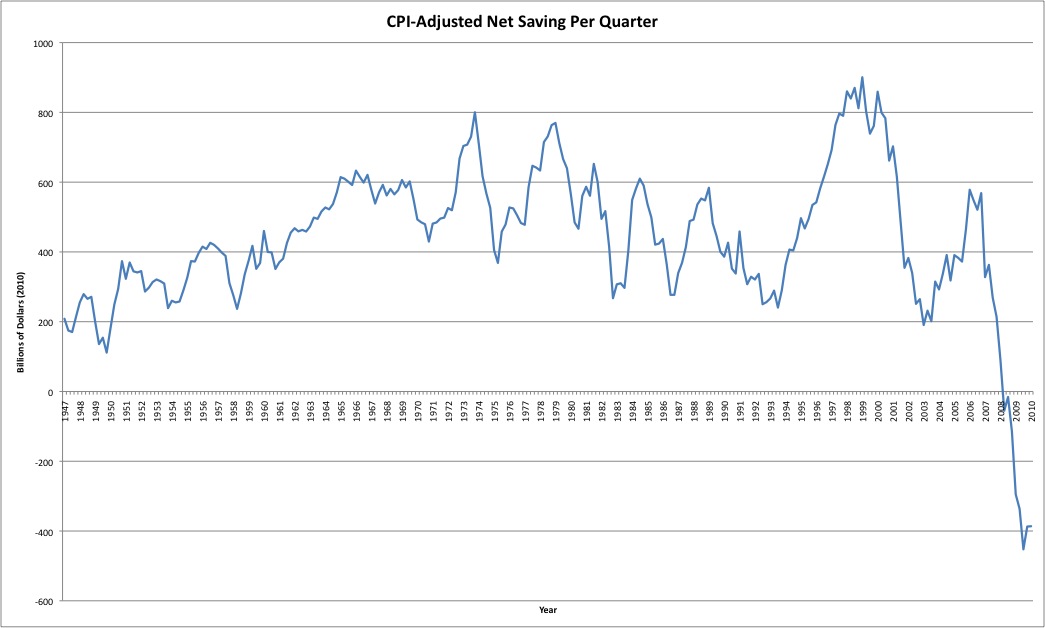
Furthermore, most individuals save. For individuals who are convinced that Americans do not save, net national savings (roughly adjusted for inflation to 2010 dollars) is depicted below (click to enlarge).
Before Professor Mankiw's idea is accepted, it must be explained why most individuals save, if individuals tomorrow are distinct entities from individuals today.  Should this be counted as charity?  Given that most save, if an individual knew that their future-self valued health at more than their now-self valued soda, they should simply have their future-self "pay" them to not drink soda by saving less--an efficient, Coaseian transfer.  Corrections conjectures that Professor Mankiw's idea is not robust to these considerations.  


Addendum: Corrections now recognizes that our point is robust even if an individual is not saving, so long as he can go into debt that his future-self must pay off. That is, the presence of savings is not even a necessary condition for Mankiw's point to collapse, as we first suggested.

Tuesday, May 11, 2010

Public housing authorities should adopt smoking ban

New Orleans Times-Picayune editorial "Public housing authorities should adopt smoking ban" (May 11th, 2010) advocates a public-housing smoking ban that is being considered by local housing authorities. However, it fails to note the Coase Theorem's input to understanding the problem of intra-household second-hand smoke.

Non-smokers living with people who smoke suffer the risks of exposure to second-hand smoke. The St. John the Baptist Parish Housing Authority wants to reduce those risks, and cut the cost of building maintenance, by banning smoking inside the agency's public properties. That's a move worth considering.

Corrections suggests that it doesn't suspect non-smokers living with people who smoke are necessarily not-well off. Specifically, we expect that any non-smokers who value a smoke-free household more than the smoker is free to pay the smoker to stop smoking in the household. Being a domestic arrangement, there are low monitoring or enforcement costs. Intra-household transfers are often present enough that every individual has an income of sorts to trade--where they may not pay in dollars, they pay through intra-household transfers, such as cooking, cleaning, television control, etc.

In this case, it appears that in all households where second-hand smoke is present, it is because the smoker values smoking more than the non-smoker values non-smoking. There does not appear to be an externality problem here. Banning smoking would seem to lower smoker's happiness, by definition more than it would increase second-hand smoker's happiness.

Saturday, March 20, 2010

Number of People Living on New York Streets Soars

New York Times article "Number of People Living on New York Streets Soars" (March 19th, 2010) fails to note the contradictory forces present when one tries to helping the homeless.

Tim Marx, the executive director of Common Ground, a nonprofit organization that provides homeless street outreach services in Brooklyn, Queens and parts of Manhattan, said he was not surprised by the increase.

“It just says that we have to keep up our efforts and intensify them,” Mr. Marx said. “The more people we have on the streets, the more they are making demands of our emergency shelter system, emergency rooms, detox centers and jails.”


The times should also note, as Corrections does here that intensifying outreach programs (subsidizing poverty in New York city limits) removes disincentives for marginal individuals to become homeless, removes incentives for the currently-homeless to change their lifestyle, and perhaps most pertinently gives incentives for the homeless to migrate to New York.

As an interesting side note, the solution to ending poverty locally would seem quite clear to Corrections: end all local welfare programs. Indeed, Corrections is surprised that the sort of Prisoner's Dilemma payoffs that local politicians face to solve their poverty program by encouraging the homeless to migrate (a localized Mariel boatlift of sorts) does not appear to take place very often.

Wednesday, February 10, 2010

Viral irrationalism

Jerusalem Post opinion "Viral irrationalism" (February 8th, 2010) reports on the failure of Jews to inoculate their children against basic diseases. It recommends required immunization, while Corrections remains uncertain as to whether or not such a requirement would be welfare-enhancing.

The Jewish community, here and in the Diaspora, is not immune to such irrationalism. Some people have been instructed by their clerics not to immunize; some have been swept up in the quagmire of medical quackery, while still others are convinced profiteering pharmaceutical companies are conspiring to promote unnecessary vaccines.


After establishing that Hasidic Jews have experienced outbreaks of mumps, the article urges required inoculation.

We urge the Health Ministry to consider requiring parents to provide a child’s pinkas hisunim – immunization record – when they register their youngsters for school. The enforcement tool would be simple: Any municipality or stream, including most of the haredi sector, which is found to admit unimmunized children, would face loss of funding from the national government.


The only reason Corrections can see that a government might get involved in required inoculation is that it represents a positive externality through herd immunity. Herd immunity is a concept in epidemiology that allows for the protection of non-inoculated individuals because enough of the herd is immune. In brief, the concept is as follows: if one person has the disease, and they give it to (on average) less than one other individual, then there will be no outbreaks. The herd is largely "immune." If they give it to (on average) more than one other individual, then there will be exponential growth in a disease and outbreaks will ensue.

So long as a society is past herd immunity thresholds, they have decreasing returns to further inoculation, in terms of herd immunity. In such a case, required inoculation can easily be seen as welfare-decreasing, especially as all other individuals have the option of becoming inoculated.

The threshold for herd immunity in mumps is approximately 80%. Israel passed that threshold in 1990. Corrections notes that among humanity's most valuable accomplishments has been the eradication of smallpox through vaccination. Vaccination has great value. However, given that the critical herd immunity threshold has been passed, allowing Jewish parents to make their own decisions about the risks of their children dying is much cheaper.

Sunday, January 31, 2010

Student1776 on "Don't Legalize Marijuana," and Response

Corrections appreciates acuminous commentary. A comment by “Student1776” was left in response to our post “Don’t Legalize Marijuana”. It was thoughtful enough to warrant its own post in response. Corrections is willing to repeat this activity for insightful commentary.

The post by Student1776 follows:

The writer of the blog makes an excellent point that the use of taxation as a means to control the extent of use. There are at least two additional pertinent elements. First, illegal status tends to constrain use differentially to areas where law is less respected or at least less effective. In the US the illegal status of marijuana or crack cocaine or other drugs tends to confine sales, distribution and to some degree consumption to ghetto areas. Making marijuana or crack cocaine legal would allow the expansion of sales and distribution to all areas - for example the suburbs - likely resulting in expanded use and an expansion of adverse social consequences both in terms of numbers of users and in terms of affecting more empowered parts of the electorate whose political pressure would doubtless be made manifest. Second, as one considers the wider principle of legalization and taxation there is a different aspect to consider. Drugs affect individuals differentially for a variety of biological and other reasons. For any given drug different people have different propensities to addiction. For example, about 6-10% of people exposed to alcohol for as little as a first exposure to several exposures will over time become addicts while 90+% of people who consume alcohol can take it or leave it. These latter people with a propensity not to be addicted are said to be able to "chip" alcohol. For opioids and tobacco the same phenomenon occurs but the number of potential addicts is larger - in a broad ballpark around 20% of people being at risk for addiction with 80% of people for example being able to use an opioid for pain for an extended period without coming to exhibit drug seeking behavior (that is to "chip" opioids or cigarettes. For amphetamine type drugs the proportion of addicts to chippers is far higher - likely on the order of 30-60% depending on the amphetamine with the number of chippers being correspondingly lower (70-40%). The point is that while marijuana has a relatively low rate of severe addictive behaviors associated with it and a high rate of chipping, other drugs are less benign. People who are addicted do continue to show some level of "rational" behavior in the sense of price responsiveness but addicts are by the nature of the disease incompletely rational. Addicts will engage in extreme and irrational activity including violence and law breaking at felony levels. The issue is that while drugs are illegal and distribution is highly restricted there are many people who are potential addicts who are simply not exposed to the addictive drug and as a consequence are able to live productive lives and not be addicted. Pricing issues might to some degree permit a similar constriction of the potential exposure of addicts but for many potential addicts not exposed at this time because of limits of distribution, their financial characteristics may allow them to surmount limitations on exposure due to pricing. It is also noted that if taxation is raised to too high a level then the taxation itself will be surmounted and we will have just created a new kind of illegality. (Not unlike the current cigarette smuggling industry). The bottom line is that the Corrections blogger is correct that taxation could be used to help control exposure, one can anticipate far wider distribution and for the highly addictive substances far higher levels of addiction and associated social damage in localities and social circles currently out of the loop of distribution.


Four points have been made that it is incumbent upon Corrections to dispute, in one form or another.

1) Illegality has differential effects on area that taxation does not have. Specifically, Student1776’s conjecture is that currently use is kept in relatively indigent areas—post legalization, it could spread to wealthier areas. This, in turn, may lead to more users, and empower “undesirable” political classes.

Concerning the first point, Corrections agrees and considered this point. However, it is important to note that there is a reason that use was constricted to indigent areas to begin with. Specifically, that these areas had low opportunity cost of both use and penalty. But it is worth noting that when the government makes something illegal, the black market has no means of writing enforceable formal contracts.

This means that in order to enforce contracts, firms use force. Firms that dominate the industry tend to be those best at wielding violence, rather than those with the most efficient methods. This, in turn, creates an industry that has a lower cost to producing violence on competing firms, consumers, and government.

Corrections posits that this helps propagate the very indigent communities that the author concerns himself with. Were these industries replaced with companies like Johnson & Johnson, Pfizer, and GlaxoSmithKline, we suspect that illegal activity such as drug-dealing, and the resultant violence, would be reduced dramatically.

This reduces transfers from wealthier communities, who will have to pay for less law enforcement, perhaps helping to empower and create more desirable political classes. Implicit in Correction’s understanding of the author’s reference to a desirable political class is one that does not depend on the Rothbardian “gang of thieves writ large,” viz., the government.

2) Drugs have differential addition rates. People who are easily addicted and were previously were not exposed to drugs will now have easy access to them. They will subsequently consume the drugs and become addicted.

Corrections does not dispute the idea that people have differential addiction rates. Indeed, it supplements the idea of differential treatment effects we expounded upon in a previous post.

We do, however, dispute the characterization that people who were previously not exposed to drugs will now have easy access to them. In the reading of Corrections, a very large proportion of the United States currently has access to crack cocaine, for instance. They may buy crack cocaine at some price. The question is in what form they pay the price. Corrections conjectures that most of the author’s potential users would pay in the form of search costs, rather than dollars. This can be translated into dollar form, of course.

Why would we assume that people who are easily addicted and have easy access to a product would become addicted? If these individuals know their propensity to become addicted, then they have the most to lose from trying before addiction. We should therefore see these very people shy away from drug use. We should expect to observe tests for whether or not someone has the propensity to become addicted. In the absence of such tests, we might expect the proper incentives to exist to develop them. In the absence of the possibility of such tests, one would expect risk-averse consumers to shy away from the product in general, as large swaths of the non-chipping population likely do for readily available drugs such as crack cocaine.

Whether or not one accepts this previous point, the first point remains: translate search costs into tax costs and it would appear the same costs from suburban individual’s point of view.

We might add that addictive substances such as crack cocaine were a technological advancement on cocaine. It allowed for small cheap, unobtrusive, mass distribution in a way cocaine did not, a point lifted from Roland Fryer, Paul Heaton, Steven Levitt, and Kevin Murphy’s 2005 NBER working paper “Measuring the Impact of Crack Cocaine.” It is not immediately clear whether or not this phenomenally destructive drug would have been as prevalent as it was were cocaine itself not illegal. On the one hand, cocaine is an input into crack cocaine production. On the other hand, cocaine is a substitute to crack cocaine itself, one whose competitive availability is likely increased much more than crack cocaine’s, in light of crack’s popularity being in part due to cocaine’s inefficient illegal distribution system.

3) Student1776 conjectures “People who are addicted do continue to show some level of "rational" behavior in the sense of price responsiveness but addicts are by the nature of the disease incompletely rational. Addicts will engage in extreme and irrational activity including violence and law breaking at felony levels.”

Corrections does not see violence and law breaking at felony levels as an irrational behavior. Take, for example, Lawrence Katz, Steven Levitt, and Ellen Shustorovich’s 2003 American Law and Economics Review article “Prison Conditions, Capital Punishment, and Deterrence”. The homicide rate within a state is negatively impacted by higher within-prison death rates (from murders, illness and AIDs, poor conditions). Indeed, the impact of one additional prison death ranged from -0.1 to -0.8 fewer homicides across the author’s specifications.

Murder, rape, robbery, aggravated assault with a firearm, and burglary of residence are not excluded from the list of crimes for which sentence enhancements significantly change behavior. Daniel Kessler and Steven Levitt found, in their 1999 Journal of Law and Economics article “Using Sentence Enhancements to Distinguish between Deterrence and Incapacitation” that those crimes declined by four percent more than California’s non-enhanced crimes, compared to the difference in decline of the same crimes in other states (without sentence enhancements) and their comparable crimes (a difference-in-difference-in-difference model).

To use the same author a third time, in the Journal of Political Economy (1998) Steven Levitt’s paper “Juvenile Crime and Punishment” shows that not only are juveniles likely deterred by differential sentences, but that an increase in the relative punitiveness of adult crimes compared to juvenile crimes causes decreases in crime when juveniles reach the age of majority. This comparison, comparable to a regression discontinuity comparison, indicates that juveniles around the age of majority appear to be making their criminal decisions based on sentences—-another rational act.

Corrections sees criminals as behaving rationally—-if not during their crimes (say, during a drug-induced state), then in the decisions leading up to the crime (the decision to become intoxicated).

4) It is also noted that if taxation is raised to too high a level then the taxation itself will be surmounted and we will have just created a new kind of illegality. (Not unlike the current cigarette smuggling industry).

Corrections concurs. We see the result as only a partial privatization. If this is the case, then at the limit legality will change nothing because the tax will be too high and the market will remain a black market. In reality, Corrections expects that a portion of the market will be legal and taxed. To take the author’s example, we posit that New York spends vastly less on enforcement and gains vastly more revenue from cigarettes by making them legal and taxing them than it would by making them illegal and paying to enforce the law (rather than be paid).

Friday, January 1, 2010

Congress should bench the BCS

Los Angeles Times opinion editorial "Congress should bench the BCS" (January 1st, 2010) cavils at the NCAA's Bowl Championship Series, advocating its demise in the place of a national championship game. Atypically, the author admits his motivation for his support of Federal meddling is not borne of any concern for legitimacy for the NCAA but for his desire for revenue equity among colleges.

I say this because the Bowl Championship Series fronts for a mammoth fraud that threatens the very foundation of public higher education. College football is a billion-dollar business, but one in which the benefits go to the few while most of the schools are awash in debt. These were the sobering conclusions of the Knight Commission on Intercollegiate Athletics. Its report in October stated that the 25 top football schools had surpluses, on average, of $3.9 million in 2008. The other 94 schools in the top division ran deficits averaging $9.9 million each. 'We've reached an indefensible, unsustainable situation,' said commission co-chairman William Kirwan. 'We've got 75% of the [college] presidents saying we cannot continue on this path.'

Relevantly, the author also takes issue with high head coach salaries:

The commission also noted that head football coaches at state colleges are often the highest-paid public employees. This year's BCS national championship coaches are Nick Saban of Alabama, who has a $32-million, eight-year contract, and Mack Brown of Texas, who just received a $2-million-a-year raise, for an annual salary of $5 million, until the end of his contract in 2016.

This is an improper accounting and complaint for seven reasons.  First, even if there is "destructive" competition over inputs like coaches, we may not expect this to impact full revenue for schools.  Second, it is clear the NCAA is competing with the NFL for coaching assets.  Third, the increased competition is indeed benefitting someone. Fourth, it is unclear if increased competition gets larger donations. Fifth, it is unclear whether or not athletics programs should be expected to lose money. Sixth, concerns over money losses are diminished under beliefs about free entry and exit.  Seventh, there is nothing preventing the NCAA from fixing the BCS if it is not maximizing revenues.

The most significant error individuals who bemoan "destructive" competition make is to observe "over" competition. Take a matching market. Men may prefer taller women, let's assume a fortiori men care about height relative to their peers. It may be in the interest of women, therefore, to wear painful high heels. However, one notes that if all women wear high heels, they maintain the same relative height and gain nothing. However, it is unclear if women are worse off for this higher level of competition. It may simply be that they are able to extract compensatory income from their match. This is true of "overcompetition" in college athletics departments with state, alumni, and corporate donors. The principle of how destructive competition might not actually harm state departments is displayed graphically below (click to enlarge).

In the above diagram, we see that even though marginal costs have increased, economic profits stay zero (average cost of making goods is equal to the price).  Firms pass on the costs to consumers.  Just as firms pass on marginal competition costs to consumers, and women may pass on the cost of high heels to their mates, so too might universities pass on the cost of athletics programs to alumni donors, state supporters, and athletic event attendees.

Second, and perhaps more importantly, it is unlikely that college sports are living the a "relative" world above.  If they were competing for a fixed number of coaches, that might be the case.  But a substitute job for college football coaches has often been professional football.  A number of coaches have moved back and forth.  For all the NFL head coaches in 2007, whose careers we display graphically below (click to enlarge) we see that a number cross back and forth between College and Professional Football coaching, denoted by blue squares and red squares respectively (click to enlarge the legend).  The higher the level within color, the higher the position (broken up into assistants, position coaches, coordinators, and head coaches).


The above graph, which traced only the path of head coaches, does not necessarily fully represent the crossover between the NFL and the NCAA.  One can imagine a graph of all head coaches in the NCAA would provide a number of resumes with NFL experience (like Nick Saban, Alabama head coach and former head coach of the Miami Dolphins).  Nonetheless, the graph is adequate to give evidence for competition between the NCAA and NFL.  In this case, there appears little reason why reforming the BCS should change the cost of inputs.

Third, one might expect that quality college football programs provide positive consumer surplus to a state populace in a manner too difficult to extract and with high fixed cost (a good which would be supplied privately under a situation allowing perfect discrimination).  This situation is depicted graphically below (click to enlarge).


Fourth, it is important to note that the Knight Commission is unable to properly calculate the real amount of revenue due to college athletics departments. Take T. Boone Pickens's cumulative donations of $400 million to Oklahoma State University, $265 million of which was directed specifically towards athletics. It is unclear how large a gift would have been given if OSU had not athletic department (or a smaller one).

Fifth, were High Schools to use a similar revenue-generation criteria of determining the success of athletics departments, the vast majority of High School athletics would collapse.  It may be that revenue is not the relevant manner in which to judge athletics programs.  Increases in school spirit, socialization, and other vectors other than revenue may justify spending money on them.

Sixth, the author's concern about school losses doesn't make an enormous amount of sense to Corrections.  The University of Chicago withdrew from Division I sports in 1946.  Northeastern dropped its football program last November, 2009, and Western Washington University did the same in January 2009.  There exists free entry and exit into these ostensibly money-losing sports.

Finally, if there are revenue concerns, there appears nothing to prevent the NCAA from changing the BCS freely.  The formation of a cartel would appear to be quite easy, as monitoring is easy and production of a game requires two defectors.

Thursday, December 31, 2009

Judges Consider New Factor at Sentencing: Military Service

Wall Street Journal editorial "Judges Consider New Factor at Sentencing: Military Service" (December 31st, 2009) waves its hands at, but fails to actually observe any externalities in military service that require the parallel justice system it describes. Specifically, it notes that military veterans coming back from foreign deployment have received special judicial treatment in light of their service.

As more soldiers return home from combat overseas and end up in the criminal-justice system, a number of state and federal judges are deciding to show former soldiers leniency in light of their service. Some veterans are receiving probation coupled with psychological treatment, generally for nonviolent crimes that normally would land them in prison.

The article gives an example of one judge's reasoning:

'We dump all kinds of money to get soldiers over there and train them to kill, but we don't do anything to reintegrate them into our society,' says John L. Kane, a federal judge in Denver. Earlier this month, Mr. Kane sentenced an Iraq war veteran convicted of bribery to probation instead of prison.

Yet Judge Kane's argument does not appear to have sound foundations, in the understanding of Corrections. The United States has a volunteer army. Individuals who sign up are doing so because the total discounted lifetime path of wages (cognitive and monetary) are higher than their next best alternative. If they were not, individuals would choose their "next best" (contradictorily, their best) alternative.

If the cost of joining the army, including the probability an individual survives, breaks down psychologically and commits crimes upon their return is too high, individuals will opt out of military service. They will do so until wages are increased or the future costs that cause them to commit crimes are decreased. This is the proper market solution to unfortunate military conditions. If military service is unattractive and unfortunate, fix it through wages, rather than through fringe benefits, like reducing disincentives on producing negative externalities to others (crime), an unsound economic proposition.

Individuals who perform military service are paid in a variety of ways. The public honors them as protectors of freedom. They are paid a wage. They gain fringe benefits through discriminatory governmental hiring practices. The military should make sure it is paying in the most efficient manner, and it is by no means clear that removing disincentives from criminal activity is welfare-enhancing.

The only case in which offering these fringe benefits to soldiers makes sense to Corrections is if ex ante the military has difficulty predicting the single individual of many to pay higher wages in the form of a light sentence, and ex post it can identify them, that the value of this benefit is high, and the moral hazard it poses is low, an unconvincing conjecture.

One might add that there could simply be sample selection in sentencing. Individuals with military service might be less prone to recidivism, incarcerating them less effective, and lighter sentences may be efficient. The article does not address this, though Corrections sees it as a possibility.

Sunday, December 20, 2009

U.S. food stamp chief wants California to boost use

Reuters article "U.S. food stamp chief wants California to boost use" (December 18th, 2009) falsely supposes that a welfare-based program will improve total utility. Discussing the need for California to recruit more of its eligible federal food-stamp programs, the article includes the following quote from a nutrition analyst:
'There are economic benefits for everyone, for the entire state, if we increase participation [in the federal food stamp program]'
Likely, however, the economic benefits do not outweigh the economic costs for both citizens of the state and for the state.  Notably, a federal program providing subsidized food gets its funding from all US citizens (including Californians), and so increased participation anywhere only costs most Californians.  In addition, the state can easily be made worse off.  By subsidizing people who do not work, food stamp programs magnify the benefit to California citizens of remaining unemployed.  If the labor force is very responsive to changes in wages (or changes in non-labor payment, like welfare), then it is possible that enough people will stay out of California's labor force (at least in the short-run) to depress state tax revenues, as graphically depicted below (click to enlarge).  Californians working and paying taxes have a positive externality to all other Californians, and labor is inefficiently undersupplied as it is.  Placing a negative implicit tax on not working moves Californians further from an optimal equilibrium.


Saturday, December 19, 2009

Not All Drugs Are the Same After All

New York Times article "Not All Drugs Are the Same After All" (December 18th, 2009) offers no economic scrutiny to the complex issue of pharmaceuticals.

Let me start by saying I’m a fan of generic drugs. They save Americans billions of dollars each year and give us access to wonderful drugs at affordable prices. I’ve recommended generics in this column many times and use them myself when possible.

The author goes on to speak on the nature of generics and how they may be inferior to the real thing. What the article does not note is two interesting ways in which generics, chemically-equivalent entities, and brand-name drugs interact.

Monopolies are inefficient, and create deadweight loss. Society grants monopolies to pharmaceutical companies to induce them to research and create new products, which create social benefit, both when the monopoly exists and when the patent runs out; competition from generics runs profit down to zero on a drug and society alone gets the full benefit of the new drug. Traditionally, there is a tradeoff between protracting the life of a patent, which encourages research and development, and shortening the life of a patent, which increases social gain for the drugs that are created. Society balances the positive externalities of research with negative externalities of monopoly.

Therefore, as it is unclear whether or not we are at an efficient patent life of twenty years, it is further unclear whether or not generics are "saving" consumers money off drugs that never exist--harming their welfare. However, elasticity of supply increases as time lengthens--after a matter of years, possibly before the patent ends, a drug can face competition from chemically-equivalent compounds. Compounds that are similar, and free-ride off a drug's preexistent research and development, but are different enough that they do not fall under a patent.

If this is the case, then a pharmaceutical firm might see monopoly profits for a matter of years, let's say seven, at which point chemically-equivalent companies compete and drive down profits for the next thirteen, at which time profits are driven down to zero. It may be the case that shortening a patent life increases profits. Were a patent life ten years, then it is possible chemically-equivalent companies would not find their thirteen years of limited competition to be profitable enough to enter an industry, and a pharmaceutical company would gain ten years of monopoly profit, rather than seven, at which point its profits would go to zero.  This scenario is depicted graphically below (click to enlarge).


Additionally, we note that generics may not save certain Americans money. Let us say that, as the article notes, generic drugs are inferior to their brand-name counterparts. Then it may be possible competition for generics makes prices increase, rather than decrease. The reason this is possible is if there exists a heterogeneous population, for which there are inelastic demanders and elastic demanders. Before generic competition elastic demanders are setting the price of a drug, and their quantity is worth a price tradeoff for the firm. When generics are introduced, elastic demanders shift to generics, while inelastic demanders are now the marginal consumers, at which point it is profit maximizing for a pharmaceutical company to raise the price of a good. It is apropos to note that profits will unambiguously decrease for the firm, as quantity will be reduced more than price is increased (otherwise a profit-maximizing monopoly would have reduced price earlier.)  This is depicted graphically below (click to enlarge).


Thursday, December 17, 2009

De-Criminalizing Children

New York Times editorial "De-Criminalizing Children" (December 16th, 2009) does not adequately make the point that there exist two risks when making the decision to imprison juveniles in juvenile detention facilities or adult jails.

When [the U.S Congress] reauthorizes the [Juvenile Justice Delinquency and Prevention Act of 1974] — it is already three years late — Congress should make it illegal for states to place children in adult prisons, perhaps with the exception of truly heinous criminals.

The Times bases its credenda on the belief that adult prisons have a dysgenic effect on youth imprisoned there. However, it is important to note that these marginal individuals, presumably more degenerate than the average individual in the juvenile justice system while more degenerate than the average individual in an adult prison, have their own negative effect on juveniles.

The Times may implicitly recognize this while neglecting it, evidenced by the last portion of their quoted statement.

If the objective is one of minimizing some function of crime and expenditure, we must recognize marginal juveniles may be subject to an adult externality, but the alternative is to expose other juveniles to their own--a balancing act must be made, rather than a universal condemnation.

Monday, December 14, 2009

Video poker? Not here.

Chicago Tribune article "Video poker? Not here." (December 14th, 2009) submits legalized gambling to an auto-de-fé. The Illinois legislature has passed a law enabling legalized video poker machines. A portion of the revenue generated by these machines is transferred to the state. The Chicago Tribune vociferously objects:

If your county or community is on the first of these two lists, congratulations. Your local officials have "opted out" of legalized video gambling. They have declared their disgust with the Illinois legislature's decision to bankroll a $31 billion capital improvements bill in part by luring more people into neighborhood gambling. These communities have said: Go somewhere else.

If your county or community isn't on the first list, get cracking.

It is a herculean task to describe the foolishness this represents. Six powerful economic arguments for legalizing video gambling abound. First, and foremost, individuals should be free to choose. Second, even if gambling is addictive, individuals still make rational decisions. Third, when utility is concave, even taking unfair bets can be a rational decision. Fourth, if even unfair bets are in the interest of multiple individuals, they will likely provide gambles privately. Fifth, the creation of another good to tax decreases deadweight loss for all other objects, on average. Sixth, if all other districts ban gambling, and a significant number of individuals from other counties are willing to travel to gamble in mine, it is in my interest to provide gambling to other districts.

The first argument, that individuals should be free to choose, should not need explanation. As a matter of conditional probability, the chances that a government has decided to limit an individual's liberties for his own good, and is correct in its conjecture, is miniscule compared to the chance that it is doing so for the narrow, personal incentives of legislators, or that it is incompetent in execution, even if well-meaning.

The second point, that gambling may be addictive but should still be legal, is more interesting. Following the earlier argument in Corrections, there is ample evidence that individuals are rational in their decisions, even about addictive goods.

The third point, that individuals are able to accept even unfair gambles is best depicted graphically below (click to enlarge). If they find themselves at a spot where there is local convexity, expected utility from a gamble is greater than expected utility without that gamble. Our fourth point, related to this, is that if we take away efficient private means of redistributing wealth efficiently, individuals will provide them, under the conditions that they are able to match with one another properly and able to provide bets with sufficiently cheap overhead, which it seems apparent they would be able to do.


We turn to the fifth point: the "creation" of a new, taxed good decreases existing deadweight loss (the amount of possible economic gain that disappears in the face of taxation) on average. This point is a subtle one, an idea that will likely be entertained in more depth in a later article. The idea behind this is the same lessons as one gains from the Ramsey Tax problem: if one can, one wants to tax every good at an equal percentage--given that one cannot, one wishes to tax the most inelastic goods. This new good decreases deadweight loss from all other goods, which all have increasing marginal deadweight loss, while creating its own (which starts at a smaller base for its increasing marginal deadweight loss). Additionally, presuming video poker is as addictive as many detractors would claim, the deadweight loss from taxing it is minimal, and such a tax decreases the deadweight loss for other goods.

Sixth and finally, if all or most other localities have successfully banned gambling in their districts, then it is in one's own localities interest to legalize video poker, provided that a large enough number of individuals from foreign localities put a sufficient amount of their money in local businesses for a locality to recoup whatever moral deracination that occurs from allowing the travesty that is video poker to exist.

Thursday, December 10, 2009

Swine flu has hit about 1 in 6 Americans, CDC says

Los Angeles Times article "Swine flu has hit about 1 in 6 Americans, CDC says" (December 10th, 2009) neglects to mention a curiosity in mathematical epidemiology that appears to have been under-looked in our Swine Flu vaccination push.

At least 50 million Americans had contracted pandemic H1N1 influenza through Nov. 14, according to the newest estimates from the Centers for Disease Control and Prevention released today -- meaning that about 15% of the entire country has been infected, about one in every six people.

And

Swine flu vaccine supplies continue to grow, he said. There are now 85 million doses available, up by 12 million from last week. As supplies have continued to increase, many communities have begun to expand eligibility requirements for the vaccine to include the population at large.

Given the ever-present reminder of H1N1's potential for mutation, it is not apparent that vaccination is beneficial. While vaccination, elimination, and eradication contains massively monetarily valuable pursuits, when a vaccination supply does not outstrip the number of vaccinations required for herd immunity, then all vaccination does is to slow infection. More generations of a virus are visited upon a population, and the costs of delaying may be greater than what is essentially a rapid (but costly) "vaccination" system.

Tuesday, December 1, 2009

Aurora neighbors buy golf course to preserve their view

Denver Post article "Aurora neighbors buy golf course to preserve their view" (December 1st, 2009) offers a curious possibility concerning discrimination that was not reported upon. It is merely a hypothetical possibility to be noted, (given a severely flawed media), rather than a reporting mistake per se.

As of today, residents of homes surrounding Heather Ridge Country Club can stop worrying that their scenic golf course will be turned into condominiums and high-rise apartments.

Three years after forming a special district to preserve the view, residents will take ownership of the golf course on East Iliff Avenue near Interstate 225. The group purchased the 90-acre golf course for $3.1 million and plans to spend another $1.5 million on improvements.

The article further notes the cost:
The 1,127 homeowners who now line the course will pay about $35 a month in taxes for bonds that are structured to be paid off in 30 years, although district members expect them to be paid off much sooner.

What better way to discriminate, if you live in an area that was, according to the 2000 Census, around 88% white, surrounded by an area that was 57% white? When the median household income for your census tract in 1999 was $40,907, this purchase of a golf course represents a 1% tax on income per year for those who don't value a golf course at anything.

If nonwhites don't particularly care for golf, then this is, hypothetically, a thoughtful way to discriminate and segregate.

Friday, November 27, 2009

Obesity is a growing problem in Ohio, with real consequences and real costs

Plain Dealer opinion editorial "Obesity is a growing problem in Ohio, with real consequences and real costs" (November 27th, 2009)  offers terrible solutions to the potential non-problem of obesity.  Concerned with obesity in Ohio, the article argues for state programs:

Ohio's lawmakers are pondering ways to help their constituents, young and old, get into better shape and avoid weighty problems in the future.  One way would be to see that young people, especially, are served healthy food.
State support for programs that grow fresh fruit and vegetables in urban garden plots for consumption from urban plates would be especially helpful.  So would banning soft drinks from schools and a return to state-mandated physical education.

Individuals are choosing to do what is best for them.  What are possible market failures?  These will occur if individuals choosing to eat junk food are not considering the full repercussions of their actions.  Likely, monopolies on junk food or other sources of imperfect information are not problems for the obese--they are inundated with health information every day.  Are there externalities to being fat?  There may be two negative externalities: the first, that obese people may cause negative externalities to people who see them on the street, the second is that obese people may cost thin people more money by receiving benefits from government health programs.  We'll assume the former isn't a serious problem, and entertain the second.  Suppose obesity has this negative externality.  What is the best solution?

The article appears to favor a subsidy on healthy food, revenue for which must be generated from a tax on another good, creating two possible deadweight losses--one from the tax, the other from the subsidy.

The efficient solution to the second would seem to be a Coaseian solution--to privatize the problem.  A Pigouvian tax on unhealthy foods falls inefficiently on the obese and the fit.  A Coaseian fix, declaring that individual health problems brought on by obesity are to be paid for by the individuals causing the externality (the obese), would be more appropriate.