Continuing with our previous mention of the spanish flu, Douglas Almond has a remarkable paper conjecturing that there were long-term negative effects of being exposed to the 1918 Spanish Flu in utero. The paper is titled "Is the 1918 Influenza Pandemic Over? Exposure in the Post-1940 U.S. Population" (JPE 2006)
Disability rates jump for that quarter and the three proceeding from it 62 years after the flu ended (click to enlarge).
Educational achievement jumps down for that single quarter of birth (click to enlarge).
Showing posts with label Identification. Show all posts
Monday, May 23, 2011
Wednesday, September 29, 2010
Told to Eat Its Vegetables, America Orders Fries
New York Times article "Told to Eat Its Vegetables, America Orders Fries" (September 24th, 2010) gives potentially misleading statistics about vegetable-consumption in the United States and fails to tell a cohesive story about the incentives for healthy eating.
Even if we believe that the population of restaurant goers is unchanged, some meals eaten out would not have been eaten out in 1989 because the number of meals eaten away from home has increased. According to a 1999 study in the Family Economics and Nutrition Review, titled "Contribution of Away-From-Home Foods to American Diet Quality" (available here), between 1989 and 1995, the percentage of meals eaten away from home increased by five percentage points (more than 20%) even though the number of meals eaten daily was unchanged. A graph of the trend is included below (click here to enlarge).
To its credit, the article makes some note of the difference between consumption trends in different demographic groups. What is missing is a solid economic interpretation.
At restaurants, salads ordered as a main course at either lunch or dinner dropped by half since 1989, to a mere 5 percent, he said.The profile of diners has changed significantly since 1989, making the average number of salads ordered at restaurants incomparable over time. This is because among modern diners, those who would have ordered salad if they were transported to 1989 may continue to order salad, making the mean number of salads ordered among this group constant between 1989 and 2010. However, this group does not include all restaurant go-ers. Some people who eat out today may not have done so in 1989.
Even if we believe that the population of restaurant goers is unchanged, some meals eaten out would not have been eaten out in 1989 because the number of meals eaten away from home has increased. According to a 1999 study in the Family Economics and Nutrition Review, titled "Contribution of Away-From-Home Foods to American Diet Quality" (available here), between 1989 and 1995, the percentage of meals eaten away from home increased by five percentage points (more than 20%) even though the number of meals eaten daily was unchanged. A graph of the trend is included below (click here to enlarge).
To its credit, the article makes some note of the difference between consumption trends in different demographic groups. What is missing is a solid economic interpretation.
To be sure, vegetables are making strides in certain circles. Women, as well as people who are older and more educated and have higher incomes, tend to eat more vegetables, said Dr. Foltz, the pediatrician who worked on the C.D.C. report.Vegetables are commodities that cost a great deal in the short-run, but pay off in the long-run. We can think of the true price of vegetables as lower than the market price, since they make people richer in terms of health. Because the length of life (and productivity) is a function of health, avoiding vegetables costs those who make higher wages more (they lose more lifetime income by dying early from unhealthy eating). So, the total price of vegetables is lower for the wealthy than the poor, even though the market price is the same. We can also expect that health is a stronger determinant of life-span in later years, so the elderly, as well as women (who live longer than men on average) can be expected to consume more vegetables.
Wednesday, September 22, 2010
Bridging the achievement gap
Los Angeles Times opinion editorial "Bridging the achievement gap" (September 22nd, 2010) discusses the achievement gap between black males and all other students (black females and white males being the primary groups of comparison). It speaks only of educational means to fix the graduation gap, while discussing crime. Corrections would like to entertain a different possibility that might help solve both. The Times also confuses correlation and causation.
The Times suggests that some of these students might be on the "prison track." "All too often they're on what educators privately dub 'the prison track.'"
If the Times is concerned that black males (or, for that matter, individuals of any race or gender) are opting out of educations and into lives of crime, one way of reducing their involvement in crime and increasing their graduation rates might be to lower their future wages as criminals.
We do a quick back-of-the-envelope calculation to test this hypothesis. We should see a correlation between an increase in law enforcement officers tomorrow and an increase in graduation rates. For the 50 states from 1998-2003, we plot the two, and offer a fitted least squares line. This is displayed graphically below (click to enlarge).
The relationship is indeed positive, which is itself phenomenal. If high schoolers were myopic and unresponsive to future police presence, we would have expected a drop in graduation rates to result in an increase in police next period--an increase in bad high school students should make more police next period a necessity. The fact that we see this indicates that the difference between our two effects is rather large. At a first glance, while the relationship is only near significant, it would appear tantalizing. For those concerned about the outliers, the relationship remains positive dropping them from a fixed effects panel data regression.
Beyond this discussion of heterogeneous impacts by race of an increase in future police presence on future crime and graduation rates, we might also add a particularly offensive quote by the Times:
These disparities aren't new — the Schott report could have been published a generation ago. What is new and noteworthy is solid evidence that this gap can be bridged, with well-tested approaches that don't require massive changes in public education and don't depend on superhero teachers and administrators.An economic idea might be that individuals, both black and white, make decisions about education today based on what they believe their income differentials will be tomorrow. One way to encourage education is to ensure higher wages for the educated. Another is to ensure lower wages for the uneducated.
The Times suggests that some of these students might be on the "prison track." "All too often they're on what educators privately dub 'the prison track.'"
If the Times is concerned that black males (or, for that matter, individuals of any race or gender) are opting out of educations and into lives of crime, one way of reducing their involvement in crime and increasing their graduation rates might be to lower their future wages as criminals.
We do a quick back-of-the-envelope calculation to test this hypothesis. We should see a correlation between an increase in law enforcement officers tomorrow and an increase in graduation rates. For the 50 states from 1998-2003, we plot the two, and offer a fitted least squares line. This is displayed graphically below (click to enlarge).
The relationship is indeed positive, which is itself phenomenal. If high schoolers were myopic and unresponsive to future police presence, we would have expected a drop in graduation rates to result in an increase in police next period--an increase in bad high school students should make more police next period a necessity. The fact that we see this indicates that the difference between our two effects is rather large. At a first glance, while the relationship is only near significant, it would appear tantalizing. For those concerned about the outliers, the relationship remains positive dropping them from a fixed effects panel data regression.The Times discusses young black males, their graduation rates, and crime. Following our above analysis, we might think that a way to increase the graduation rates of young black males (who head into crime at higher rates than young white men or young black women) might be to decrease their wage differential between crime and legitimate employment through the hiring of more law enforcement officials over the course of several years. This would have the added effect of decreasing crime. Indeed, if individuals are forward looking and we have a believable commitment mechanism, we needn't wait to see the effects.
Clearly the analysis Corrections provides is both preliminary and inconclusive--it is merely suggestive. Nevertheless, it offers an interesting avenue to improve education by rational forward-looking individuals of all races and genders.
Beyond this discussion of heterogeneous impacts by race of an increase in future police presence on future crime and graduation rates, we might also add a particularly offensive quote by the Times:
A large-scale study in Chicago found that 74% of the boys who attended preschool graduated from high school, compared with 57% of those who didn't.This is a correlation. It is not clearly causal.
Saturday, September 4, 2010
After Bargains of Recession, Air Fares Soar
New York Times article "After Bargains of Recession, Air Fares Soar" (September 4th, 2010) ignores the global phenomenon in air fares to concentrate on the recent.
It rather seems a joke, considering airline companies costs have gone down, low-cost carriers have become more prevalent, tickets have become competitive due to the internet, nonstop tickets are more common. When efficiency rises, marginal costs go down, quantity rises, and profits fall, it's difficult for consumers not to be massively better off (consumers that aren't New York Times consumers should be neutral when it comes to competitive profits--the reason they're relevant here is because when efficiency rises, overall surplus increases--if profits haven't risen, we know consumers have received all of the increased surplus).
Below, Corrections graphs out a way to indicate three stylized facts from Berry and Jia: prices fall, elasticity of demand increases, supply increases, and quantity supplied increases (click to enlarge). This is not the only way to depict these facts, and these are not the only facts from the paper, but they are suggestive enough that a first pass analysis seems to completely identify the direction of consumer surplus (coloring from blue to red, it unambiguously increases).
The increase in fares is the result of a remarkable discipline shown by the airlines, which have generally not added more flights this year even as the economy has improved and demand has picked up. For the airlines, flying fewer and fuller planes has paid off.Steven Berry and Panle Jia examine the changes in air fare demand between 1999 and 2006, finding in their recent article "Tracing the Woes: An Empirical Analysis of the Airline Industry" in American Economic Journal: Microeconomics (ungated working paper) (gated published), that, quoting their abstract:
Passengers are paying the price. For leisure travelers, domestic fares have increased by more than 20 percent in the second quarter compared with a year earlier, according to data compiled by the travel Web site Orbitz.
Compared with 1999, we find that, in 2006, air-travel demand was 8 percent more price sensitive, passengers displayed a stronger preference for nonstop flights, and changes in marginal cost significantly favored nonstop flights. Together with the expansion of low-cost carriers, they explain more than 80 percent of legacy carriers' variable profit reduction.This analysis (identified with BLP assumptions) occurred on a span of time before the recession pushed down further prices. As its its wont as the flagship of the left, the New York Times then turns around as soon as prices rise after declining for a dozen years and uses weasel words to describe Airline executives: "Airline executives have since been preaching the need to reduce the number of seats they offer."
It rather seems a joke, considering airline companies costs have gone down, low-cost carriers have become more prevalent, tickets have become competitive due to the internet, nonstop tickets are more common. When efficiency rises, marginal costs go down, quantity rises, and profits fall, it's difficult for consumers not to be massively better off (consumers that aren't New York Times consumers should be neutral when it comes to competitive profits--the reason they're relevant here is because when efficiency rises, overall surplus increases--if profits haven't risen, we know consumers have received all of the increased surplus).
Below, Corrections graphs out a way to indicate three stylized facts from Berry and Jia: prices fall, elasticity of demand increases, supply increases, and quantity supplied increases (click to enlarge). This is not the only way to depict these facts, and these are not the only facts from the paper, but they are suggestive enough that a first pass analysis seems to completely identify the direction of consumer surplus (coloring from blue to red, it unambiguously increases).
Friday, September 3, 2010
Enabling prostitution
Philadelphia Inquirer editorial "Enabling Prostitution" (09/03/2010) discusses prostitution in a misinformed manner. It further does not appropriately analyze counterfactual scenarios.
It is the case that forced prostitution is present in the United States. However, it is by no means clear that either a significant portion of prostitution is forced, nor that the level of forced prostitution would decrease when the difficulty of prostitution increases.
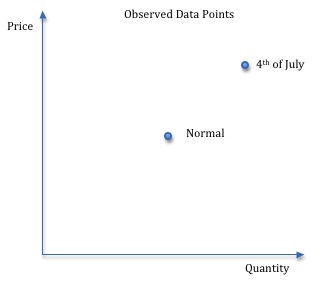
On the first point, we can take a recent empirical study on prostitution that requests no citation (citation will be given when the paper is published). What it indicates, however, is that there is a 63% increase in the number of tricks done on the 4th of July weekend. Forty-three percent of that apparently comes from full-time prostitutes. The other 20% comes from 4th-of-July-only prostitutes, part-time prostitutes that only come in because of the $11 average price increase. To Corrections, this sort of short-term supply elasticity, a vast reservoir that enters the market for one weekend only indicates voluntary prostitution.
If we assume that the 4th of July comes solely from a demand shock, that the fundamentals of supply remain the same, and approximating with linearity then we can identify the supply change (this is the source of the supply increase identification).
Below, we depict the pure data:

Here, we take the same data and add supply and demand lines, based on the idea that the 4th of July represents a demand shock:

On the second point, if we think that forced prostitutes are an inferior input into the production of prostitution, then enabling prostitution, causing an increase in the quantity supplied, will reduce their use in prostitution. The same concept might be applied to manual labor in manufacturing computers. It is likely that an increase from one computer demanded a year to several thousand would cause manual labor to all but disappear. So too with forced prostitution--cheapening the cost of supplying prostitution is likely to compete forced prostitution out of business.
Some misguided observers of this debate actually believe there's nothing wrong with adults offering sex for money online. They ignore the fact that prostitution often involves other dangerous crimes, including robbery and assault. And sometimes these ads facilitate the illegal sex trafficking of women or girls who are being held against their will.
It is the case that forced prostitution is present in the United States. However, it is by no means clear that either a significant portion of prostitution is forced, nor that the level of forced prostitution would decrease when the difficulty of prostitution increases.
On the first point, we can take a recent empirical study on prostitution that requests no citation (citation will be given when the paper is published). What it indicates, however, is that there is a 63% increase in the number of tricks done on the 4th of July weekend. Forty-three percent of that apparently comes from full-time prostitutes. The other 20% comes from 4th-of-July-only prostitutes, part-time prostitutes that only come in because of the $11 average price increase. To Corrections, this sort of short-term supply elasticity, a vast reservoir that enters the market for one weekend only indicates voluntary prostitution.
If we assume that the 4th of July comes solely from a demand shock, that the fundamentals of supply remain the same, and approximating with linearity then we can identify the supply change (this is the source of the supply increase identification).
Below, we depict the pure data:

Here, we take the same data and add supply and demand lines, based on the idea that the 4th of July represents a demand shock:

On the second point, if we think that forced prostitutes are an inferior input into the production of prostitution, then enabling prostitution, causing an increase in the quantity supplied, will reduce their use in prostitution. The same concept might be applied to manual labor in manufacturing computers. It is likely that an increase from one computer demanded a year to several thousand would cause manual labor to all but disappear. So too with forced prostitution--cheapening the cost of supplying prostitution is likely to compete forced prostitution out of business.
Thursday, August 19, 2010
Academic Bankruptcy
New York Times OpEd "Academic Bankruptcy" (August 14th, 2010) makes the argument that colleges are spending too much, without really considering the economic landscape for such institutions.
The article continues, mustering projections for future tuition without considering the forces at work:
The "paying customers" of a college are its students. As the figures below make clear, college enrollment has continued to increase over time (click to enlarge 1, 2).
Given the acknowledged increase in the price of tuition, and the increase in the amount of college degrees purchased, we can conclude with certainty that demand for education has been increasing over time, as supply-and-demand are partially identified.
In addition, a high tuition price does not make education "unaffordable." When students see that the returns to skill are high (that education is valuable), they can borrow against their future earnings until it is not worthwhile to do so. What determines the price of education? In a human capital model (rather than a signaling model), the price of education will be equal to the value of the increase in productivity it provides students. This increase is determined largely by faculty quality. While talented faculty are scarce, but provide students with a high increase in productivity, the price of tuition will remain high.
Nothing in the article ties the price of education with increases in the productivity of students. If students see that they are not learning anything, and so realize that their future wages will not increase enough to justify tuition, they will not attend college. An aggregation of such decisions will decrease the demand for education and cause tuition to fall.
Rather than learning to live within their means, Columbia University, where I teach, and New York University are engaged in a fierce competition to expand as widely and quickly as possible.
The article continues, mustering projections for future tuition without considering the forces at work:
With unemployment soaring, higher education has never been more important to society or more widely desired. But the collapse of our public education system and the skyrocketing cost of private education threaten to make college unaffordable for millions of young people. If recent trends continue, four years at a top-tier school will cost $330,000 in 2020, $525,000 in 2028 and $785,000 in 2035.
The "paying customers" of a college are its students. As the figures below make clear, college enrollment has continued to increase over time (click to enlarge 1, 2).
Given the acknowledged increase in the price of tuition, and the increase in the amount of college degrees purchased, we can conclude with certainty that demand for education has been increasing over time, as supply-and-demand are partially identified.
In addition, a high tuition price does not make education "unaffordable." When students see that the returns to skill are high (that education is valuable), they can borrow against their future earnings until it is not worthwhile to do so. What determines the price of education? In a human capital model (rather than a signaling model), the price of education will be equal to the value of the increase in productivity it provides students. This increase is determined largely by faculty quality. While talented faculty are scarce, but provide students with a high increase in productivity, the price of tuition will remain high.
Nothing in the article ties the price of education with increases in the productivity of students. If students see that they are not learning anything, and so realize that their future wages will not increase enough to justify tuition, they will not attend college. An aggregation of such decisions will decrease the demand for education and cause tuition to fall.
Saturday, July 10, 2010
For a New Generation, an Elusive American Dream
New York Times article "American Dream is Elusive for New Generation" (July 6th, 2010) neglects forces of supply when discussing the labor market facing recent college graduates. Referring to the choices of one recent college graduate, the article notes:
Interestingly, a recession resulting in a decrease in the number of jobs available to skilled workers (a decrease in the demand for skilled labor) may not be the only thing keeping college graduates from "good" work. In fact, the supply of college graduates has continued to increase over time. The graph below plots BLS records of the number of college graduates in the labor force (both employed and unemployed) over time (click here to enlarge). Such competition for work drives down wages.
In addition, we should expect the number of college graduates to increase during a recession simply because fewer job opportunities make investment in future productivity more attractive. Potential labor force members will instead spend their time in school so that when they are able to find work, they will be paid even more for their labor. The article then cites work by a Yale economist meant to worry readers that a low payoff to education now will persist into the future:
Of course, those who choose to enter the labor force during a recession are those for whom additional human capital accumulation will likely not pay off. Specifically, if everyone who does not take their first job during a recession chooses to invest in a two year law or business school degree, taking their first job after the recession passes, why would we expect them to have the same annual pay fifteen years later? The author notes this in her paper:
Over the last five months, only one job materialized. After several interviews, the Hanover Insurance Group in nearby Worcester offered to hire him as an associate claims adjuster, at $40,000 a year. But even before the formal offer, Mr. Nicholson had decided not to take the job.
Rather than waste early years in dead-end work, he reasoned, he would hold out for a corporate position that would draw on his college training and put him, as he sees it, on the bottom rungs of a career ladder.
Interestingly, a recession resulting in a decrease in the number of jobs available to skilled workers (a decrease in the demand for skilled labor) may not be the only thing keeping college graduates from "good" work. In fact, the supply of college graduates has continued to increase over time. The graph below plots BLS records of the number of college graduates in the labor force (both employed and unemployed) over time (click here to enlarge). Such competition for work drives down wages.
In addition, we should expect the number of college graduates to increase during a recession simply because fewer job opportunities make investment in future productivity more attractive. Potential labor force members will instead spend their time in school so that when they are able to find work, they will be paid even more for their labor. The article then cites work by a Yale economist meant to worry readers that a low payoff to education now will persist into the future:
In a recent study, she found that those who graduated from college during the severe early ’80s recession earned up to 30 percent less in their first three years than new graduates who landed their first jobs in a strong economy. Even 15 years later, their annual pay was 8 to 10 percent less.
Of course, those who choose to enter the labor force during a recession are those for whom additional human capital accumulation will likely not pay off. Specifically, if everyone who does not take their first job during a recession chooses to invest in a two year law or business school degree, taking their first job after the recession passes, why would we expect them to have the same annual pay fifteen years later? The author notes this in her paper:
I also find that cohorts who graduate in worse national economies are in lower level occupations and have slightly higher educational attainment.In fact, the author argues that such high effects persist when we assume that students cannot shift their graduation and educational attainment decision in response to economic fluctuations. Far weaker effects than those reported in the article persist when people are allowed to endogenously choose their education--OLS results suggest a long run 1.5% wage loss. Though the New York Times article may be correct in noting a long-run wage differential, it completely mis-interprets a theoretical exercise (instrumenting for year of graduation using year of birth) to make a point.
Wednesday, June 16, 2010
Parenting should be a nonissue in gay marriage debate
Los Angeles Times article "Parenting should be a nonissue in gay marriage debate" (June 16th, 2010) concerns itself with the issue of gay marriage. However, it cites a study that is incapable of properly identifying what the Times suggests it identifies.
The study in question, "US National Longitudinal Lesbian Family Study: Psychological Adjustment of 17-Year-Old Adolescents" in June 2010 Pediatrics, by Gartrell and Bos, examines sons and daughters from 154 volunteer lesbian couples. The note that the children rated significantly higher should raise some alarms for the people at the Times, especially given the study's 7% attrition rate. Why would we assume volunteer lesbian couples would be representative of marginal lesbian couples who get married and have children because of a change in law?
That is to say, if we are to evaluate public policy, we should evaluate the individuals whose decision would change due to the law. However, we are by definition not examining these individuals in this study, and we are not identified. We might further imagine that a change in the law will change the "rules" under which the data was observed, further rendering the study irrelevant.
The Times is better served by its next, well-made point, that "The premise is also irrelevant," rather than unidentified studies.
And a key reason, one of the lawyers said, is that children fare best when raised by a married couple of opposite genders.
The premise itself is dubious. A longitudinal study published online this month in the journal Pediatrics found that the adolescent children of lesbian couples fare very well. In fact, they 'rated significantly higher in social, school/academic and total competence and significantly lower in social problems, rule-breaking, aggressive and externalizing problems' than others their age.
The study in question, "US National Longitudinal Lesbian Family Study: Psychological Adjustment of 17-Year-Old Adolescents" in June 2010 Pediatrics, by Gartrell and Bos, examines sons and daughters from 154 volunteer lesbian couples. The note that the children rated significantly higher should raise some alarms for the people at the Times, especially given the study's 7% attrition rate. Why would we assume volunteer lesbian couples would be representative of marginal lesbian couples who get married and have children because of a change in law?
That is to say, if we are to evaluate public policy, we should evaluate the individuals whose decision would change due to the law. However, we are by definition not examining these individuals in this study, and we are not identified. We might further imagine that a change in the law will change the "rules" under which the data was observed, further rendering the study irrelevant.
The Times is better served by its next, well-made point, that "The premise is also irrelevant," rather than unidentified studies.
Tuesday, June 15, 2010
No Closing Time for Income Taxes
New York Times article "No Closing Time for Income Taxes" (June 11th, 2010) cautions against relying on marijuana taxes as partial substitutes to income taxes based on America's experience with repealing prohibition:
We may, however, rehabilitate the point in an economic manner by suggesting that government spending obeys the law of demand: as the price of government taxation goes down, as it would by introducing a new good (an economic result from Ramsey's Optimal Tax), then we should expect consumption of government to go up.
Prohibition had been dead for three years, but the damnable taxes Pierre du Pont had expected to die with it lived on. Contemporary Californians indulging a fantasy of income tax relief emerging from a cloud of legalized marijuana smoke should realize that it is likely only a pipe dream.However, the article gives no reason why the prohibition experience should generalize to marijuana. Specifically, the article notes a major confound to the repeal of prohibition--the New Deal--but maintains its position that the effects of taxing alcohol will be similar to those of taxing marijuana.
Roosevelt and Congress did respond to the repeal windfall by cutting income tax rates for workers earning less than $3,000 a year. But the New Deal had little sympathy for the wealthy, whose taxes actually increased over the next few years. Rather than the trade-off du Pont expected, the government used the excise income to expand.Argument by anecdote, or by one historical experience confounded with everything else that happened at the time, should leave anyone unconvinced. In a time of economic recovery, when the Republican party is gaining favor, why would we expect taxes to rise? Certainly, this is not the same landscape as Pierre du Pont saw cloud his attempt at income tax relief. History should be analyzed with its complexity in mind, not applied blindly.
We may, however, rehabilitate the point in an economic manner by suggesting that government spending obeys the law of demand: as the price of government taxation goes down, as it would by introducing a new good (an economic result from Ramsey's Optimal Tax), then we should expect consumption of government to go up.
Tuesday, June 1, 2010
Happiness May Come With Age, Study Says
New York Times article "Happiness May Come With Age, Study Says" (May 31st, 2010) speaks on research involving, as its main variable of interest, surveys concerning the states of mind of individuals of different ages.
This may be considered a more subjective and methodological correction, but Corrections considers such research to generally be invalid due to heterogeneity in responses by class. For example, wealthier people may simply respond to questions differently than poor people. Not because they are "happier," but due to some difference in type--rich people are likely different from poor people. Similarly, older people may respond to questions about happiness different from younger people.
There may be a saving grace for happiness research, exogeneous variation. For example, we might survey 1,000 individuals and discern their subjective happiness responses. We may then observe them a few months later--perhaps one has won the lottery or inherited some large sum of money. In this case, we can difference out his previous responses to his new responses, and attributed the difference to the large exogenous shock in wealth.
However, we can never get any such variation in age. We cannot take a young person and suddenly put them in an old person's body. The research, as Corrections sees it, is largely bound by the untenable structural assumption that old people's responses mean the same thing as young people's responses.
A large Gallup poll has found that by almost any measure, people get happier as they get older, and researchers are not sure why.
This may be considered a more subjective and methodological correction, but Corrections considers such research to generally be invalid due to heterogeneity in responses by class. For example, wealthier people may simply respond to questions differently than poor people. Not because they are "happier," but due to some difference in type--rich people are likely different from poor people. Similarly, older people may respond to questions about happiness different from younger people.
There may be a saving grace for happiness research, exogeneous variation. For example, we might survey 1,000 individuals and discern their subjective happiness responses. We may then observe them a few months later--perhaps one has won the lottery or inherited some large sum of money. In this case, we can difference out his previous responses to his new responses, and attributed the difference to the large exogenous shock in wealth.
However, we can never get any such variation in age. We cannot take a young person and suddenly put them in an old person's body. The research, as Corrections sees it, is largely bound by the untenable structural assumption that old people's responses mean the same thing as young people's responses.
Labels:
Identification,
Source: New York Times
Monday, May 31, 2010
Men should exercise to improve sex life
LA Times article "Men should exercise to improve sex life" (May 31st, 2010) notes a study that finds
Men who exercised had significantly higher scores on a sexual-function questionnaire compared with men who were sedentary, according to a study released Monday at the annual meeting of the American Urological Assn.The article then makes the causal claim implied in its title. Of course, the relationship (that more exercise implies better sex life) may be inverted. Perhaps it is true that men who have greater utility from their sex life are willing to pay more to maintain that sex life. This will, among other things, cause these men to exercise more, improving their appearance to the opposite sex (and so increasing the amount of sex they have). In addition, it may be that more virile men have both better sex and are pre-disposed to exercise more. Fundamentally, the article gives us no reason to exclude either reverse-causality or a correlation caused by an unobserved third factor as responsible for the relationship reported between sex and exercise. Nonetheless, the article suggests in its title that people change their lives in way fundamentally rooted in a rejection of these possibilities.
Labels:
Identification,
Source: Los Angeles Times
Saturday, April 24, 2010
The Liberal Democrat eruption is not finished yet
The Guardian article "Liberal Democrat eruption is not finished yet" (April 25th, 2010) offers a corrupted version of the median voter theorem, suggesting that but one in twenty-five marginal voters decides the ruling party in Britain.
This might appear to be true, and it might appear that the marginal voter is one twenty-fifth of the eligible voting population. However, it's not clear that this is actually the case. For any given election, there may be 75% of the population supporting the candidate that wins. Two-thirds of that 75% have an incentive to free-ride on the other 25% plus one that can win the election for them without having to vote, something that might be considered to be costly.
In such a situation, the defection of every single individual who was going to vote for the winning party would mean nothing--there is a vast resovoir of previously supra-marginal, now-marginal agents willing to vote for the winner. Voting is endogenous to chances of winning, and the Guardian appears to have missed this.
Elections are determined by remarkably few voters. These are those voters who choose to vote (in the past two elections only six in 10); who have little party loyalty (about one in five); and who live in marginal seats. As few as one voter in 25 decides who rules the land.
This might appear to be true, and it might appear that the marginal voter is one twenty-fifth of the eligible voting population. However, it's not clear that this is actually the case. For any given election, there may be 75% of the population supporting the candidate that wins. Two-thirds of that 75% have an incentive to free-ride on the other 25% plus one that can win the election for them without having to vote, something that might be considered to be costly.
In such a situation, the defection of every single individual who was going to vote for the winning party would mean nothing--there is a vast resovoir of previously supra-marginal, now-marginal agents willing to vote for the winner. Voting is endogenous to chances of winning, and the Guardian appears to have missed this.
Friday, April 9, 2010
Don't Dismiss Michael Steele
Newsweek Magazine article "Don't Dismiss Michael Steele" (April 8th, 2010) offers a claim with no backing or counterfactual at all. Specifically, it suggests that Michael Steele is chairman of the Republican Party in part due to race.
No evidence was given for having his job in part due to race. Corrections sees the statement as quite ludicrous, and fails to see the evidence behind such a bold claim. Indeed, it's hard for us to imagine evidence that would support this claim, save data or evidence on the selection process itself, which was not given. Newsweek lacks identification for their claim that race played a role in Michael Steele's chairmanship.
After all, the very fact that Steele is in the job has something to do with race. "He has a symbolic value in the context of an Obama presidency," notes Sharon Collins, a sociologist at the University of Illinois. "So race is front and center." Since race has been so central to his tenure, it inevitably influences how people see him, says Collins, who studies high-ranking black executives. "When [Steele] said that, my first thought was, I know what he means, but he will never be able to explain it to people who haven't experienced it or aren't sensitive to that on some level."
No evidence was given for having his job in part due to race. Corrections sees the statement as quite ludicrous, and fails to see the evidence behind such a bold claim. Indeed, it's hard for us to imagine evidence that would support this claim, save data or evidence on the selection process itself, which was not given. Newsweek lacks identification for their claim that race played a role in Michael Steele's chairmanship.
Labels:
Identification,
Political Economy,
Source: Newsweek
Wednesday, March 31, 2010
Life span may be as wide as your smile
LA Times article "Life span may be as wide as your smile" (March 29th, 2010) makes the causal connection between smiling and longevity, among other things. Unfortunately the article doesn't note the fact that causality can run both ways, and giving people encouragement that smiling more will improve their lives may be quite misleading.
People who smile a lot are usually happier, have more stable personalities, more stable marriages, better cognitive skills and better interpersonal skills, according to research. Science has just uncovered another benefit of a happy face. People who have big smiles live longer.Maybe being happy, having a more stable personality, having a more stable marriage, and better cognitive and interpersonal skills causes one to smile more. When we see a positive correlation between smiling and other measures of happiness, we should be careful not to infer that smiling more will cause improvements in other areas of our lives without evidence that this is the case. Science has not necessarily uncovered the benefit of having a happy face--people are likely happy for a reason.
Wednesday, March 3, 2010
Study Finds Cohabiting Doesn’t Make a Union Last
New York Times article "Study Finds Cohabiting Doesn’t Make a Union Last" (March 2nd, 2010) suggests that living together causes an increased probability of divorce. This deceptive suggestion comes from a mislabeling of correlation for causation.
Just because some academic studies have shown that living together may increase the chance of divorce somewhat, young adults themselves don’t believe that.quotes the article. Lighters do not cause lung cancer despite the fact that we observe more lighters in the pockets of those who die from lung cancer. Largely, the poorer and the less religious are more likely to live together. Perhaps these factors, not cohabitation, are driving higher divorce rates among co-habiting couples. No one should be advised to avoid cohabitation on the basis of this study alone; it lacks any exogenous variation in cohabitation and so cannot claim causation.
Labels:
Identification,
Source: New York Times
Saturday, January 30, 2010
A Troubling Uptick
New York Times editorial "A Troubling Uptick" (January 29th 2010), which describes an increase in teenage pregnancy this year and cites a study by the Guttmacher institute, misleadingly suggests that abstinence programs caused increased pregancy in 2010. Here, the causation is unknown, and the Times should not mistake correlation for causation (as it often does):
But the institute also sees a link between the rise in the teenage pregnancy and abortion rates and the Bush administration’s reliance on abstinence-only sex education programs that bar teaching about contraception. This is not an unreasonable inference.Likely, the inference is unreasonable. Perhaps funding for abstinence-only programs is given to schools most in need of health-education funding. Those schools most in need of funds tend to have higher teen pregnancy rates. For example, Section 510 funding for abstinence education is determined by the relative number of low-income teens in a state to low-income teens in other states (source: www.advocatesforyouth.org). In addition, over the last eight years many variables have moved together. Discussing only the correlation between two variables over time (such as teenage pregnancy and presidency), and ignoring all other trends would be misguided.
Labels:
Identification,
Source: New York Times
Tuesday, January 19, 2010
A Wall Street pay puzzle
Washington Post column "A Wall Street pay puzzle" (January 18th, 2010) displays a complete lack of economic understanding in reporting financial pay. The column brings up an article by Larry Katz, but
The study cited, by Claudia Goldin and Lawrence Katz in the American Economic Review: Papers and Proceedings, was simply a survey with no exogeneous variation. The regressions they ran, therefore, cannot have causal implications, but merely descriptive ones. In other words, there may be an underlying reason why individuals who have the same grade point average, demographics and college major still have different wages: they are a different brand people, with different underlying motivations, ambitions, intelligence, or other unmeasured qualities.
The column then errs further, arguing that individuals in this situation would be paid three times as much as equal peers who go into other occupations because what they do is more valuable. If individuals are going into other occupations, and foregoing wages that are three times higher, it begs the question of whether or not there are compensating differentials involved. That is to say, when one sees two people they think are the exactly the same taking jobs with three times different pay, either the individual are different, or the job that pays three times as much has some undesirable attribute that makes the "real" pay equalize--otherwise both would take jobs in the same industry.
A study of Harvard graduates found that those who went into finance "earned three times the income of other graduates with the same grade point average, demographics and college major," reports Harvard economist Lawrence Katz, the study's co-author.
Is it possible that what Wall Street does is three times more valuable to society than other well-paid occupations? That's hard to believe
The study cited, by Claudia Goldin and Lawrence Katz in the American Economic Review: Papers and Proceedings, was simply a survey with no exogeneous variation. The regressions they ran, therefore, cannot have causal implications, but merely descriptive ones. In other words, there may be an underlying reason why individuals who have the same grade point average, demographics and college major still have different wages: they are a different brand people, with different underlying motivations, ambitions, intelligence, or other unmeasured qualities.
The column then errs further, arguing that individuals in this situation would be paid three times as much as equal peers who go into other occupations because what they do is more valuable. If individuals are going into other occupations, and foregoing wages that are three times higher, it begs the question of whether or not there are compensating differentials involved. That is to say, when one sees two people they think are the exactly the same taking jobs with three times different pay, either the individual are different, or the job that pays three times as much has some undesirable attribute that makes the "real" pay equalize--otherwise both would take jobs in the same industry.
Sunday, January 17, 2010
A poor prison plan for California
L.A. Time's OpEd entitled "A poor prison plan for California" (January 17th, 2010) does not take note of one major reason that researchers would have trouble establishing the superiority of public prisons relative to private prisons, even in the presence of such a relationship: private prisons will generally, if not always, replace failing or poorly run public prisons--necessarily, then, it will be difficult to find public prisons with which to properly compare these private replacements.
Of course, private prisons are often established only where public prisons fail, or are on an unsustainable cost path. This will generally mean that when a private prison is built in a state, those public prisons that remain were already preforming better than the public prison that was replaced. Similarly, cross-state comparisons will suffer from the problem that states with private prisons were likely in a worse starting condition than states that have maintained public prisons only. Again, if the worst prisons in a state are replaced with privately-run prisons, then a zero difference between the new private prison and the remaining public prison is likely evidence of private success. This is because had the worst prisons remained public, they would (presumably) continue to do worse than the rest of the prisons in the state.
Studies on whether rent-a-reformatories are cheaper for taxpayers than government-run prisons have had conflicting results, largely because the data are hard to compare. Opinions also differ widely on whether private prisons, which tend to have lower guard-to-inmate ratios than public lockups, experience more violence. It's safe to say that if differences exist, they aren't very big.
Of course, private prisons are often established only where public prisons fail, or are on an unsustainable cost path. This will generally mean that when a private prison is built in a state, those public prisons that remain were already preforming better than the public prison that was replaced. Similarly, cross-state comparisons will suffer from the problem that states with private prisons were likely in a worse starting condition than states that have maintained public prisons only. Again, if the worst prisons in a state are replaced with privately-run prisons, then a zero difference between the new private prison and the remaining public prison is likely evidence of private success. This is because had the worst prisons remained public, they would (presumably) continue to do worse than the rest of the prisons in the state.
Labels:
Identification,
Source: Los Angeles Times
Wednesday, January 13, 2010
'If you've got a trade, you've got it made'
Los Angeles Times article "'If you've got a trade, you've got it made'" (January 13th, 2010) appears to make the assumption that the elasticity of demand for blue-collar work is inelastic--that blue-collar wages are relatively untouched by new entrants into the market.
Our nation needs blue- collar workers -- skilled mechanics, machinists, welders, carpenters and electricians, as well as computer, solar and cable technicians, etc. -- just as much as it needs college grads.
As one retired plumber told me: 'No one is going to outsource your local repair guy. If you've got a trade, you've got it made.'
This ignores the fact that even if demand is completely inelastic for local repair guys, as the retired plumber suggests, supply can increase and reduce the wages of blue collar workers, rendering them more vulnerable than the times admits. The process by which wages fall is displayed graphically below (click to enlarge). Indeed, one expects that this is the reason for what has happend to U.S. born blue collar workers (using partial identification, we conjecture that we can say that demand increased more than supply increased, as wage differentials have fallen and quantity of workers has increased). Larry Katz and Claudia Goldin's diagram for the high school/college wage gap from their Brookings Papers on Economic Activity (2007) is also displayed graphically below (click to enlarge).
Labels:
Identification,
Source: Los Angeles Times,
Wages
Wednesday, January 6, 2010
Gauging the Dedication of Teacher Corps Grads
New York Times article "Gauging the Dedication of Teacher Corps Grads" (January 3rd, 2010) does a miserable job of critical thinking when reporting on a study about "Teach for America."Specifically, it does not note that the study has no ability to claim causal relations:
The study used a survey to compare the three types of individuals. Yet there are reasons why some individuals decline an offer for Teach for America and others accept it. By definition, they had a better alternative, while those who accepted did not. That in and of itself signals that they are different and not comparable. Similarly there are reasons individuals drop out. To pretend that all three types are the exact same save for some random outcome is a ludicrous conjecture on its face.
If the study wanted to be causal, it would have to use an instrumental variable approach, or randomized trial, or natural experiment. All the study does is to examine sample selection, and is not causal in the least.
In areas like voting, charitable giving and civic engagement, graduates of the program lag behind those who were accepted but declined and those who dropped out before completing their two years, according to Doug McAdam, a sociologist at Stanford University, who conducted the study with a colleague, Cynthia Brandt.
The reasons for the lower rates of civic involvement, Professor McAdam said, include not only exhaustion and burnout, but also disillusionment with Teach for America’s approach to the issue of educational inequity, among other factors.
The study used a survey to compare the three types of individuals. Yet there are reasons why some individuals decline an offer for Teach for America and others accept it. By definition, they had a better alternative, while those who accepted did not. That in and of itself signals that they are different and not comparable. Similarly there are reasons individuals drop out. To pretend that all three types are the exact same save for some random outcome is a ludicrous conjecture on its face.
If the study wanted to be causal, it would have to use an instrumental variable approach, or randomized trial, or natural experiment. All the study does is to examine sample selection, and is not causal in the least.
Subscribe to:
Posts (Atom)


